In 2023, U.S. companies ramped up their year-over-year hiring in Latin America by 50%. This tendency remains strong, making the region the number one nearshore talent market.
What's driving this? Part of it comes down to the fact that Latin America has fast-growing tech ecosystems as well as competent IT specialists who are comfortable working in multinational teams. Also, add to that the convenient time zones that make collaboration with North America more fruitful.
But the real tipping point for many companies is cost. Admittedly, developer rates in Latin America are more attractive than those in the U.S. or Western Europe.
However, it's important to understand that Latin America is far from being samey. Countries within the region come with various rates, risks, and market sizes. This article explores all these nuances, particularly focusing on developer salaries in Latin America by country.
Hire software developers in Latin America
The Latin American software development market at a glance
We'd like to start by taking a look at the market you'd like to step into.
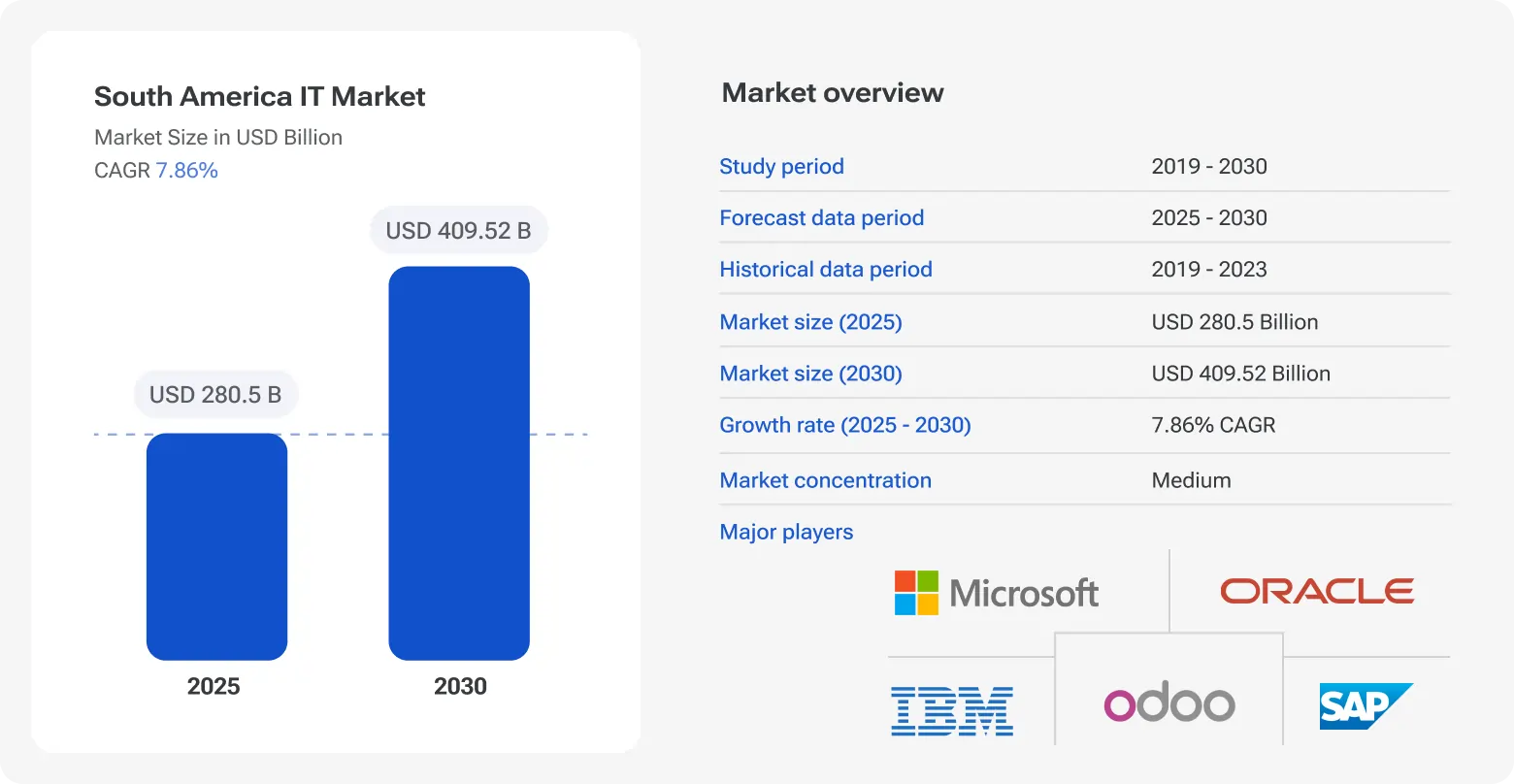
Latin America isn't an emerging market anymore. It's a prosperous hiring and outsourcing destination with talented software engineers and powerful ecosystems.
Source: Mordor Intelligence
Multiple industry analyses peg the total pool of software developers and related tech professionals in the region at around 2 million. Therefore, in the huge Latin America tech talent market, you can easily find specialists in web and mobile development, data science, cloud computing, AI/ML, etc.
Recognizing the power of technology, governments across Latin American countries introduce diverse initiatives to support entrepreneurs and start-ups. No wonder the region is home to 39 unicorn startups.
Fintech and e-commerce lead the market here, so finding engineers with experience in those domains isn't difficult.
The key players in the region are such countries as Brazil, Mexico, Argentina, Colombia, and Chile. Peru, Uruguay, and Costa Rica have less crowded and mature markets, but they're starting to stand out more.
Saying the demand for local IT specialists is high would be an understatement — it's extremely high. This is explained by the huge cost difference between hiring a developer in Latin America versus the United States. The opportunity to save a significant amount of money is the reason why the vast majority of American tech companies are now looking to Latin America to scale their teams.
Let's have a look at numbers.
Cost of hiring software developers in Latin America vs. the U.S.
Role
Average U.S. salary (USD/month)
Average LatAm salary (USD/month)
Potential savings
Source: South
This way, by hiring developers in Latin America, you can set up a 2 or even 3 times larger team, paying the same amount of money.
What you should know before outsourcing to Latin America
All in all, proficiency, a large talent pool, relative proximity, and lower rates have made Latin America very attractive for companies looking to ramp up their software development teams.
Hiring software developers in Brazil 🇧🇷
As the largest country on the continent, Brazil offers the most extensive talent pool and enough variety to cover almost any tech stack you can think of. Yet, it's not always the cheapest option. But we'll get to that.
Tech talent availability
With over 750,000 software developers, Brazil definitely has something to offer companies seeking tech talent. Moreover, about 55,000 ICT graduates enter the workforce annually.
Brazil's university system plays a big role here. Educational institutions like the University of São Paulo, Federal University of Paraná, and Unicamp produce outstanding engineering talent. The growing number of tech specialists helps balance out the high demand from local and international companies.
The biggest IT companies and RBDs are traditionally located in large cities.
Major tech hubs:
São Paulo — the main tech and financial center, though the most expensive
Rio de Janeiro — a tech hub strong in enterprise and media-related tech
Florianópolis — a smaller but very active startup scene
Campinas and Curitiba — more engineering-driven, with strong university ties
Key industries & expertise
While the Brazilian market is broad, a few areas stand out:
Fintech (the strongest in Latin America)
E-commerce & marketplace development
SaaS platforms development
So, in Brazil, you can find generalists as well as very specific experts — it just might take a bit longer and cost a bit more.
Developer salaries
Salaries in Brazil can vary depending on experience, location, and specialization. São Paulo, for example, tends to push numbers up.
Here's the average annual salary of local software developers:
Junior developers
Mid-level developers
Senior developers
Source: Jobicy
A couple of things worth noting:
Specialists in DevOps, AI/ML, and cloud computing can easily add 10–25% on top.
International exposure often outweighs years of experience.
Salaries in the largest cities are closer to Eastern Europe than to budget-friendly LatAm.
Outsourcing hourly rates
If you prefer collaboration with outsourcing vendors, hourly rates are obviously higher than direct salaries.
Usually, hourly rates look like this:
Junior developers: $25–35/h
Mid-level developers: $40–60/h
Senior developers: $70–90/h
Sources: Index.dev
Again, top-tier specialists — let's say AI engineers or solution architects — can go beyond that, especially if they're working on complex projects.
Advantages of hiring developers in Brazil
There are many reasons to opt for Brazil:
The largest developer pool in Latin America
Lots of engineers with real product experience and the capability to work in cross-functional teams
Easy collaboration with companies in North America due to overlapping working hours
Wide skill coverage, from frontend to AI and enterprise systems
Significant savings compared to U.S. hiring
Potential challenges
It's worth noting that there might be some challenges you need to be aware of:
Not the lowest cost, which is why other countries in Latin America might be a better fit if your main goal is to cut expenses
English skills are usually strong in major hubs but less predictable outside them
Brazil's labor laws can be tricky if you're hiring directly, while they're less of an issue if you work with vendors
Hiring software developers in Mexico 🇲🇽
For US-based companies, Mexico is the easiest entry point into nearshore software development in Latin America, thanks to its geographical location, large talent pool, strong cultural alignment, and almost no time difference. But there are also nuances you need to know.
Tech talent availability
Mexico has one of the largest developer populations in the region, with about 700,000 IT professionals. This scale ensures that companies can find the talent they need to build and scale their teams effectively.
Mexico also benefits from strong technical universities and government-backed tech initiatives. Annually, about 110,000–130,000 ICT specialists graduate from the National Autonomous University of Mexico (UNAM), the Monterrey Institute of Technology and Higher Education (ITESM), the Instituto Politécnico Nacional (IPN), and others. Thanks to this constant stream of fresh talent, the ecosystem remains dynamic and competitive.
As you might guess, the top-tier engineers are concentrated in hubs.
Major tech hubs:
Mexico City — the largest and most diverse talent pool
Guadalajara — the 'Silicon Valley of Mexico'
Monterrey — a hub focused on enterprise and industrial tech
Querétaro — a growing tech innovation hub
Key industries & expertise
Mexico's tech ecosystem is heavily influenced by its proximity to the U.S. and strong industrial base.
Key areas include:
Enterprise IT services (especially for U.S. clients)
Automotive & embedded systems
E-commerce and retail platforms
Because of the great number of multinational companies in Mexico, many local developers are used to structured environments and enterprise-grade systems.
Developer salaries
Salaries in Mexico are relatively competitive for the region, but in top cities, they're rising faster than many companies expect.
The average annual salaries of local developers are the following:
Junior developers
Mid-level developers
Senior developers
Source: Jobicy
U.S. demand really drives salaries up. DevOps, data, and AI experts working directly for US companies can earn even more than $100K per year. Location is an important factor too — talent in Mexico City and Monterrey tends to be more expensive.
Outsourcing hourly rates
High demand and the fact that Mexico shares a border with the U.S. also impact outsourcing rates:
Junior developers: $28–$38/h
Mid-level developers: $45–$65/h
Senior developers: $75–$95/h
Sources: Index.dev
While Mexico isn't the cheapest destination, it often feels like a good, reliable neighbor, which, for many US-based companies, is worth paying a bit extra.
Advantages of hiring developers in Mexico
We've already mentioned some pros, but let's review the whole list:
Time overlap with the USA, simplifying collaboration
Proximity to the USA, enabling easy travel for on-site visits
Large skilled talent pool
Cultural alignment with North American work styles
Potential challenges
Now, let's turn our attention to the downsides that also exist:
Rising competition for talent as U.S. companies actively hire here
Higher costs, since, partly, you also pay for convenience and proximity
High retention pressure, because developers with great hard and soft skills often receive multiple offers
Hiring software developers in Argentina 🇦🇷
Because of its talented engineers and low rates, Argentina is one of the best options in Latin America. No wonder you can find it almost in every list of outsourcing destinations.
Tech talent availability
According to many estimates, Argentina's talent pool includes around 115,000 software developers, with rookies entering the workforce each year. For example, in 2022, STEM graduates made up about 14.8% of all graduates. The University of Buenos Aires, the National University of Salta, the National University of La Plata, and the National University of Córdoba are key tech talent factories in the country.
Major tech hubs:
Buenos Aires — the main hub, with the largest concentration of IT specialists
Córdoba — a growing tech scene that has a strong university presence
Rosario — an emerging software development center
One more thing that we'd like to mention here is that since local engineers are highly skilled and export-oriented, many of them have experience working with international clients.
Key industries & expertise
Argentinian developers excel at creating complex and logic-heavy solutions. You'll easily find expertise in areas like:
Fintech and banking systems
Data engineering & analytics
Full-stack web development
Developer salaries
Argentina offers the lowest software developer salary in Latin America. However, compensation levels can rather quickly change due to economic instability and currency dynamics.
Here are the average salaries of Argentinian developers across experience levels:
Junior developers
Mid-level developers
Senior developers
Source: Jobicy
In fact, salaries of top-tier talent in high-demand roles can exceed $90–100K. Another detail is that local developers usually prefer USD-based compensation, which is a way to protect their income from currency fluctuations. Because of that unstable economic situation, rates don't always stay still for long.
Outsourcing hourly rates
Argentina is often perceived as one of the cheapest markets for outsourcing. Compared to Mexico or Brazil, rates here are indeed lower, but the gap has decreased a bit in recent years:
Junior developers: $20–$30/h
Mid-level developers: $35–$55/h
Senior developers: $65–$85/h
Source: Index.dev
High-quality services, efficient communication, and affordability make the country an attractive option for many companies.
Advantages of hiring developers in Argentina
Here are the key benefits that you get when choosing Argentina for hiring:
Engineers with solid soft and hard skills
High English proficiency compared to many Latin American countries
Experience with international clients
Potential challenges
We'd also like to point out the problems you may face:
Economic volatility and currency fluctuations that can affect salary expectations
Retention risks as top developers frequently receive offers from international companies
Market competition, as the demand for top talent is high
Hire software developers in Argentina
Hiring software developers in Colombia 🇨🇴
Colombia has become a visible player in the LatAm market. Though the country doesn't have the scale of Brazil or Mexico, it offers highly qualified talent, reasonable rates, and a fast-growing ecosystem.
Tech talent availability
The local ICT sector employs over 430,000 professionals. Software developers make up a large part of that workforce — around 150,000 engineers. This number is growing as the government invests in tech education and digital transformation initiatives. The University of the Andes and the National University of Colombia are the main contributors to the talent pipeline.
Major tech hubs:
Bogota — the largest tech and business hub
Medellín — the city known for its startup ecosystem and government-backed innovation programs
Cali — a smaller, but steadily growing tech hub
Key industries & expertise
The tech ecosystem of Colombia has been quickly expanding, with competencies in:
Cloud-native applications
DevOps and backend systems
Here, you'll find a lot of developers working across the stack, especially in startup environments.
Developer salaries
Compared to Mexico or Brazil, salaries in Colombia are more affordable but not the lowest in the region.
Let's see the average values:
Junior developers
Mid-level developers
Senior developers
Source: Jobicy
As in other LatAm countries, in Colombia, Cloud, DevOps, and AI/ML specialists earn more. And yes, in Bogota, salaries are usually higher than in other cities.
Outsourcing hourly rates
The country is often viewed as a cheap nearshore outsourcing option, especially for mid-level talent. Numbers speak for themselves:
Junior developers: $22–$32/h
Mid-level developers: $38–$58/h
Senior developers: $68–$88/h
Source: Index.dev
While rates can vary depending on specialization, overall, Colombia offers a good balance between cost and quality.
Advantages of hiring developers in Colombia
The country is definitely worth your attention. Here is why:
Competitive rates without a decline in quality
Time zone overlap with North America
Government support for the tech sector
Experience with international clients
Potential challenges
The country description wouldn't be complete without a list of challenges:
English proficiency can vary
The market is in the process of maturing and isn't as extensive and experienced as in Brazil or Argentina
Talent concentration in Bogota and Medellín, and outside hiring can be limited
Competition is growing as more global companies enter the market
Hiring software developers in Chile 🇨🇱
The country doesn't offer scalability and low rates. Nevertheless, many companies go for it. Why? Because of its reliability and diligent engineers.
Tech talent availability
Chile has about 61,000 ICT specialists, and that's not enough. According to Chile's National Training and Employment Service, in 2022, there was a deficit of about 6,000 IT professionals. Local universities — University of Chile, Pontifical Catholic University of Chile, Federico Santa Maria Technical University, University of Santiago de Chile, etc. — provide the best tech talent for the country. Thus, in 2024, there were about 8,000 IT graduates, which is yet far less than needed, especially when it comes to cloud architects, data engineers, and security analysts. So yes, compared to some other LatAm countries, the scale is limited, but the quality is solid.
Major tech hubs:
Santiago — the heart of the local tech ecosystem
Valparaíso — a smaller hub, but with a growing startup presence
Key industries & expertise
Chile focuses on specialized and regulated domains, like:
Enterprise software development
Cloud infrastructure and DevOps
Here, you'll often find developers with experience in creating complex, compliance-heavy environments.
Developer salaries
Chile often surprises companies with higher costs than they expect from a LATAM country.
Here are the average annual salaries of local software developers:
Junior developers
Mid-level developers
Senior developers
Source: Jobicy
Predictably, senior engineers with strong expertise in cloud, security, or data can go even higher.
Outsourcing hourly rates
Outsourcing rates follow the same pattern. The average hourly rates in Chile are higher than in much of Latin America:
Junior developers: $30–$40/h
Mid-level developers: $50–$70/h
Senior developers: $80–$100/h
Source: Index.dev
Advantages of hiring developers in Chile
Let's see what companies get while paying more for Chilean developers:
High-quality engineering talent
Strong expertise in regulated industries
Reliable delivery for long-term projects
Stable economic and business environment
Potential challenges
Like every country, Chile comes with its own challenges:
Higher costs, as Chile is one of the more expensive markets in Latin America
Problems with scaling large teams due to a smaller talent pool
Longer hiring timelines, especially for niche or senior roles
Hiring software developers in Peru 🇵🇪
The country is still in the emerging category, which is why Peru is less talked about than big LatAm players. Yet, as the non-obvious choice, it offers competitive rates and a growing pool of developers.
Tech talent availability
The numbers vary across sources, but generally, there are around 40,000 developers in Peru. It isn't that many, and that's important to keep in mind from the start. However, it's also worth noting that the talent pool is growing.
To boost market advancement, the Peruvian government has established 11 new Science and Technology Parks and invested heavily in modernizing its universities' tech curricula. For example, the Universidad de Ingeniería & Tecnología (UTEC) in Lima received $100 million in investment. Both government and business are interested in increasing the number of quality engineers.
Major tech hubs:
Lima — the main tech center
Arequipa — a growing tech scene
Sure, Peru is still building its reputation, but many developers, particularly those who are employed by outsourcing companies, have already worked with international clients.
Key industries & expertise
Peru's tech ecosystem is developing, but we can already recognize key sectors:
Web and backend development
SaaS product development (early-stage and mid-scale)
Data analytics (emerging)
Note that local tech talent primarily consists of generalist developers, rather than highly niche specialists.
Developer salaries
Peru is one of the more cost-effective markets in Latin America. Average annual salaries look like this:
Junior developers
Mid-level developers
Senior developers
Source: Jobicy
As expected, salaries increase for developers with strong English skills and experience in working with international teams. Still, compared to Brazil or Chile, Peru is more affordable.
Outsourcing hourly rates
Outsourcing rates are also quite attractive, which is why Peru can be seen as a budget-friendly nearshore option.
Vendors usually charge within the following ranges:
Junior developers: $18 – $25/h
Mid-level developers: $30 – $45/h
Senior developers: $50 – $60/h
Source: Wild.Codes
Advantages of hiring developers in Peru
We'd like to list the key benefits Peru offers:
Competitive pricing, especially for mid-level talent
Growing tech market with increasing international exposure
Time zone overlap with North America
Lower competition compared to larger markets
Potential challenges
As for the problems you may face, be ready to handle the following:
Difficulty in scaling teams due to the small talent pool
Limited availability of senior specialists, which may increase hiring time
Less robust ecosystem compared to Brazil, Mexico, or Argentina
Stronger English proficiency among top candidates, but less consistent overall
Hiring software developers in Uruguay 🇺🇾
While a rather small talent pool, Uruguay is renowned for professionalism and reliability. Companies often consider it when they need to bring in trustworthy, senior-level engineers without too much fuss.
Tech talent availability
The country has just about 21,000 IT specialists, according to Microsoft's Talent Report on the IT Sector in Uruguay 2023. Yet, a great education system, government support for the tech sector, and the high level of digital adoption foster the development of the local tech market, which already pulls in companies that value quality over scalability.
Major tech hubs:
Montevideo — the capital, where over 60% of the country's IT companies are located
Punta del Este — the secondary hub for startups
While the country isn't a tech talent conveyor, it still has something to offer. Local developers are highly professional and often have long-term collaborations with international clients.
How to hire software developers in Latin America
Key industries & expertise
The tech ecosystem of Uruguay is primarily focused on:
Full-stack and backend engineering
DevOps and cloud infrastructure
One more important thing about Uruguayan developers is that they often contribute to product-oriented teams, not just execute purely engineering tasks.
Developer salaries
Uruguay's quite high salaries for LatAm can actually catch companies off guard. As a rule, local developers earn the following sums per year:
Junior developers
Mid-level developers
Senior developers
Source: Jobicy
Pay attention that it's not the ceiling — some senior engineers can go even higher.
Outsourcing hourly rates
As you may assume, outsourcing rates in Uruguay are also quality-focused, not budget-first. If you work with local vendors, rates usually land somewhere around:
Junior developers: $20 – $30/h
Mid-level developers: $35 – $50/h
Senior developers: $55 – $70/h
Source: Wild.Codes
Uruguay isn't a cost-saving destination in the traditional sense. It's more about consistency and lower risk.
Advantages of hiring developers in Uruguay
Not so popular compared to other outsourcing destinations in Latin America, Uruguay still comes with a number of advantages:
Highly competent engineering talent
Stable business and legal environment
Experience with international clients
Focus on reliable delivery and long-term collaboration
Potential challenges
Uruguay also has some cons, and we won't sugarcoat them:
A very small talent pool hindering quick team ramp-up
Higher costs compared to many LATAM countries
Limited availability of niche specialists
Hiring software developers in Costa Rica 🇨🇷
Without an extensive talent pool but with quite high rates, Costa Rica has become a go-to destination for companies that prioritize quality and stability.
Tech talent availability
Costa Rica cannot boast legions of IT specialists. There are just about 22,000 software developers in the country. While not suitable for massive scale, this market has been shaped by years of collaboration with international companies. Costa Rica has attracted Intel, IBM, Amazon, and other tech leaders over the years, which has helped create a workforce that can deal with global standards and enterprise environments.
Major tech hubs:
San José — the key tech and business center
Heredia — a city with numerous multinational tech offices
Key industries & expertise
First of all, Costa Rica is known for enterprise-grade development and global service delivery. The key areas here are the following:
SaaS platform development
Developer salaries
If you are looking for the most cost-efficient option, Costa Rica isn't the best choice. Local salaries are pretty high:
Junior developers
Mid-level developers
Senior developers
Source: Jobicy
As with other countries, cloud, DevOps, and AI/ML specialists can earn even more. High salary expectations are primarily driven by the presence of numerous multinational companies working here.
Outsourcing hourly rates
Outsourcing rates in Costa Rica are far from the lowest in the region.
Here are the common rate ranges:
Junior developers: $25 – $35/h
Mid-level developers: $40 – $55/h
Senior developers: $65 – $80/h
Source: Wild.Codes
Advantages of hiring developers in Costa Rica
International companies choose Costa Rica for a good reason. The country has many advantages:
Stable political and economic situation
Extensive experience in working with international companies
Advanced outsourcing ecosystem
Good cultural match with North America
Potential challenges
There are a few potential challenges you may encounter when collaborating with Costa Rican developers:
Higher rates compared to many LatAm countries
Small talent pool that impedes team scaling
Competition from multinational companies
Key insights
Probably, you've already understood that LatAm isn't a single market but is a mix of very different digital ecosystems, each with its own cost range, talent, and trade-offs.
Some LatAm countries offer better scale, some lower prices, and others stand out for stability and smooth delivery. As a result, many companies consider software development outsourcing in Latin America.
Comparison of key hiring destinations in Latin America
Country
Average annual developer salary
Hourly outsourcing rates
Talent pool
EF English Proficiency Index 2025
Key tech hubs
Junior: $14,400–19,200Mid-level: $19,200–28,800Senior: $28,800–43,200
Junior: $25–35/hMid-level: $40–60/hSenior: $70–90/h
São Paulo, Rio de Janeiro, Florianópolis, Campinas, Curitiba
Junior: $14,000–24,000Mid-level: $24,000–36,000Senior: $36,000–54,000
Junior: $28–38/hMid-level: $45–65/hSenior: $75–95/h
Mexico City, Guadalajara, Monterrey, Querétaro
Junior: $10,800–14,400Mid-level: $14,400–21,600Senior: $21,600–32,400
Junior: $20–30/hMid-level: $35–55/hSenior: $65–85/h
Buenos Aires, Córdoba, Rosario
Junior: $12,960–17,280Mid-level: $17,280–25,920Senior: $25,920–38,880
Junior: $22–32/hMid-level: $38–58/hSenior: $68–88/h
Junior: $21,600–28,800Mid-level: $28,800–43,200Senior: $43,200–64,800
Junior: $30–40/hMid-level: $50–70/hSenior: $80–100/h
Junior: $14,400–19,200Mid-level: $19,200–28,800Senior: $28,800–43,200
Junior: $18–25/hMid-level: $30–45/hSenior: $50–60/h
Junior: $21,600–28,800Mid-level: $28,800–43,200Senior: $43,200–64,800
Junior: $20–30/hMid-level: $35–50/hSenior: $55–70/h
Montevideo, Punta del Este
Junior: $21,600–28,800Mid-level: $28,800–43,200Senior: $43,200–64,800
Junior: $25–35/hMid-level: $40–55/hSenior: $65–80/h
The table above lets us make the following conclusions:
1. Big countries offer easier scaling
If you need to hire a lot of developers quickly, Brazil and Mexico are the best destinations. Their talent pools are huge, which gives you many options.
2. Cheaper options always have trade-offs
Some LatAm countries — let's say Argentina and Peru — offer lower Latin American developer rates. But things like economic instability or small ecosystems can affect your experience quickly.
3. There is a happy medium
The country that hits the sweet spot is Colombia, with its reasonable rates, adequate scale, and fewer surprises.
4. Paying more, you often have fewer hassles and surprises
Chile, Uruguay, and Costa Rica aren't the cheapest options. But they're often chosen for smoother delivery and better communication, ensuring minimum disruptions and maximum predictability.
Conclusion
Latin America is a unique region that offers attractive rates, decent talent quality, international experience, and time zone compatibility, especially with North America.
Yet, when it comes to choosing a country and an outsourcing vendor, your decision should be based on your priorities, whether that's budget friendliness, stability, seamless communication, scalability, or anything else.
If you'd like to hire developers in Latin America, the Devico team is always happy to advise on developer availability, rates, and engagement models.
Great software starts with great people