Hire
Hire by role
Hire Front-end developers
Hire Back-end developers
Hire Full-stack developers
Hire Android developers
Hire iOS developers
Hire Mobile developers
Hire AI engineers
Hire by skill
Hire JavaScript developers
Hire React Native developers
Hire React.js developers
Hire .NET developers
Hire TypeScript developers
Hire Flutter developers
Hire Golang developers
Hire by country
Devs in Ukraine
Expirienced engineers with strong product focus and fast integration.
Devs in Poland
EU-based developers with reliable delivery and high standards.
Devs in Argentina
Senior engineers with strong technical depth and timezone alignment.
DevOps trends in 2026: 10 shifts that matter — and what to do about each one

Summarize with:

Stay in touch
Leave your email and we will inform you about all our news and updates
Most "DevOps trends" lists are tool catalogues with a year stamped on them. This one is written for the people who have to decide what to adopt, what to ignore and what to budget for: ten shifts that are actually changing how software is delivered in 2026, the data behind each, what it means at different levels of maturity, and what to do about it — including the trends that are mostly noise.
In short: the centre of gravity in DevOps has moved from "automate the pipeline" to "run the platform as a product and put AI to work inside it". The market behind it keeps growing — from about USD 10.4 billion in 2023 towards USD 49 billion by 2030 according to Maximize Market Research — but the shifts that matter are organisational as much as technical: platform engineering, AI agents in CI/CD and operations, software supply-chain security, GitOps as the default deployment model, FinOps as an engineering discipline, observability consolidating on OpenTelemetry, policy and compliance as code, Kubernetes becoming boring, developer experience as a measured outcome, and the end of the standalone DevOps team. The constant underneath all ten: the four DORA metrics still decide whether any of it worked.
The ten trends and the numbers behind them
Platform engineering
80% of large engineering organisations expected to have platform teams by 2026; platforms linked to +8% individual and +10% team productivity
AI in the pipeline
~76% of developers use or plan to use AI tools; 25% more AI adoption ↔ −1.5% throughput, −7.2% stability
Supply-chain security
512,847 malicious open-source packages found in one year, +156% year on year
GitOps
60% of users have run GitOps for over a year; 31% started in the last 12 months
FinOps
~27% of cloud spend estimated as waste; public cloud spend USD 723 billion in 2025
OpenTelemetry
Second most active project in the CNCF after Kubernetes
Policy and compliance as code
Extensive security automation cuts the average breach cost by USD 2.2 million
Kubernetes
66% of organisations run Kubernetes in production
Developer experience
69% of developers lose 8+ hours a week to inefficiencies
End of the DevOps team
83% of organisations implement DevOps practices; only 18% are "highly evolved"
1. Platform engineering and internal developer platforms
What is happening. Organisations past 30–50 engineers are replacing ad hoc DevOps support with an internal developer platform (IDP): self-service environments, golden-path pipelines, templates and a portal (Backstage, Port, Cortex) that let product teams ship without filing tickets.
Gartner predicted in 2022 that 80% of large software engineering organisations would establish platform engineering teams by 2026, and among companies at that scale the prediction has largely played out. In Puppet's State of DevOps Report: Platform Engineering Edition, 94% of respondents said platform engineering helped their organisation realise the benefits of DevOps and 68% reported faster development velocity.
Why it matters — with a caveat. The "DevOps team" that owned pipelines for everyone became the bottleneck it was meant to remove; a platform run as a product scales. But the DORA 2024 report found that while internal platforms were associated with 8% higher individual productivity and 10% higher team performance, they also correlated with a small dip in delivery throughput and stability — platforms built without their users in mind add process rather than remove it.
What to do. Under 30 engineers: do not build a platform; standardise on one pipeline template and one way to create environments. Above that: appoint a platform product owner, measure request lead time and adoption, and start with the two or three golden paths most teams use. Staff the platform team deliberately — Devico supplies DevOps engineers for hire and whole platform teams for this phase, embedded with the in-house lead who owns direction. The structures are compared in how to build an effective DevOps team structure.
2. AI in the pipeline: from assistants to agents
What is happening. In the Stack Overflow Developer Survey 2024, 76% of developers were using or planning to use AI tools in their workflow (62% already using), up from 70% a year earlier. AI assistants now write a large share of infrastructure as well as application code — Terraform modules, Kubernetes manifests, pipeline definitions — and AI in operations has moved from marketing to practice: anomaly detection, alert correlation, incident summaries. In 2025–2026 the first agentic use cases reached CI/CD: agents that triage failing builds, propose fixes for flaky tests and open dependency-update pull requests with the changelog summarised.
Why it matters — with a caveat. DORA's 2024 research found more than 75% of respondents relying on AI for at least part of their work and most reporting productivity gains — and, in the same data, that a 25% increase in AI adoption was associated with a 1.5% drop in delivery throughput and a 7.2% drop in delivery stability, with 39% of respondents reporting little or no trust in AI-generated code. More code, bigger changes, less review: speed without the discipline of small batches produces more failed deployments, not fewer.
What to do. Treat AI output as a draft: keep review mandatory, keep batches small, and add tests and policy checks that catch a plausible-but-wrong manifest. Use AIOps first where the signal is clearest — alert deduplication and correlation, log anomaly detection — and measure its effect on time to detect and recover. The practical state of play is in how AI is transforming DevOps; the engineers who run these systems are now a recognised profile, and MLOps and AIOps engineers sit alongside DevOps in most platform teams.
3. Software supply-chain security becomes a pipeline requirement
What is happening. Sonatype's State of the Software Supply Chain 2024 counted 512,847 malicious open-source packages discovered in the preceding twelve months — a 156% increase year on year — bringing the total since 2019 past 700,000. After SolarWinds (2020) and Log4Shell (December 2021), customers, insurers and regulators now ask for evidence: a software bill of materials (SBOM) for every release, signed artifacts and provenance (Sigstore, SLSA), dependency and container scanning on every build, secrets detection that blocks commits. The EU Cyber Resilience Act, in force since December 2024 with vulnerability-reporting obligations from September 2026 and full application in December 2027, and US federal procurement rules following Executive Order 14028 turn this from best practice into a requirement for many vendors.
Why it matters. The pipeline is now part of the attack surface and part of the compliance evidence. A build whose provenance you cannot prove is a build you may not be able to ship to a regulated customer.
What to do. Generate SBOMs automatically in CI (Syft, CycloneDX), sign images and attestations (Cosign), scan dependencies and containers (Snyk, Trivy, Grype) with a patch SLA, scan for secrets (gitleaks, GitGuardian), and store the evidence where auditors can find it. How a security-integrated pipeline differs from plain DevOps is set out in DevOps vs DevSecOps.
4. GitOps is the default deployment model for Kubernetes
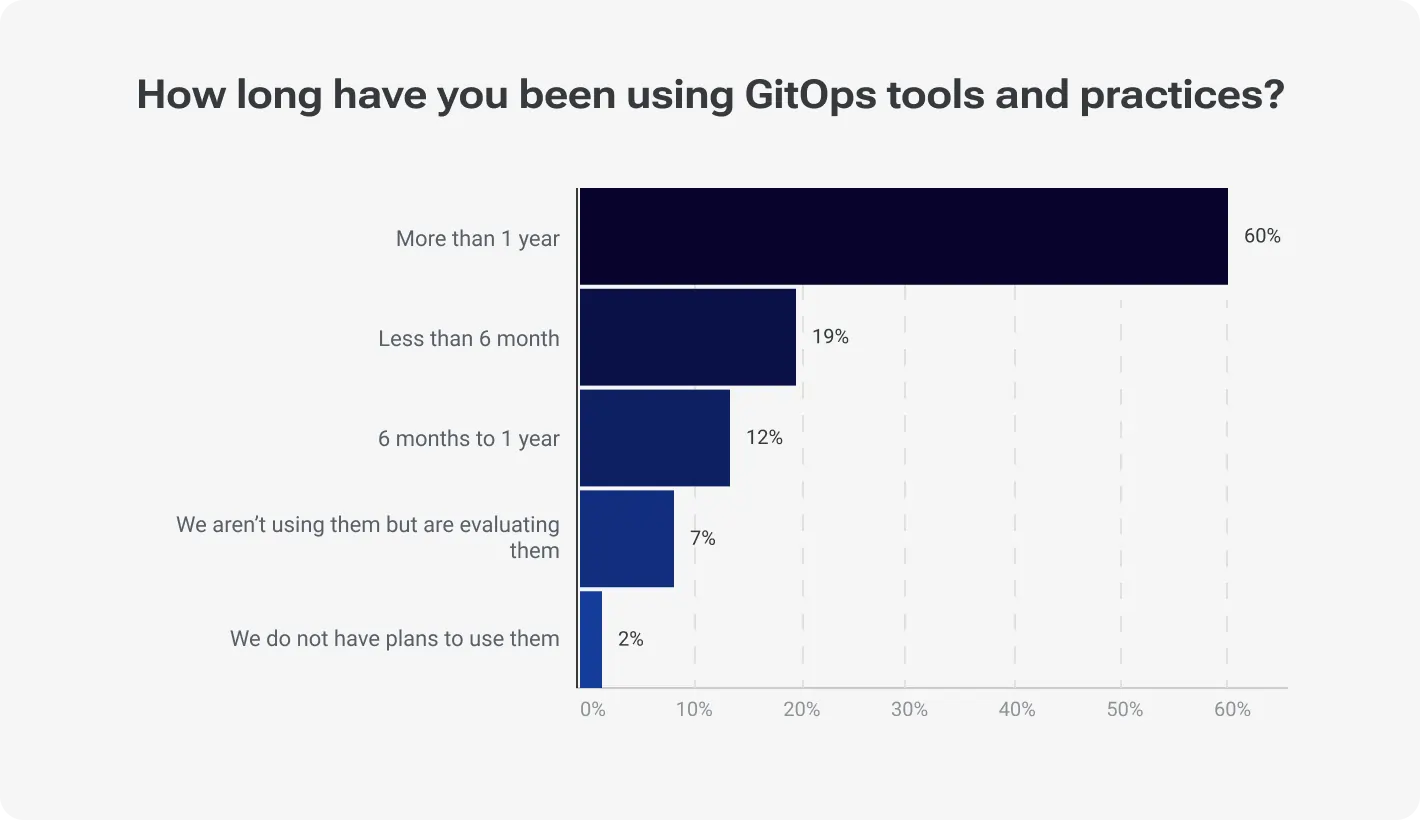
What is happening. GitOps — the desired state of infrastructure and applications declared in Git, with an agent (Argo CD, Flux) continuously reconciling clusters to match — has gone from early-adopter practice to the standard way to deploy on Kubernetes. In the CNCF GitOps microsurvey, 60% of respondents had used GitOps for more than a year and a further 31% had started within the previous twelve months; both Argo and Flux reached CNCF graduated status in late 2022.
Why it matters. It gives you an audit trail, rollback by revert, drift detection and a single workflow for application and infrastructure changes — the properties regulators and SREs both want.
What to do. If you deploy to Kubernetes with scripts or manual kubectl, move to Argo CD or Flux; it is the highest-return change most teams can make this year. Keep environments as directories or branches with promotion by pull request, and put policy checks (trend 7) in front of the merge. Devico's DevOps automation services start from a GitOps reference architecture for exactly this migration.
5. FinOps: cloud cost becomes an engineering metric
What is happening. Gartner forecast worldwide end-user spending on public cloud at USD 723 billion for 2025, up from USD 595 billion in 2024, and in Flexera's State of the Cloud Report 2024 respondents estimated that about 27% of their cloud spend was wasted, with managing cloud spend the top cloud challenge for the second year running. Finance has stopped treating infrastructure as an engineering black box; cost per environment, per service and per deployment now appears on engineering dashboards next to latency.
Why it matters. The same automation that makes environments cheap to create makes them cheap to forget. Teams that measure cost reduce it; teams that get a monthly invoice argue about it.
What to do. Tag every resource by team and service through infrastructure as code (untagged resources fail the policy check), put unit costs on the platform dashboard, automate rightsizing and schedule non-production environments off outside working hours, and review cost in the same monthly meeting as the DORA metrics. The metric set is in DevOps KPIs and metrics.
6. Observability consolidates on OpenTelemetry
What is happening. OpenTelemetry has become the vendor-neutral standard for metrics, logs and traces: the CNCF's project velocity analysis has ranked it the second most active project in the foundation after Kubernetes for several years running, and every major observability vendor now ingests it natively. That has broken the lock-in that made switching tools a rewrite, and shifted competition to analysis, cost and AI features rather than agents.
Why it matters. Distributed systems fail in the interactions between services; tracing across them is the only way to find the cause fast, and it was expensive and proprietary until the standard arrived. Observability costs — especially log volume — are also now a FinOps line item.
What to do. Instrument new services with OpenTelemetry from the start and migrate agents on the rest; standardise on one backend (Grafana stack, Datadog, Elastic, Honeycomb, New Relic) rather than one per team; define SLOs and alert on them, not on raw metrics; control log volume at the collector. Running the stack 24/7 is a common first thing to hand to an external team — it is the core of Devico's DevOps support services.
7. Policy as code and continuous compliance
What is happening. Security, cost and compliance rules are moving out of review boards and into the pipeline as code: Open Policy Agent (a CNCF graduated project since 2021) and Kyverno on Kubernetes, Checkov and tfsec on Terraform, cloud-native guardrails such as AWS Service Control Policies and Azure Policy. Evidence for SOC 2, ISO 27001, HIPAA or PCI is collected automatically from the pipeline and the cloud rather than assembled for the audit. The payoff is measurable: IBM's Cost of a Data Breach Report 2024 put the average breach at USD 4.88 million and found organisations with extensive use of security AI and automation saved USD 2.2 million per breach against those without.
Why it matters. It is the only way DevSecOps scales: a human change-advisory board cannot review daily deployments across fifty services, and a policy engine can. Continuous compliance also shortens audits from weeks to days.
What to do. Start with five to ten policies that would have prevented your last incidents — public buckets, unencrypted volumes, containers running as root, untagged resources, unsigned images — enforce them in CI and at admission, and add the evidence export. Expand from there.
8. Kubernetes gets boring — and spreads to the edge
What is happening. Kubernetes is no longer a trend; it is infrastructure. The CNCF Annual Survey 2023 found 66% of organisations running Kubernetes in production, with most of the rest evaluating it, and managed services (EKS, AKS, GKE) absorbing most operational pain. The action has moved to what runs on it — platform layers, GitOps, service meshes that are quieter than their 2020 versions — and to where it runs: edge and on-premises distributions (K3s, Talos, OpenShift) for retail, manufacturing, telecom and anywhere latency or data residency matters. Serverless has settled into its niche for event-driven and spiky workloads rather than replacing containers.
Why it matters. "Should we use Kubernetes?" is settled for most companies above a certain scale; "do we have the people to run it well?" is not. Senior Kubernetes and cloud skills remain the scarcest in the market.
What to do. Use managed Kubernetes unless you have a reason not to; keep the cluster count small and the configuration in Git; treat the cluster as platform-team territory rather than something every product team configures. If the skills are missing, buy time with external engineers rather than learning on production — the model is described in our guide to DevOps outsourcing.
9. Developer experience becomes a measured outcome
What is happening. Atlassian's State of Developer Experience Report 2024 found that 69% of developers lose eight or more hours a week to inefficiencies — slow tooling, waiting on environments, context switching — and that 63% say their leaders do not understand their pain points. DORA's research now treats developer experience — fast feedback, low cognitive load, stable priorities — as a driver of delivery performance, and platform teams are measured on it: time to first commit for a new engineer, build time, environment provisioning time, satisfaction surveys. The SPACE framework and developer-experience surveys have become normal management tools.
Why it matters. A day a week per developer is the largest capacity line most engineering budgets do not track. Burned-out teams with slow tooling do not produce elite DORA metrics whatever the architecture; developer experience is the leading indicator, delivery performance the lagging one.
What to do. Measure build time, environment provisioning time and onboarding time alongside DORA; run a quarterly developer survey and act on the top two complaints; treat the platform's backlog as a product backlog driven by its users.
10. The standalone "DevOps team" is ending
What is happening. Puppet's 2021 State of DevOps Report found 83% of organisations implementing DevOps practices but only 18% at a "highly evolved" level — and the organisations stuck in the middle were disproportionately those with a separate DevOps team between development and operations. The organisational trend under all the others is the replacement of that team by product teams that own their services in production, supported by a platform team and, at scale, an SRE function and enabling teams; Team Topologies (Skelton and Pais, 2019) has become the common vocabulary for this.
Why it matters. Most failed DevOps transformations built a third silo; the organisations with elite delivery metrics almost never have a team called "DevOps" between development and operations.
What to do. If you have a DevOps team today, give it an expiry date or make it a platform team with a product owner; move on-call for each service to the team that builds it; keep DevOps engineers as members of product and platform teams rather than as a department. The readiness factors for making this change are in DevOps transformation: readiness checklist and roadmap.
What to do about the trends at each stage of maturity
Ad hoc / managed (manual or fragile deployments)
CI on every commit; infrastructure as code; dependency and secrets scanning; one pipeline template
GitOps; basic FinOps tagging; OpenTelemetry on new services
Platform portal; AI agents in CI/CD; service mesh
Defined (reliable weekly deployments)
GitOps; policy as code for the top ten rules; SBOM and signing; FinOps dashboard; OpenTelemetry migration
Platform team with a product owner; AIOps for alert correlation; developer-experience survey
Edge Kubernetes; multi-cluster
Advanced / elite (on-demand deployments)
Internal developer platform; continuous compliance evidence; AI-assisted operations with review discipline; DX metrics
Agentic CI/CD pilots with guardrails; edge where the business needs it
Anything adopted because a vendor demo looked good
Trends that are mostly noise
- "NoOps". Operations work does not disappear; it moves into platforms and providers. Someone still owns reliability.
- AI replacing DevOps engineers. DORA's stability numbers above are what happens when review is cut; AI removes toil, not roles.
- A new "X-Ops" every quarter. DevSecOps, DataOps, MLOps, FinOps and AIOps are real; most other suffixes are a product category looking for a methodology.
- Multi-cloud as a default. Running the same workload on two clouds costs more than it saves for almost everyone; multi-cloud is a portfolio reality, not a design goal.
- Service mesh everywhere. Valuable at scale for mTLS and traffic control; unnecessary overhead for a dozen services.
Conclusion
The DevOps trends of 2026 are less about new tools than about where responsibility sits: platforms run as products, AI working inside pipelines under human review, security and compliance encoded in the pipeline rather than reviewed around it, cost and developer experience measured alongside delivery, and product teams owning production. None of it replaces the fundamentals — small batches, automated tests, infrastructure as code, observability — and all of it is judged by the same four numbers. Adopt what your maturity stage can absorb, measure it, and leave the rest for next year.
FAQ
What are the biggest DevOps trends in 2026?
Platform engineering and internal developer platforms, AI in CI/CD and operations, software supply-chain security (SBOMs, signing, provenance), GitOps as the default for Kubernetes, FinOps as an engineering metric, observability on OpenTelemetry, policy and compliance as code, Kubernetes as standard infrastructure spreading to the edge, developer experience as a measured outcome, and the replacement of standalone DevOps teams by product and platform teams.
Is DevOps still relevant in 2026?
Yes — 83% of organisations implement DevOps practices according to Puppet's research, and the practices are more widespread than ever. What has changed is the organisation: "DevOps" as a separate team is fading; DevOps practices owned by product teams and supported by platform engineering are the norm.
Will AI replace DevOps engineers?
No. DORA's 2024 research found that higher AI adoption correlated with a 1.5% drop in throughput and a 7.2% drop in stability, because more code shipped with less review. AI removes toil — triaging builds, drafting infrastructure code, correlating alerts — while the need for senior judgement in the pipeline rises.
What is platform engineering and how does it differ from DevOps?
Platform engineering is the practice of building an internal developer platform — self-service environments, golden-path pipelines, tooling — as a product for the organisation's own developers. It is how DevOps practices are delivered at scale; Gartner expected 80% of large engineering organisations to have such teams by 2026.
Should a small team follow these trends?
A team under 30 engineers should adopt the fundamentals — CI on every commit, infrastructure as code, scanning, GitOps if on Kubernetes, basic cost tagging — and skip platform portals, AI agents in CI/CD and service meshes until scale demands them.
What is GitOps and why is it a trend?
GitOps declares the desired state of infrastructure and applications in Git and lets an agent such as Argo CD or Flux reconcile the live environment to match. It gives auditability, rollback by revert and drift detection; in CNCF's survey 60% of users had run it for over a year.
Still have a question?
Talk to us