The time when companies hired within their own country is in the past. Today, the whole world is a large labor market, with Latin America being particularly attractive.
Both early-stage startups and enterprise giants build engineering teams across LatAm countries. In fact, thousands of software developers in Brazil, Argentina, and Mexico are involved in offshore development. Not because it's trendy, but because it works.
Latin America has evolved into one of the most popular hiring destinations. Companies take advantage of a huge pool of talented engineers, real-time collaboration, affordable rates in contrast to those in the US and Western Europe, and a thriving tech ecosystem that quickly adjusts to the work of global product teams.
Still, hiring in Latin America isn't as simple as posting a job and waiting for the right candidates to appear. The market has its own dynamics and a level of competition that often astonishes companies testing the waters.
This guide explains how to hire software developers in Latin America successfully, covering how the market works, why it's so popular, which hiring models make sense, where to find talent, and how to evaluate candidates.
Overview of the Latin America tech talent market
Latin America didn't become an appealing talent market overnight. The progress has been gradual, backed by years of investment in education, the growth of IT ecosystems, and the increasing presence of international companies.
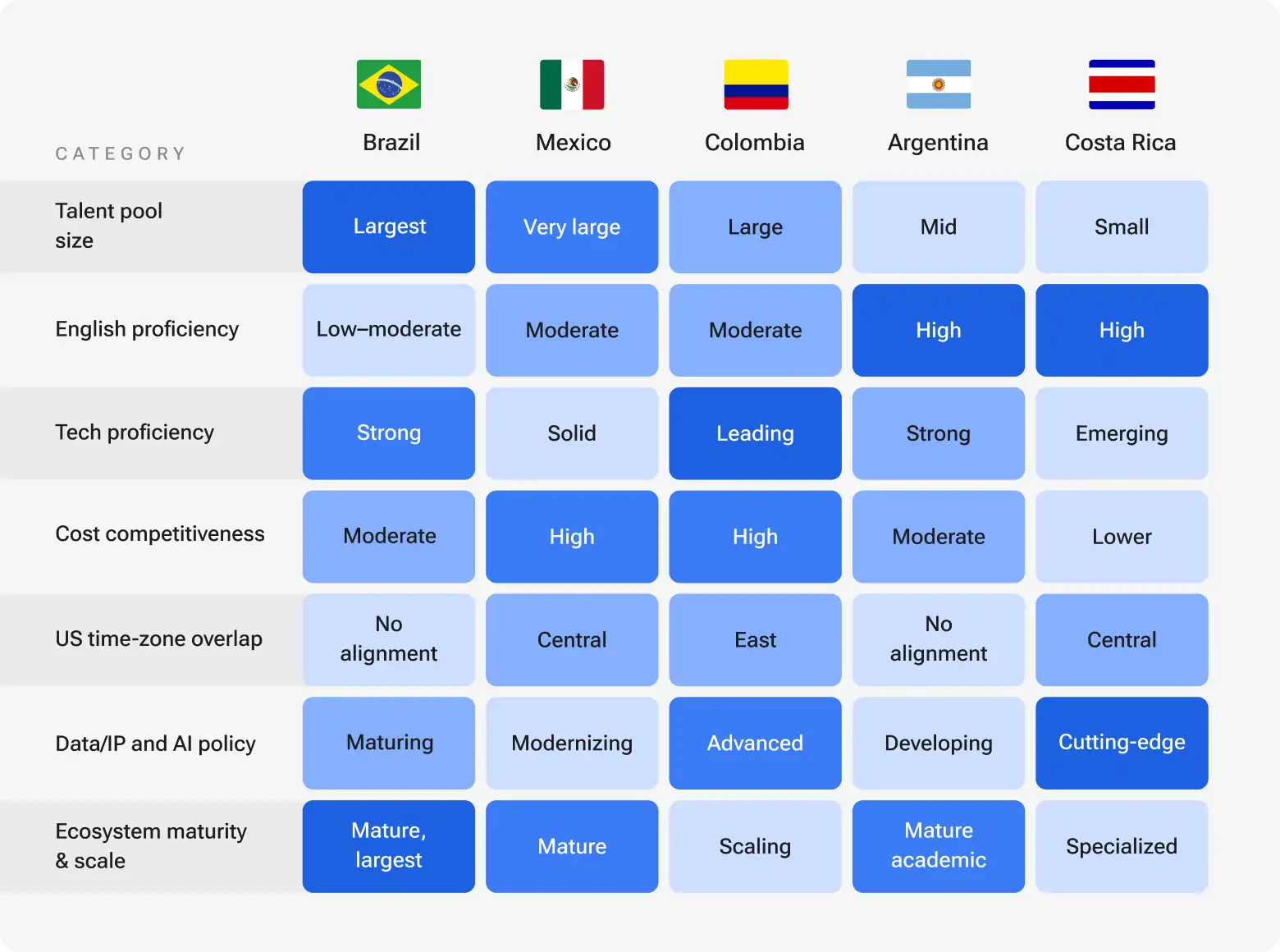
Today, there are over 2 million software developers in the region. While Brazil and Mexico are undisputed leaders in talent market size, countries like Argentina, Colombia, Chile, and Peru also make up a good part of this figure.
Tech universities keep producing thousands of tech graduates per year, while online IT courses, self-directed learning, and bootcamps have also opened access to tech careers. This results in a broad, layered talent pool with a mix of academic knowledge and hands-on experience.
Traditionally, top-tier specialists as well as large IT companies and R&Ds are concentrated in the largest tech hubs, including:
São Paulo that remains the largest and most economically influential
Mexico City that is experiencing growing startup activity
Buenos Aires that is known for technically strong engineers with international experience
Bogotá and Santiago that are also magnets for investment and talent
Industries dominating in the region also noticeably impact local talent. Thus, fintech is the key domain in Latin America. Latin America boasts several of the world's largest fintech solutions, including Nubank in Brazil, Mercado Pago in Argentina, and others. So, it's not surprising that there are a lot of experts in backend development, security, and transaction-heavy architectures.
E-commerce and SaaS are close behind, producing engineers who specialize in building scalable, user-facing platforms. Interestingly, healthtech is an emerging but quickly growing sector here.
Also, there is one important but often overlooked nuance — competition. It's driven by high internal and external demand for Latin America software developers. The most experienced engineers are already employed — usually by international companies — and aren't actively searching for a job. Hiring them directly usually requires direct outreach, strong positioning, and salary bidding.
At the same time, international exposure of the LatAm market not only fuels competition but also influences local talent's skill set. This way, they gain experience in cutting-edge technologies and international collaboration. Therefore, when you hire in Latin America, you don't bring someone into a global environment for the first time, but you engage someone who is already part of it.
So, Latin America gives you scale, but not simplicity. And the companies that realize this early usually get much better results when hiring here.
Why hire developers in Latin America
According to the 2026 State of LatAm Hiring Report, in the USA, there is a 250% year-over-year increase in demand for developers from Latin America. So what makes US-based and other companies look at Latin America? Actually, there are several serious reasons.
1. Large talent pool
As mentioned above, Latin America has an abundance of tech talent. This gives you more options — you can choose between different seniority levels, stacks, and skills, covering practically any talent gap. Secondly, you can scale your team without immediately hitting a talent ceiling.
2. Experienced software engineers
The survey shows that 98% of engineering hires in Latin America were mid-level or senior professionals. This indicates that the region provides seasoned engineers who can immediately contribute to a project.
Local specialists have great hard skills, a decent English level, and experience working with global delivery standards and distributed teams. All of these make onboarding faster and the whole collaboration more efficient.
3. Cost efficiency
We have approached the key reason, at least for most companies. Direct tech talent hiring and software development outsourcing in Latin America are cheaper than in the US or Western Europe. This gives businesses an opportunity to save money or bring in more engineers to address the bottlenecks.
You can hire 3 or 4 developers in Latin America, while in the USA, you can afford only two with the same budget.
Cost of hiring software developers in Latin America. Breakdown by country
4. Convenient time zone
A large time difference slows work down. Questions sit unanswered, feedback arrives too late, and urgent issues cannot be solved quickly.
With Latin America, you can enjoy real-time collaboration and communication. Standups happen at a convenient time for everyone, decisions move faster, and the delivery process is smoother. This small nuance makes a big difference, which is why many US-based companies look for nearshore developers in Latin America.
5. Cultural match
Latin American developers usually integrate well into US and Western European teams. Communication is normally direct, and collaboration feels natural since many engineers have already worked in agile, product-focused environments. As a result, onboarding takes less time, and teams run with fewer misunderstandings.
Latin America is too beneficial to ignore. If it's not part of your hiring strategy yet, it may be time to reconsider.
Hiring models available in Latin America
Once you've decided to hire in the region, the next question is how.
Primarily, there are two options: in-house hiring and outsourcing software development in Latin America. If you opt for the latter, you can, in turn, choose between staff augmentation, a dedicated team, and the project-based model.
Different companies make a choice, depending on how quickly they need to move, how much control they want, and how comfortable they are with managing external specialists. Anyway, we offer to review each option.
In-house hiring
Hiring developers as employees is the direct route, which many companies opt for. This model offers the most control and works well for building stable, long-term teams or working on strictly regulated products. However, it also comes with added complexity. The thing is that employment laws vary by country, payroll can get tricky, and setting everything up takes time. Those who are not tied by compliance requirements often go with outsourcing, which eliminates many administrative hassles.
Staff augmentation
Those who choose outsourcing often work with partners through staff augmentation. In this model, developers join your internal team, follow internal processes and standards, and are managed by internal leads but remain employed by a vendor. It's faster, simpler from a legal standpoint, and easier to scale up or down. The trade-off is some dependency on the partner.
Dedicated development team
A dedicated development team in Latin America is a good option for companies that need a full-fledged team quickly and don't want to hold day-to-day control over all processes. In this case, an external provider assembles and manages a software development team. One more bonus is flexibility; the team can be easily ramped up or down based on current needs.
Project-based model
The project-based model is when you hand over a certain piece of work to a vendor. This can be MVP creation, software modernization, or new feature development. Clear scope and strong coordination are key prerequisites for successful outsourcing.
In reality, at different project stages, companies use different models. They might start with a dedicated team to move quickly, then transition to direct hiring as the project evolves, and use staff augmentation whenever a specific skill is needed to complete a particular task(s).
Hire software developers in Argentina
Where to find software developers in Latin America
Sourcing talent in Latin America follows standard patterns but with a few nuances. Let's see what options you have.
LinkedIn
Professional platforms like LinkedIn are still central, particularly for connecting with developers who aren't on a job hunt. When hiring in Latin America, this is very helpful, as the most skilled engineers are already employed. This proactive outreach is much more effective than just looking for incoming applications.
Tech job boards
Nowadays, there are numerous platforms helping companies find remote talent, including LATAM-based specialists. Job boards like Get on Board, Torre, and Workana make it quite easy to reach candidates in any corner of the world.
Their key advantage is speed. Your job post can attract a large number of applicants within days, sometimes even hours. The downside is that instead of struggling to find candidates, you often find yourself sorting through dozens of profiles to pick up the best matches.
Developer communities
Local meetups, Slack groups, Discord communities, and tech events can be very effective for connecting with talented developers, especially those who may not be actively applying for roles but are open to the right opportunity. Sure, these channels usually work better for building relationships than for immediate hiring, but over time, they can become a good source of referrals.
Referrals and networks
Speaking of referrals, they remain one of the best ways to find top professionals in Latin America. The developer community in any country is rather tight-knit, and experienced engineers often know others with similar skill levels. A good referral can bring in higher-quality candidates from the start without the initial screening effort.
Local recruitment agencies
If you don't have time or resources for sourcing, local recruitment agencies can help, especially when you need senior or niche specialists. Their capabilities depend on how large their network is within a country or city. In more established markets like Brazil or Mexico, agencies often have a broader reach, but in smaller markets, outcomes can vary.
Outsourcing vendors
Many companies eventually turn to outsourcing. This isn't because sourcing internally is impossible, but because it's resource-intensive. Identifying, screening, and coordinating candidates across multiple countries, especially without local expertise, takes a lot of time. Outsourcing companies handle much of that work, allowing you to evaluate fit and make decisions.
The complete guide to software development outsourcing in Latin America
One important detail is that sourcing strategies often need to be localized. Hiring software developers in Argentina follows different patterns than Brazil or Colombia. Candidate expectations, preferred communication channels, and even response rates can differ from country to country.
Also, relying on a single source rarely delivers good results. To succeed with hiring in LatAm, you'd better use a combination of several approaches.
How to evaluate software developers in Latin America
Candidate evaluation is a critical phase that helps you see if a developer's skills really match what's on their CV. In the market of Latin America, where backgrounds and roles vary a lot, proper interviews are the best way to make confident hiring decisions.
Based on our experience, we'd recommend you pay particular attention to the following aspects when interviewing.
1. Technical skills
Obviously, you need to know whether a developer has worked with the stack you use, has architecture experience, and is good at problem-solving. Therefore, at some point, you have to move from what candidates say they can do to what they actually do. Practical assessments can help you with this.
That could be:
a short live coding session
a deep dive into a past project
Your goal isn't to catch errors or create pressure but to understand how someone thinks:
how they approach a problem
how they explain downsides
2. Communication skills
Efficient communication is a must. In Latin America, English proficiency varies across countries and individuals. Still, top developers, especially those who have worked in international teams, usually have a good command of English.
But language fluency isn't the only criterion. During an interview, assess how your candidate structures their answers, explains their reasoning, and asks questions when something is unclear. This observation can be more helpful than a formal language test.
3. Work in international teams
Make sure your candidate has experience working with international companies. Why is this important? Well, this experience simplifies many things, as a person handles async communication, understands time zone coordination, knows the work culture, and more quickly adapts to new processes. You don't have to teach them nuances — they already know them.
4. Cultural match
Cultural fit is a tricky aspect. In general, it refers to how someone approaches work.
To make sure someone is indeed a good fit, ask the following questions:
Do they take ownership or wait for direction?
What do they think about giving and receiving feedback?
How do they handle uncertainty or changing requirements?
How do they approach strict deadlines?
In cross-border teams, the cultural aspect impacts how smoothly collaboration runs.
Take your time for proper candidate evaluation, and your chances for a good hire will increase.
Key challenges when hiring developers in Latin America
For all its advantages, hiring in Latin America isn't seamless. Some challenges aren't immediately apparent and show up when companies are already in the process.
To help you, we offer to discuss what you will have to deal with.
Competition for senior engineers
One of the most common surprises is how competitive the market is, especially for high-flyers.
The talent pool is indeed large, but the strongest engineers often already work with international companies. They don't actively apply for jobs and rarely respond to generic outreach.
On the other hand, with inbound applications only, you'll see a narrower slice of the market. Therefore, our advice to you is to keep contacting top candidates, using personalized communication, a clear value proposition, and a hiring process that moves quickly.
Raising salary expectations
Latin America is viewed as a 'low-cost' region compared to North America or Western Europe. However, as more global companies hire here, rates grow.
Competition drives expectations higher as top candidates often compare multiple international offers at the same time.
Get it right: rates are still advantageous, but the focus isn't on the cost only. Hiring here becomes more about finding the right balance between cost and quality. Companies that recognize this early try to secure stronger candidates faster.
Tricky local regulations and compliance
Hiring Latin America software developers in-house comes with legal and administrative complexity.
Labor laws vary by country, and requirements around contracts, taxes, and benefits aren't always straightforward. Hiring in Mexico differs from hiring in Brazil or Argentina.
Companies without local expertise can experience a slowdown in hiring or face compliance risks. That's one of the reasons many teams choose to work with local outsourcing vendors when entering the region.
Continuous retention efforts
Once you find the right candidate, the mission isn't over. Again, because of the high demand, experienced developers often receive multiple offers. Some may still stay in touch with other companies even after accepting an offer.
In such a way, retention becomes part of the hiring strategy. Take care of:
clear expectations from the start
interesting work and growth opportunities
Sure, there are certain challenges when you hire software developers in Latin America, but none of them are deal-breakers. The companies that adjust early usually succeed.
Tips for hiring developers in Latin America
Hiring talent in the region can indeed be rewarding, of course, if you approach it thoughtfully. For those who are new to the market and want to know how to hire developers in Latin America successfully, the tips below can be helpful.
1. Clearly outline roles and expectations
Unclear roles result in mismatched candidates, too long hiring cycles, and confusion during onboarding. Accurately defined responsibilities, tech stack, and expectations make it easier for you to attract the right folks and filter out the wrong ones. In a market where candidates often compare several opportunities at once, clarity also signals your professionalism.
2. Follow a structured evaluation process
When every candidate goes through a different interview path, decisions become subjective. Consistency, i.e., the same core questions, similar coding tasks, and clear evaluation criteria, makes comparisons more efficient.
3. Move faster than feels comfortable
One of the biggest mistakes is to underestimate how quickly the market moves. In Latin America, experienced developers are often in multiple conversations at once, sometimes with companies from different countries. If your process stretches over weeks, there's a high likelihood that your candidate will accept another offer before you make a final decision. Get rid of unnecessary delays — speed without rushing is paramount.
4. Work with trusted partners
If you're new to the region, collaboration with local outsourcing companies and recruitment agencies can be very beneficial for you. They understand where to look, how to screen candidates, and how to avoid pitfalls. It's not the only way to hire, but it's the one that helps you save time and mitigate risk.
5. Focus on long-term collaboration, not just cost
Cost efficiency is what brings companies to Latin America, but going for the lowest rate quickly creates problems. Candidates who accept below-market offers don't stop looking around, especially in such a competitive market. It's better to offer fair compensation, as well as interesting tasks and growth potential. This will attract more qualified specialists and increase the chances they'll stay with you long enough.
Conclusion
Latin America offers many benefits to businesses looking to ramp up their engineering teams. Affordable costs, strong engineering talent, and nearshore advantages are just a few to mention.
But you cannot come and immediately get the specialist you need. A deep market understanding and structured hiring strategy are needed. Also, you should decide whether you are ready to tackle the complexities related to direct hiring or if you'd rather apply for local outsourcing services. If you opt for collaboration with a vendor, you should find a trusted one as well as define which collaboration model works best for you.
There are many nuances when hiring software developers in Latin America, and our team is ready to share insights and help you build high-performing development teams.
Great software starts with great people