Think back to 2012. Fabulous time, you may say. Yet, not for Knight Capital, a global financial services firm. That year brought them a USD 460 million loss among other tech problems due to technical debt.
They owned a trading platform. And, as with almost any beginning, it was imperfect with its outdated and poorly maintained code. This foundational problem caused a series of unintended trades, which, in turn, resulted in one of the largest financial losses in history. The next day, Knight Capital’s stock price dropped by 75%.
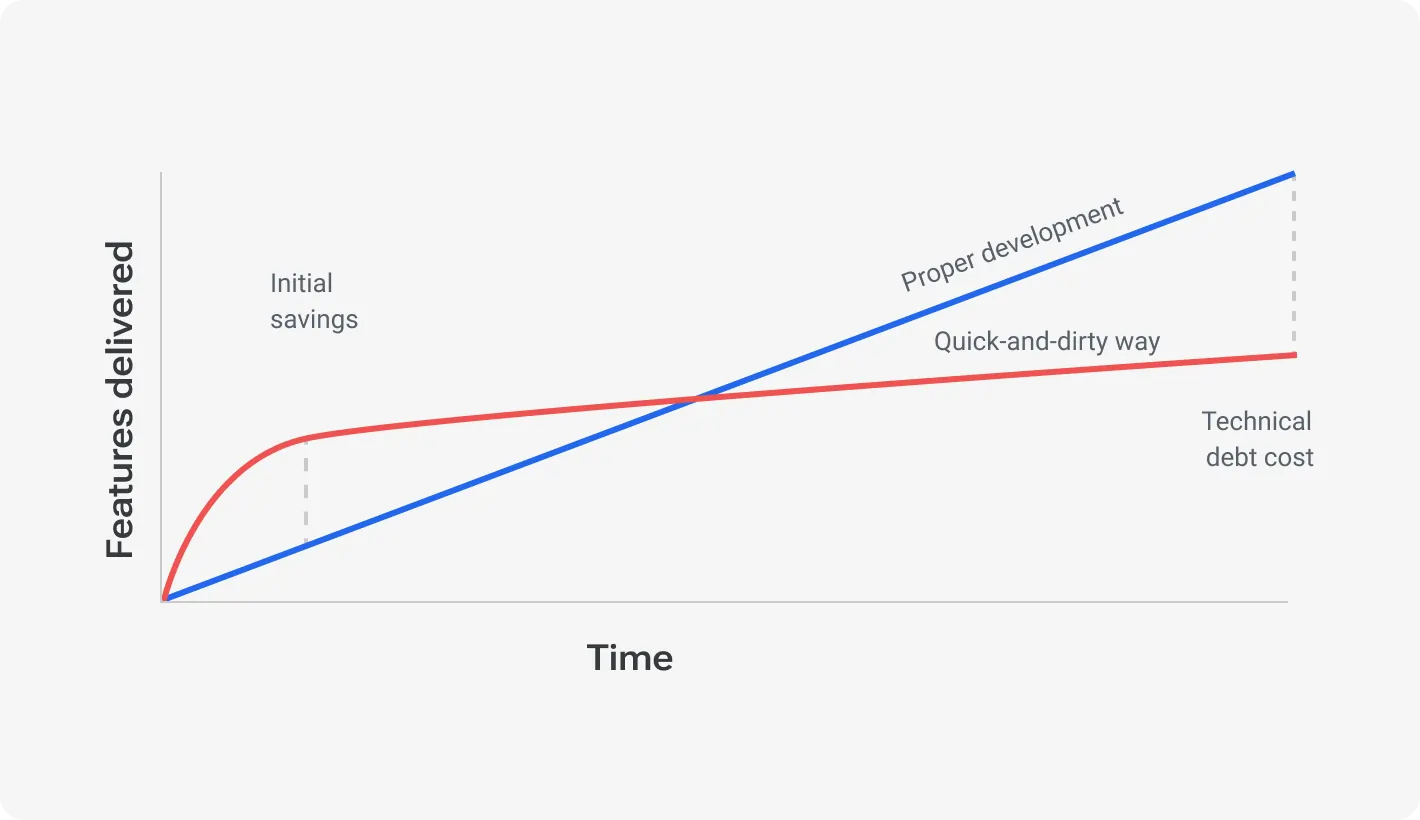
It's easy to think that their mistake was a one-off, a freak accident that couldn't happen to anyone else. But the truth is, the financial impact of technical debt is a ticking time bomb that can affect any company. Cutting corners always pays off (but in a bad meaning). Prioritizing short-term gains over long-term sustainability accumulates and silently eats away at your company's foundation.
But the real question is, how do you stop this tech issue from spiraling out of control? Effective technical debt management lies in a deep understanding of financial implications and a strategic approach to mitigating its effects.
Further, we'll explore the financial realities of tech debt, from the hidden costs of maintenance to the opportunity costs of delayed innovation. Alongside examining the strategies that successful companies use to manage their technical debt.
What is technical debt?
Technical debt is a credit card: when you stick to temporary solutions that allow you to meet a short-term goal (to buy something for credit money). However, it comes with long-term consequences.
Paying by credit card? Be ready to accumulate fees. Similarly, technical debt accumulates complexity, bugs, and, more relatable to the article, maintenance costs. Scarcity premiums are part of that: hire Perl developers today and you pay above market. In any case, the longer you wait to pay off the debt, the more it grows, making it harder to manage (of course if you are not a billionaire child).
Technical debt occurs when developers too often make crutches the choice no 1 in solving problems. Consequently, the project ends up with poor code quality, lack of documentation, and total failure.
Empower your IT team to focus on innovation and growth by outsourcing your technical debt management
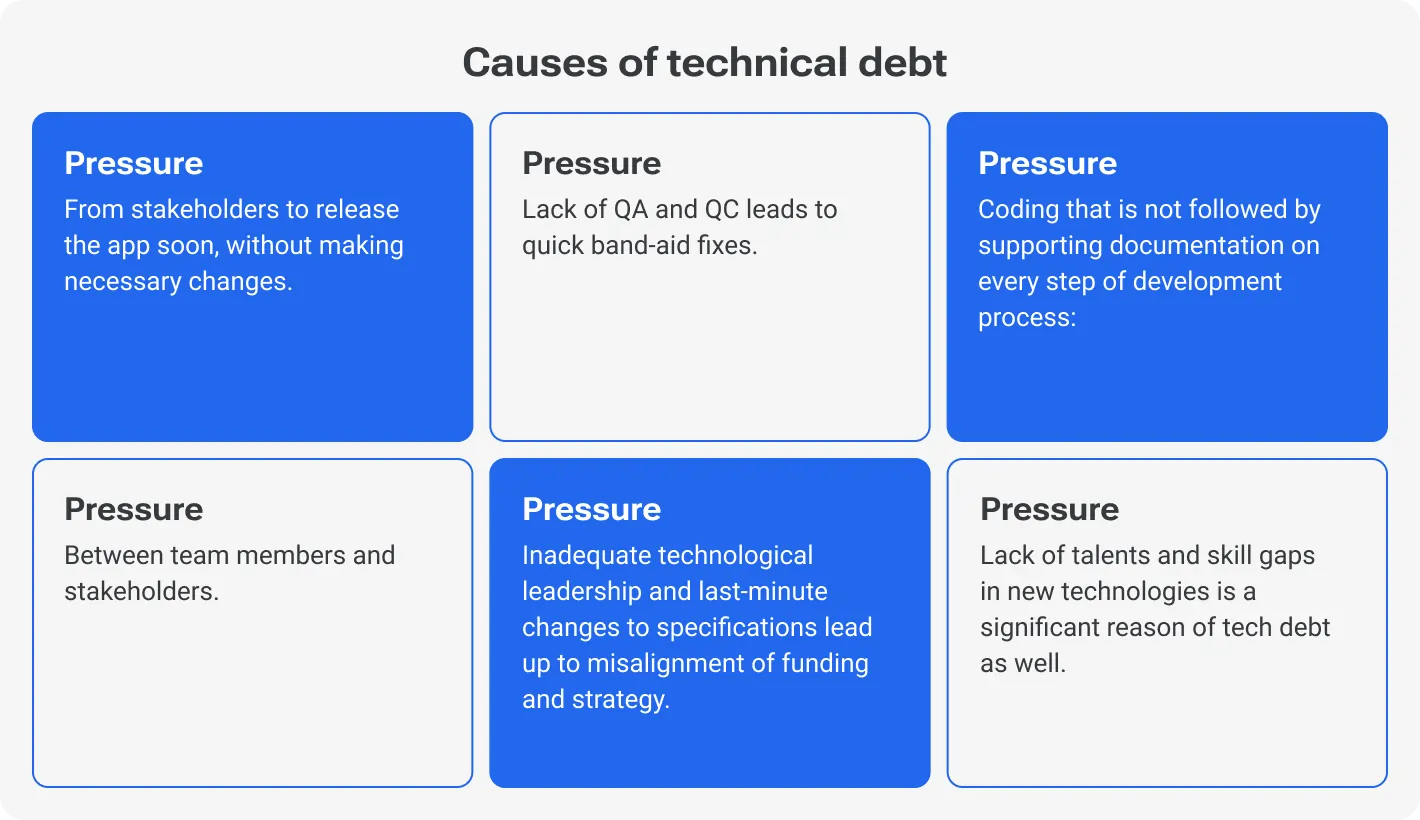
Common causes of technical debt [pressure is a uniting issue]
-
Rushed projects, where the focus is on delivering quickly rather than delivering quality
-
Lack of documentation with inability for new team members to understand the codebase
-
Outdated technology, leading to security vulnerabilities
-
Insufficient testing, which means a lot of bugs and errors that “need to be fixed later”
-
Poor communication among team members
The newest driver of technical debt: AI-generated code
Generative AI has changed how fast teams ship code. It hasn't changed what bad code eventually costs you.
Tools like GitHub Copilot and Cursor meaningfully accelerate output, but they've also introduced a fast-moving source of technical debt that didn't exist three years ago. Accenture now identifies AI as a leading contributor to technical debt accumulation at the enterprise level, with the pace accelerating alongside adoption rates.
The core problem isn't that AI writes bad code. It's that it writes plausible code, code that passes review, reaches production, and carries hidden structural issues that only surface later.
The four ways AI accelerates debt accumulation:
1. Review cycles become unreliable. AI-generated code looks clean, so it gets approved faster. Speed of review is not the same as depth of review.
2. Ownership gaps widen. If no one wrote a block of code intentionally, no one fully owns it. That knowledge vacuum becomes expensive when something breaks.
3. Debt layers compound faster. AI generates fixes and workarounds on top of existing debt, making each layer harder to unpick than the last.
4. Security surface expands silently. AI-generated code can introduce subtle vulnerabilities through lack of context about your specific compliance requirements and security architecture, a critical risk in regulated industries like fintech and healthcare.
The teams that will carry the least AI-generated debt two years from now aren't using AI the least. They're the ones that established mandatory human review against architectural standards, automated static analysis as a hard gate, and clear ownership policies for AI-assisted contributions, before the accumulation became structural.
The long-term impact of technical debt
Have you run through the 2023 Global CTO Survey? Take time. Numbers vary from research to research, but one thing is constant: technical debt is a major challenge for most companies. In the mentioned survey, 91% of CTOs stated that.
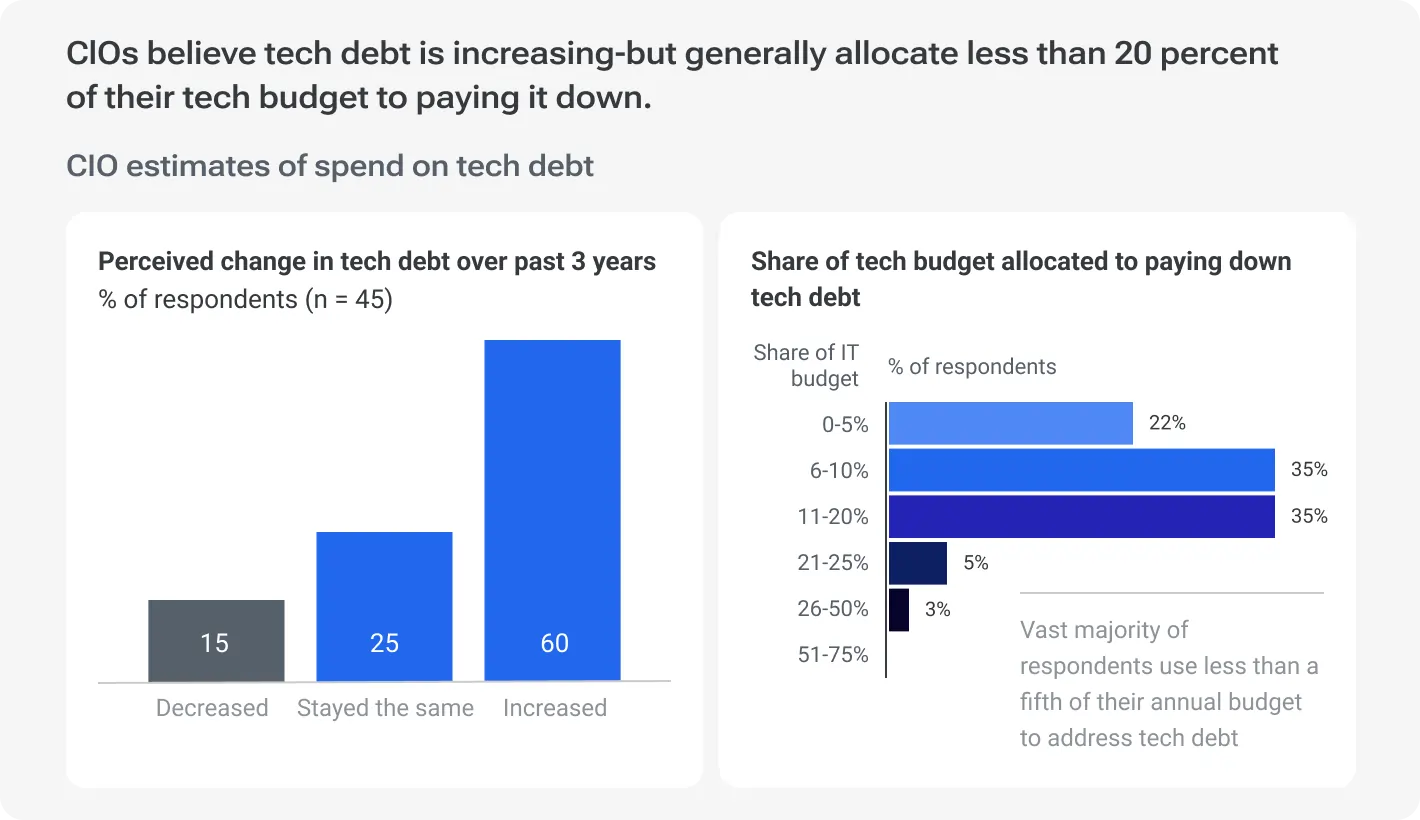
Also, 71% of developers spend at least 25% of their time dealing with technical debt. McKinsey seconds that: companies can spend about 20% of their IT budgets dealing with the consequences of technical debt while its real costs are more than 40%.
All these statements lead us to the conclusion — technical does not fall down to a technical problem only. It’s also a financial one as it diverts resources away from innovation and toward maintenance.
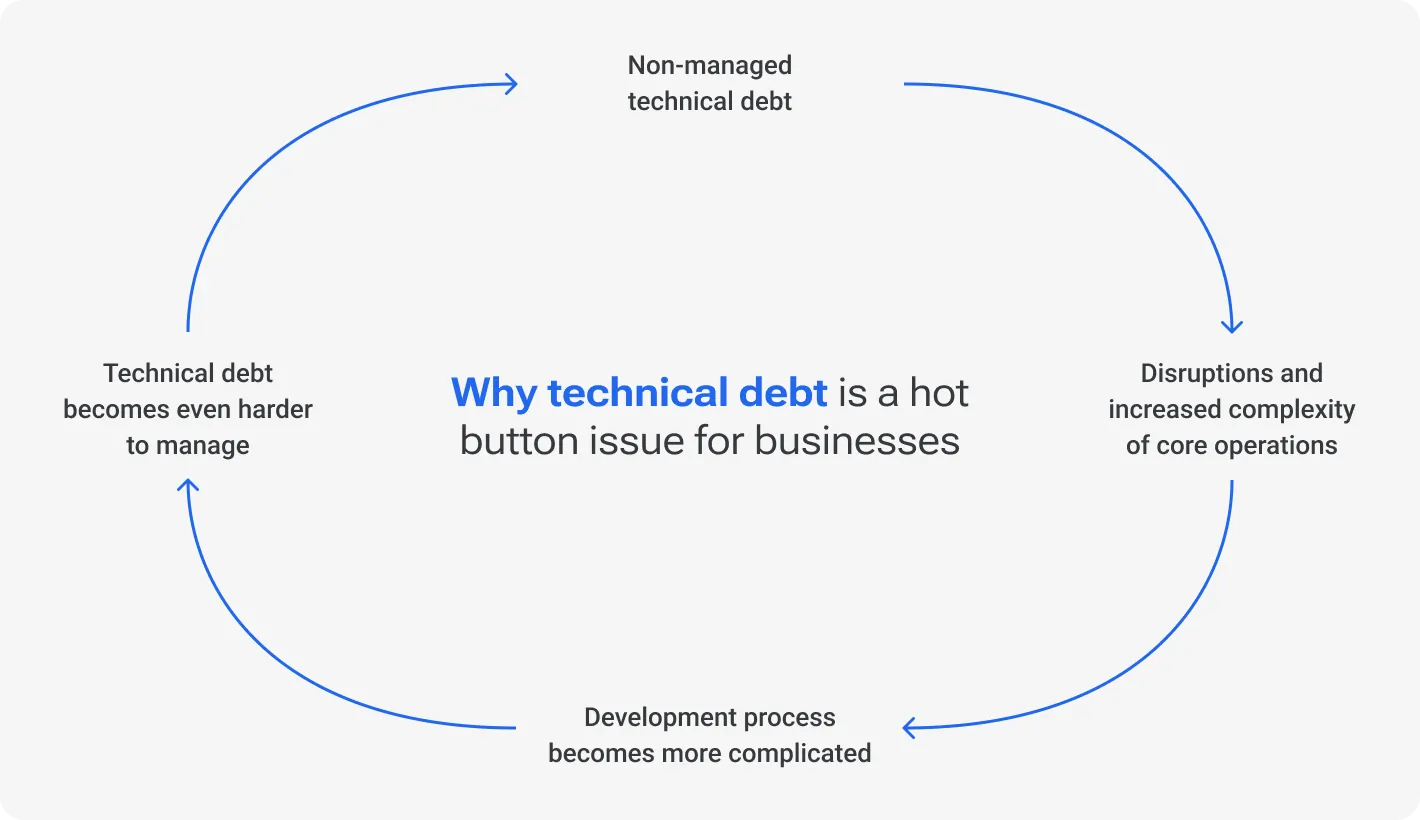
As technical debt accumulates, it slows down development, increases the risk of errors, and makes it harder to adapt to changing market conditions. In the worst-case scenario, technical debt can lead to company-wide crises (recall the Knight Capital example).
Your developers are spending 30% of their time fixing yesterday's mistakes. Let's change that
The accumulation of technical debt
Technical debt is an obligation. So does the cost of technical debt. Let's go deeper into how this debt accumulates and its insidious effects.
How technical debt builds up
It accumulates when developers cut corners to meet deadlines and ignore software development best practices; resulting in:
Code refactoring neglect: You must deliver, now! This is what developers often hear (or think). Such “voices” inevitably lead to inadequate code. Without refactoring, code becomes increasingly complex, brittle, and as they say spaghetti-like.
Test automation overlooked: testers aren’t gods. And without thorough testing chances are you will end up with a ripple effect. Without a robust test suite, developers will sit on the fence about making changes.
Dependency management chaos: We have all been there. Some parts were taken from GitHub, some were stolen from Chinese devs, and some were written with Copilot. Overreliance on third-party libraries and sources without proper dependency management can create compatibility issues and security vulnerabilities.
This is not to mention hardcoding values instead of using configuration files, copy-pasting code instead of refactoring and ignoring code smells, such as duplicated code or long methods.
Increased bugs and errors
Slower development cycles
Decreased team productivity
The main advice is to communicate. That’s simple. Yet, not enough. To convey the importance of addressing technical debt, it's essential to:
Illustrate long-term costs: Use real-world examples (Equifax, Blackberry, some Nokia cases, etc.) or case studies to show how technical debt impacts the company's bottom line.
Promote best practices: Facilitate adherence to coding standards, proper documentation, and thorough testing. Implement internal awards to speed up practice adoption.
Conduct regular code reviews: Implement regular code reviews to identify and address shortcuts and inadequate practices early.
Early warning signs
Technical debt is not a one-night situation. Its presence is indicated by early warning signs. Below are 6 of them.
-
Development cycles become longer: As technical debt grows, it takes longer to implement new features or fix bugs.
-
Increasing bug reports: Technical debt can lead to a wave in bug reports, as the codebase becomes more prone to errors.
-
Productivity decreases: Your developers will waste time tackling outdated code, and their morale will suffer.
-
Codebase entropy: The codebase becomes increasingly disorganized, with duplicated code, inconsistent naming conventions, and unclear architecture.
-
Fear of change: The professional confidence of your dev team will shrink as they might break something or introduce new bugs.
-
Irreplaceable specialists: A few team members become the sole experts on specific parts of the codebase, creating a single point of failure and making it difficult for others to contribute.
To mitigate the impact of tech debt, you must first understand how it accumulates. Keep in mind that addressing tech debt is a strategic move; your business's finish point depends on it.
How to measure technical debt: 8 top metrics
Financial implications of technical debt
You may think that code debt is a far cry from the cash gap. Yet, its financial implications can be far-reaching and devastating. Proof of the pudding is the following considerations of the short-term and long-term costs of technical debt.
Short-term vs. long-term costs
When considering the true cost of technical debt, it's crucial to size up the immediate costs of addressing it against the deferred costs of ignoring it.
Short-term costs:
Beating technical debt from the very beginning will take additional time and resources. For example, refactoring code, updating documentation, and improving testing processes. But in the long run, it’ll pay off.
Suppose a development team needs to implement a new feature that requires refactoring a critical component of the codebase. The estimated time is 2 weeks. The delay of the feature's release will be about 2 weeks.
The immediate cost of addressing the technical debt is the 2-week delay, which translates to USD 10,000 in opportunity costs (assuming a weekly revenue of USD 5,000). Let’s take a look at delaying costs.
Long-term costs:
If the team decides to ignore the technical debt and implement the feature quickly, they potentially save 2 weeks, but they'll undertake additional costs after the deployment. Among other things, this move can lead to:
At least 10% more bugs and an additional 1 week of debugging time (considering the average hourly rate in the US this may cost about USD 5,000).
About 20% slower development cycles and an additional 2 weeks of development time for the next feature (potential cost is about USD 10,000).
15% higher maintenance costs, resulting in an additional USD 7,500 per year.
As we see, the deferred costs of ignoring the technical debt mount to USD 22,500 over the next year. By addressing the technical debt upfront, the team saves USD 12,500 in the long run.
We’ve already mentioned McKinsey's study: Companies can spend up to 20% of their budget on managing the consequences of technical debt.
Get a structured reduction plan from Devico's engineers
The hidden cost nobody budgets for: Talent attrition
There's one financial consequence of technical debt that almost never appears in an IT budget — and it's often the most expensive one.
Senior engineers leave when maintenance work crowds out meaningful work. When the ratio of firefighting to building tips too far, the engineers with the most options, your best people, start looking elsewhere. What leaves with them isn't just headcount. It's institutional knowledge about how your critical systems actually behave in production: knowledge that's rarely documented and takes 12–18 months to rebuild in a replacement hire, if it gets rebuilt at all.
The direct replacement cost for a senior engineer runs 1.5–2x their annual salary when accounting for recruiting fees, onboarding time, and reduced team productivity during the gap. On a $150,000 salary, that's up to $300,000 per departure, a cost that never shows up on the technical debt ledger, but is caused by it.
Technical debt doesn't just slow your roadmap. At a certain accumulation level, it starts dismantling the team executing it.
Case studies
Bank of America
Bank of America faced severe issues due to technical debt and then eventually faced the music. The bank’s outdated IT infrastructure made it difficult to roll out new digital services and comply with regulatory changes (which are very strict in the financial industry).
The estimated cost of maintaining legacy systems was around USD 3 billion annually. At the end of the day, the bank undertook a comprehensive modernization project (USD 1+ billion in price), to address the technical debt and improve operational efficiency.
Healthcare.gov
The launch of Healthcare.gov became a cautionary tale. Back in 2013, it was packed with technical issues, including a complex and poorly designed architecture. The site's technical debt was estimated to be around USD 200 million. All tech debt was eventually addressed, but it took a series of costly refactorings and rewrites.
How to calculate the real cost of technical debt: 4 Formulas CFO can use
Talking about technical debt in abstract terms — "it slows us down," "it creates bugs," "it's a risk" — rarely moves budget conversations forward. Numbers do.
Below are four formulas that translate your codebase's condition into financial language. Use them to understand the true scale of your debt, justify remediation investment, and get engineering priorities approved at the executive level.
Formula 1: Technical Debt Ratio (TDR) — How much debt do you actually carry?
TDR tells you how large your technical debt is relative to the total cost of building your system. Think of it as your debt-to-asset ratio — the same concept your finance team uses, applied to your codebase.
Formula:
TDR = Remediation Cost ÷ Total Development Cost
How to get your inputs:
Remediation cost: Use a code analysis tool like SonarQube to estimate the hours required to fix all flagged issues, then multiply by your average developer hourly rate
Total development cost: Total hours invested in building the codebase × average hourly rate
Worked example:
Your product has taken 10,000 developer hours to build at an average rate of $120/hour — a total development cost of $1.2M. SonarQube estimates 2,400 hours of remediation work needed, which at $120/hour equals $288,000 in remediation cost.
TDR = $288,000 ÷ $1,200,000 = 24%
What the number means:
TDR
Risk level
What it signals
Healthy codebase, manageable debt
Debt is present but controlled
Slowing development, budget attention needed
Debt is actively harming delivery speed and quality
A 24% TDR means nearly a quarter of your engineering investment is locked in debt. That's the number you bring to the first CFO conversation.
Formula 2: Technical Debt Interest Rate — What is carrying it costing you each month?
TDR measures the size of the debt. The Interest Rate measures what you're paying to carry it — every single month — in lost engineering capacity.
Formula:
Interest Rate (% Loss) = (Maintenance Hours ÷ Total Dev Hours) × % Attributed to Technical Debt
Worked example:
Your 8-person engineering team logs 1,280 hours per month in total. Roughly 40% of that time — 512 hours — goes to maintenance, bug fixes, and rework rather than new features. Your team estimates that 50% of that maintenance burden is directly caused by technical debt.
Interest Rate = 40% × 50% = 20% of total engineering capacity lost to debt
Now put a dollar figure on it:
Average fully-loaded developer cost: $130,000/year = ~$10,800/month per developer. Across 8 developers: $86,400/month in total engineering spend.
Monthly debt interest payment = $86,400 × 20% = $17,280/month — or $207,360/year
That's over $200K annually in salary spend that produces no new value. It fixes problems that shouldn't exist in the first place.
This is consistent with what Stripe found in their developer productivity research: engineers spend roughly 33% of their time dealing with technical debt. For most mid-size engineering teams, that figure translates directly into six-figure annual losses — without a single outage, breach, or visible crisis.
Formula 3: Cost of Delay (CoD) — What is the revenue impact of moving slower?
The first two formulas measure internal costs. CoD shifts the lens outward: what is technical debt costing you in missed revenue, delayed features, and lost competitive ground?
Formula:
CoD = Value of Feature per Week × Weeks Delayed by Technical Debt
B2B scenario:
Your sales team has closed three enterprise deals contingent on a new API integration feature. The feature is estimated at 6 weeks of development. But because your core payment module is heavily debt-laden, every change requires extensive workaround testing — adding 4 weeks to the timeline. The integration ships in 10 weeks, not 6.
The feature unlocks $80,000/month in new contract revenue — roughly $20,000 per week.
CoD = $20,000 × 4 weeks = $80,000 in deferred revenue — from a single delayed feature
Multiply that across a typical quarterly roadmap of 4–6 features, and CoD quickly exceeds your estimated remediation cost. Technical debt isn't just a development problem. At this point, it's a revenue problem — and it belongs in a board-level conversation.
Formula 4: Remediation ROI — Is fixing it worth the investment?
This is the formula that gets budget approved. Once you know the size of your debt (TDR), what carrying it costs monthly (Interest Rate), and what it's costing you in revenue drag (CoD), the final step is to calculate whether remediation pays for itself — and how fast.
Formula:
ROI = ((Annual Interest Savings + Annual CoD Recovered) − Remediation Cost) ÷ Remediation Cost × 100
Worked example (using the numbers above):
Annual interest savings (recovered engineering capacity): $207,360
Annual CoD recovered (assuming 2 delayed features per quarter at $80K each): $320,000
Estimated remediation cost: $288,000
ROI = (($207,360 + $320,000) − $288,000) ÷ $288,000 × 100 = $239,360 net gain ÷ $288,000 = 83% ROI in Year 1
By Year 2, with remediation costs already absorbed, the annual gain runs to $527,360 with no additional investment.
A few important notes on running this calculation for your own situation:
Be conservative with CoD. Use confirmed pipeline or signed commitments rather than projections. Conservative numbers are more defensible in a CFO conversation.
Account for transition costs. Remediation sprints will temporarily reduce feature output. Factor in 15–20% productivity dip during the remediation period.
Reassess TDR every quarter. Technical debt is not static. Without active management, a 20% TDR becomes 30% within 12–18 months as new shortcuts accumulate on top of existing ones.
Impact on business operations
Code debt isn’t limited to the development team. Its consequences affect business operations and ultimately, the bottom line of your entrepreneurship endeavor.
Productivity and efficiency
Technical debt slows development speed, making it challenging to meet deadlines and respond to changing market conditions. When developers spend more time fixing bugs and dealing with poorly written code, they’re draining their ability to innovate and build new features.
Pay attention:
Stripe’s study states that developers spend about 44.1 hours per week or up to 33% of their time grappling with technical debt.
Customer satisfaction and retention
Timely managing technical debt directly impacts customer satisfaction and retention. When a product is filled with bugs, has slow performance, and has poor user experience, customers become frustrated and there is no way they become brand advocates.
They say the proof of the pudding is in the eating:
UX matters: This is not advertising, but many people are sure that Apple's iPhone has a seamless user experience, thanks to a focus on quality and among other features minimal technical debt. This has contributed to Apple's loyal customer base and market dominance with at least 23% of the smartphone market share.
The “keeping up” failure: Blackberry didn’t manage to maintain the needed level of user experience and tech advancements. This is not to mention that ignoring technical debt led to a decline in user satisfaction and a significant loss of market share as users switched to more reliable alternatives like iPhone and Android smartphones.
Correlation between innovation and competitiveness
Unreasonable technical debt (is it always unreasonable?) has nothing to do with innovations. When a significant portion of resources is dedicated to maintaining a spaghetti code, there is no room for experiments.
Consequences:
Reduced market share: Responding to changing market conditions will be challenging. Hence, there will be lost market share.
Missed opportunities: Technical debt can prevent companies from exploring new technologies, features, and business models, ultimately missing out on revenue opportunities.
Strategic technical debt management: Should we aim at zero technical debt?
Strategies to manage and mitigate technical debt
The best thing you can do to manage and mitigate technical debt is to use both prevention techniques and proper reduction strategies. And include them in financial planning. This way, you can minimize the technical debt and ensure a sustainable codebase. Let’s dive deeper into these measures.
Prevention techniques
Preventing technical debt is always better than trying to reduce it later. Here are some best practices for preventing technical debt:
Code reviews: Obvious yet workable advice that spots errors and inconsistencies early, reducing tech debt accumulation.
Top tips:
-
Implement a particular system or protocol in the review process.
-
Use tools like GitHub or Bitbucket for streamlined code review workflows.
-
Foster constructive feedback and continuous learning.
Automated testing: Many bugs pop up due to a human factor. Automate testing and your code changes will not introduce them and won’t break existing functionality.
Top tips:
-
Write test cases in the early stages of SDLC.
-
Integrate testing into the continuous integration (CI) pipeline.
-
Review and update tests to cover new features and changes.
Proper documentation: Tech writer pays off. If your devs ain’t got no time to maintain documentation, hire a separate tech writer to help developers make informed decisions.
Top tips:
-
Keep documentation up-to-date.
-
Confluence or Sphinx help organize documentation.
-
Incorporate documentation as part of the development workflow.
Pair programming: When you have someone to count on, chances are you will reduce the likelihood of technical debt.
Continuous refactoring: Another standard practice for maintaining a clean and simple architecture.
Reduction strategies
Technical debt mitigation is not a matter of a one-day solution. Unraveling the existing debt requires a system. Here are four points to consider when it comes to existing tech debt.
Technical debt prioritization: Prioritize technical debt based on business value, risk, and complexity, and tackle the most critical issues first.
Refactoring sprints: Tackle with debt in dedicated sprints. Distinguish separate sprints for refactoring and technical debt reduction.
Code cleanup: Schedule regular code cleanup sessions to remove dead code, simplify architecture, and improve code quality.
Modularization: Break down monolithic codebases into smaller, independent modules, making them easier to maintain and update.
Example: We have a fintech company developing their new app. Technical debt arised, making them applying reduction practices. The team allocated about 20% of their development capacity to refactoring. This initial investment will pay off: In six months, they potentially will reduce their technical debt by a third and improve development speed alongside reducing maintenance costs.
Financial planning and budgeting
As we already understand, financial planning is crucial for sustainable growth. So is for technical debt mitigation. Consider these two frameworks for financial planning and budgeting.
-
Cost of Delay (CoD) framework: Estimate the cost of delaying technical debt reduction and prioritize debt reduction based on business value and risk.
-
Technical Debt Ratio (TDR) framework: Calculate the technical debt ratio by dividing the estimated cost of addressing technical debt by the total development cost. Use this ratio to allocate resources and budget for technical debt reduction.
We've helped engineering teams cut maintenance overhead by up to 30% in 6 months
To sum up
They say technical debt is a killer. It’s true as it significantly impacts financial and operational processes. Whether you are aware of it or not, it reduces productivity, decreases customer satisfaction, and buries innovation.
The first step to “tech freedom” is to understand the consequences of technical debt, and only then you can take proactive steps to manage and mitigate tech debt. Recognize the importance of technical debt management and take action to address it.
Devico’s experts identify the “amount” of your technical debt, develop a customized reduction strategy, and implement best mitigation practices alongside prevention techniques to avoid accumulation in the future.
Code debt holds your business back. Take over the codebase today and ensure a sustainable future for your company.
Contact us to book a free 1-hour consultation or learn more about our technical debt management services to investigate our capabilities.
Gain an access to seasoned professionals specialized in managing technical debt