It usually starts the same way. Two or three developers, a product owner on the client side, and one big assumption: the team will organize itself.
For a while, it does.
Then delivery slows. Code quality drops. Decisions that should take minutes take days, because no one on the team has the authority or the context to make them.
The instinct is to hire more developers. Almost always, that makes it worse.
DORA's research points to something simpler. When a team has a leader who brings vision, who challenges people, who supports and recognizes them, performance goes up and the business does better. Now picture an outstaffed team. People work remotely. They're spread across time zones. The client checks in maybe once a day. Take away clear technical leadership and you've opened the most expensive gap there is.
Bring in a tech lead too late and you don't just lose speed. You lose architectural consistency, delivery momentum, and the long-term health of the codebase.
This article is about getting the timing right. When to add a tech lead to an outstaffed team. What that person actually does. And how to decide whether to grow one from within or bring one in from outside.
Motivated and focused experts for up to 60% less than locals, delivered in days, not months
What a tech lead actually does in an outstaffed team
The general role of a tech lead is well-known. What’s less clear is how it changes when the team is remote, distributed across time zones, and working under the client’s product direction.
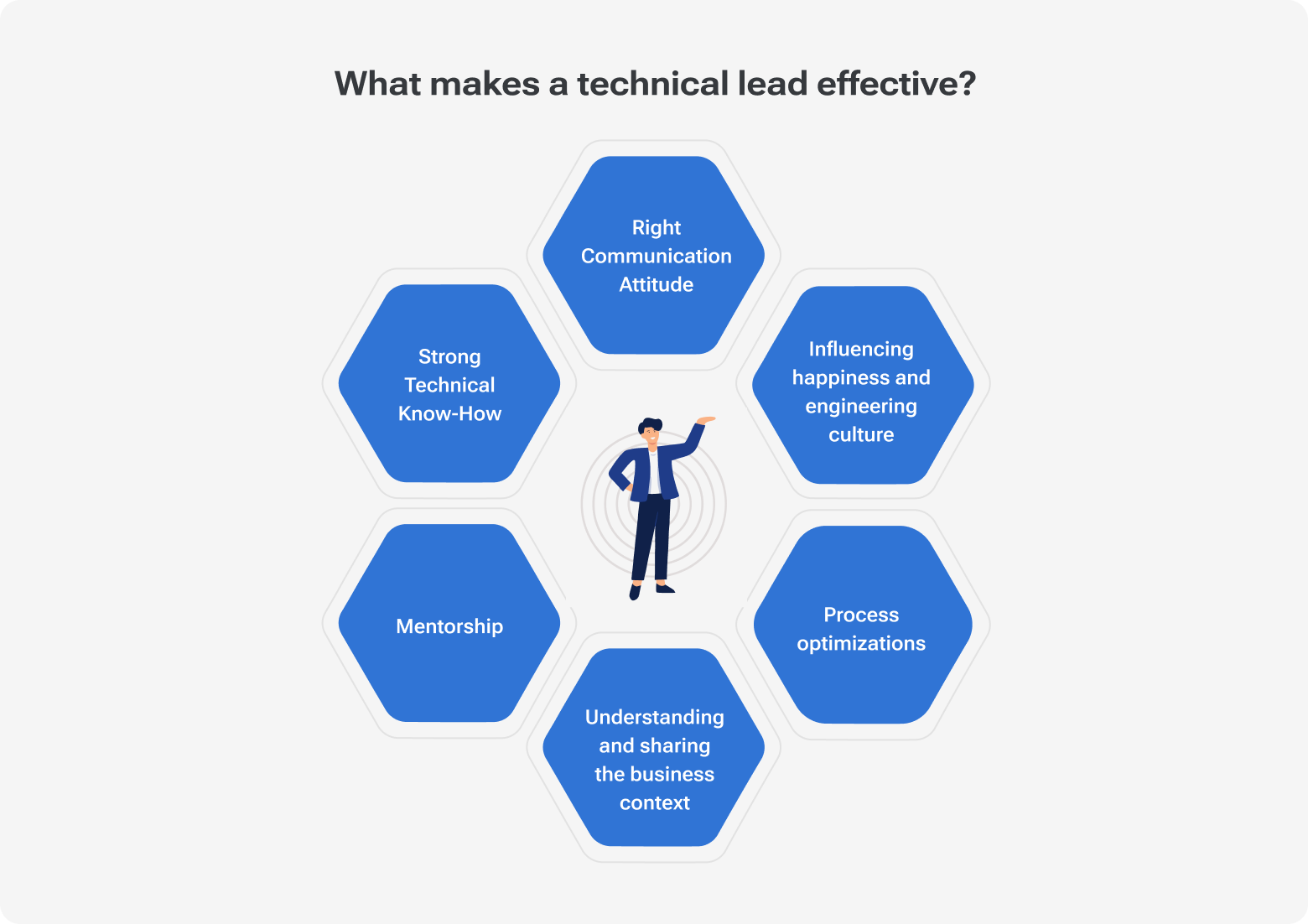
Having worked with outstaffed teams for years, we can identify three core responsibilities of a tech lead in a remote development team:
A tech lead makes and shares architectural decisions, ensures alignment with code quality standards, and prevents technical debt from accumulating over time.
Acting as the primary technical point of contact between the outstaffed team and the client, they translate business requirements into technical scope, clarify priorities, and unblock developers when decisions must be made quickly without long approval chains or delayed email discussions.
A tech lead runs or oversees code reviews, identifies architectural and maintainability issues, and ensures the codebase is still understandable for new developers joining or contributing to the project.
Also, it would be useful to define what a tech lead is not. They aren’t a project manager responsible for timelines and delivery logistics. They aren’t a senior developer doing solo work. And they are also not a CTO defining long-term business or product strategy at the executive level.
The table below highlights the distinctions between these roles.
CTO vs. PM vs. tech lead vs. senior developer in a remote team
Role
Primary responsibility
Main area of ownership
Success is measured by
Typical involvement in daily development
Strategic technology leadership
Company-wide technology vision and business alignment
Long-term scalability and business impact
Delivery planning and process coordination
Timelines, resources, communication, risk management
On-time delivery and process transparency
Technical leadership and coordination
Architecture, technical decisions, code quality, team alignment
Team efficiency, system maintainability, delivery stability
Individual technical contribution
Feature implementation and problem-solving
Quality and speed of personal output
Risks you face without technical leadership in a remote team
Most companies hire a tech lead reactively, after something has already gone wrong. The risks of a tech lead’s absence are too specific and serious to be ignored. Recognizing them early can save you from big trouble.
Risk #1: Tech decision paralysis
Having no one on the team with enough authority or context to make decisions independently, an outstaffed team waits for client input on questions that ideally should be resolved within the team, whether it’s tool choices, database schema selections, or API design trade-offs. Altogether, such delays eat up a lot of time.
Risk #2: Technical debt accumulation
Without someone responsible for maintaining code quality standards, developers use different norms, testing approaches, and documentation practices. The codebase gradually diverges, and in a few months, your new product looks like a legacy system because of a major tech debt. According to a McKinsey survey, rework caused by technical debt can take 10–20% of a technology budget. You do need a tech lead to ensure consistency and avoid debt accumulation.
Risk #3: The client being the de facto tech lead
When no one on the outstaffed team owns technical direction, the client often fills the gap without realizing it. They make architectural decisions they’re not qualified to make or answer questions that should never have reached them. The client shouldn’t be the last line of technical defense, and taking on the role of a tech lead usually results in blurred responsibilities and slow decision-making.
Risk #4: Slowdown every time a new developer is onboarded
Without a tech lead whose explicit job is helping newcomers settle into the project, onboarding becomes fragmented, and the work of the whole team slows down. Documentation is incomplete or outdated, new developers ask different teammates for context, and senior engineers are frequently interrupted to explain decisions, workflows, and dependencies. As a result, every new hire creates a temporary productivity drop across the team.
Risk #5: Unexpected problems
Security vulnerabilities, architectural issues, and scalability problems that a tech lead would catch in code review accumulate in silence. Yet, when you least expect it, they show up as production incidents, failed audits, performance bottlenecks, or expensive emergency fixes.
Avoid operational and HR hassle and the constant threat of attrition with your own R+D department from Devico
Five signals that tell you it’s time to bring in a tech lead
As mentioned above, an outstaffed team can work without a tech lead for some time. However, there comes a point when continuing this way starts introducing problems and inefficiencies. We'd like to review five signals that should make you consider bringing a tech lead into the team.
Signal #1: Team size has exceeded 3–4 developers
With a very small team, coordination is done through direct communication. But once a team grows beyond 3-4 developers, informal alignment stops being enough. Brooks's law indicates that communication overhead increases as the number of people grows. Decisions that were once made in conversation now require structure, context, and consistency.
As coordination gets complicated, decisions slow down, and the team relies on implicit assumptions instead of shared direction, the need for a technical lead becomes obvious.
Signal #2: The client spends more than 20% of their engineering leadership time answering technical questions from the team
This is a structural issue often masked as a communication problem. When a CTO or VP of Engineering spends about 20% of their time tackling technical questions from an outstaffed team, the company already pays for the absence of a tech lead through the senior leader’s time.
At an estimated USD 150–250/hour opportunity cost, even 10 hours per week turns into a substantial hidden expense, and in outstaffed setups, this is often close to the cost of a dedicated tech lead. The difference is that one option frees up leadership time, while the other quietly consumes it.
Signal #3: Delivery velocity varies across sprints with no clear reason
A fluctuating velocity that doesn’t relate to scope changes or external dependencies often points to coordination and technical alignment issues inside the team.
Work gets slowed down not by complexity itself, but by unclear ownership of decisions, inconsistent technical direction, and rework caused by misalignment. Without a tech lead who gets control over delivery, the process becomes unpredictable, even if individual developers are highly capable.
Signal #4: Code reviews are neglected or tackled by one senior developer
If code reviews are skipped because no one has ownership of them, the codebase accumulates quality risk. If one senior developer reviews everyone’s work on top of their own output, that developer operates as an informal tech lead without the authority or the headroom to do it well.
In both cases, the system lacks clear ownership of quality standards. Either control is absent, or it is overloaded in the wrong place.
Signal #5: New developers need more than two weeks to become productive
Often, this is a documentation and architecture legibility signal. When onboarding time takes more than two weeks, the codebase has outgrown its current leadership structure. It’s time to engage a tech lead who will own the documentation, onboarding process, and architectural guidelines so that the system will be comprehensible to anyone new.
If two or more signals apply to your team, there is a high probability that the cost of waiting is already higher than the cost of acting.
How to vet a senior developer without being a technical expert
Team size and system complexity as planning benchmarks
While the signals above help define whether an outstaffed team needs a tech lead, many companies would rather think ahead instead of waiting until delivery issues appear and signs become visible.
In these terms, team size and system complexity are useful planning indicators, particularly when setting up an outstaffed team from scratch. With their help, one can estimate when informal coordination will likely stop being effective enough and when to hire a tech lead for a startup.
The table below can serve as a planning reference.
Team size
System complexity
Is a tech lead needed?
Low
e.g., an MVP, a single feature
Not needed. A senior developer would be enough.
Medium
e.g., a multi-feature product
It’s better to evaluate against the signal checklist.
Medium-high
e.g., an active product, multiple modules
Needed, as coordination requires a more structured approach.
High
e.g., a scaled product, multiple work streams
Needed, as well as an engineering manager.
High complexity
e.g., a regulated industry, a security-critical project, a distributed architecture
Absolutely needed, because complexity demands a dedicated technical lead regardless of headcount.
An important thing to note is that seniority and team makeup affect these benchmarks. For example, two senior architects working on a sophisticated software solution may need technical leadership earlier than five mid-level engineers developing a standard web application. So, treat the table as a planning tool, not a rigid rule.
Promoting from within vs. bringing someone new
Once the decision to add a tech lead is made, there are two ways to go. The first one is to promote somebody from the existing team, and the second is to bring in a new person specifically for the role. Which one to pick depends on what’s actually available.
Promoting from within
Before searching externally, you’d better look carefully at the folks inside the team. In many cases, the best candidate is already there.
The advantages of this approach:
familiarity with the context, codebase, and team dynamics
developed trusted relationships with colleagues
faster transition into the leadership role
Yet, not all strong senior developers become good tech leads.
A tech lead is one of the key outstaffing team roles that requires special skills. Technical expertise is still paramount, but leadership ability, great communication skills, ownership, and readiness to support the whole team are also brought into the limelight. Some developers do well in that environment, while others like being purely hands-on without coordinating people or processes.
So, to identify a capable internal candidate, you need to go beyond technical skills and pay close attention to behavioral patterns:
Who has already been reviewing others’ code informally?
Who clarifies details before implementation starts?
Who helps teammates without being asked?
Who thinks about the system as a whole, not only individual tasks?
Hiring a tech lead
Not every team has somebody skilled or willing to take on tech lead responsibilities. In such cases, engaging a qualified person from outside is the way to go.
This approach has several pros:
selecting specifically for the leadership profile
bringing in a fresh architectural perspective
avoiding the period of transitioning an individual contributor into a management mindset
At the same time, there are some cons too. Someone joining from outside usually needs time to comprehend the product domain, architecture, and team dynamics. Occasionally, the introduction of a new person can also affect existing workflows for a while.
When hiring a tech lead, we’d recommend you emphasize an outstaffed setting. Therefore, look for candidates with:
comfort in making decisions without having access to stakeholders
experience treating code review as a core responsibility, not as an occasional task
ability to present technical decisions for non-technical clients.
Tech lead costs vs. tech lead’s absence costs
Many companies are reluctant to introduce a tech lead because they see it as an additional expense. In fact, the absence of technical leadership often costs more, just in less visible ways. Once you consider the hidden costs, it becomes clear that keeping the existing outstaffed team structure is often more expensive.
The cost of a tech lead in staff augmentation
In the Eastern European outstaffing market, a tech lead usually costs 15–35% more than a senior developer, depending on the level of architectural ownership and leadership responsibility.
However, in an outstaffed model, you don’t carry the full operational burden of hiring. Recruitment, HR processes, retention, replacement risk, and administrative overhead are on a vendor, while you pay a set monthly rate.
Importantly, a tech lead isn’t just another developer with a higher rate. Their output shows up at the team level: faster decisions, fewer blockers, cleaner architecture, and less rework.
The hidden costs of not having a tech lead
The cost of the tech lead’s absence accumulates in a range of smaller inefficiencies. The most costly ones are worth your particular attention.
Having no tech lead to make technical decisions within the team, this often becomes the responsibility of the client’s CTO or VP of Engineering. Instead of working on product strategy or organizational planning, senior leadership handles day-to-day implementation questions, architecture clarifications, and coordination overhead. Taking into account how expensive their time is, this is an inefficient use of senior leadership capacity.
Without internal technical authority, a team uses inconsistent engineering practices and quickly accumulates tech debt, which, in turn, results in a significant amount of rework. Fixes, additional testing, and repeated implementation cycles consume a wealth of time. While on average, developers spend 23% of their time on tech debt, in teams without clear technical ownership, this percentage tends to be higher.
Without a tech lead, distributed, outstaffed teams often face poor documentation, coordination overhead, and technical friction that slow down delivery. Developers spend more time resolving ambiguities, aligning on decisions, and fixing inconsistencies instead of building new functionality, which gradually reduces overall team velocity.
A longer-term people cost should also be taken into account. Poorly maintained systems, inconsistent code review practices, and unclear technical direction foster frustration among engineers. Thus, McKinsey describes technical debt as a factor contributing not only to product delays and cost increases but also to engineers “leaving in frustration."
In isolation, these inefficiencies may appear manageable. But their total cost often exceeds the price paid for adding a dedicated tech lead.
When adding a tech lead to a distributed team isn’t the solution you need
While a tech lead efficiently addresses coordination, quality, and technical direction problems, they aren’t able to solve every delivery problem. Knowing where adding a tech lead actually cannot help you will help you find the right solutions faster.
The problem is product definition and prioritization
If wrong things are built, and requirements and priorities change faster than implementation can stabilize, the issue lies in product management or client-side decision-making. A tech lead can improve execution within a given scope, but they cannot handle unclear product direction. Trying to solve a product problem by adding technical leadership will just create frustration instead of the stability you expect.
The problem is the performance of individual developers
If one or several developers underdeliver, the issue is poor performance management, not missing leadership. An attempt to address weak execution by adding another management layer rarely changes the results. A tech lead can mentor developers and improve technical standards, but they don’t tackle hiring or performance problems directly.
There is a need for a CTO, not a tech lead
If there is no clear technical strategy, no ownership of architectural direction, no clarity around build-vs-buy decisions, or no long-term engineering roadmap, the gap is actually at the CTO level. A tech lead can guide implementation, but they cannot replace strategic engineering leadership. The better solution might be to use CTO-as-a-Service, which many outsourcing companies offer exactly for such scenarios.
Wrap up
Knowing when to add a tech lead is one of those decisions that quietly shapes everything else. Delivery quality. Project stability. The cost of building.
Some companies see it coming. They plan for the role early, based on how complex the system is and who's already on the team. Others only feel it once coordination breaks and delivery starts to slip.
The companies that get this right aren't smarter. They just notice the signals sooner, before the gap in technical leadership starts costing them speed, quality, and money.
If you're building or scaling an outstaffed team, structure matters as much as raw talent. Devico helps companies put together distributed engineering teams with the right seniority, the right roles, and the right technical leadership for what the product actually demands.
Great software starts with great people