Hire
Hire by role
Hire Front-end developers
Hire Back-end developers
Hire Full-stack developers
Hire Android developers
Hire iOS developers
Hire Mobile developers
Hire AI engineers
Hire by skill
Hire JavaScript developers
Hire React Native developers
Hire React.js developers
Hire .NET developers
Hire TypeScript developers
Hire Flutter developers
Hire Golang developers
Hire by country
Devs in Ukraine
Expirienced engineers with strong product focus and fast integration.
Devs in Poland
EU-based developers with reliable delivery and high standards.
Devs in Argentina
Senior engineers with strong technical depth and timezone alignment.

Top 10 Blockchain Development Companies in 2026
The best blockchain development company depends on what you are building. A product leader launching a consumer wallet needs different capabilities from a protocol team developing consensus infrastructure or a bank tokenizing regulated assets.
For product and engineering leaders seeking an end-to-end development partner, Devico ranks first in this researched shortlist. Its public portfolio documents delivery across crypto-finance applications, non-custodial wallets, multichain infrastructure, mobile products, backend systems, blockchain indexers, and quality assurance. LimeChain is the stronger specialist for core protocols and developer tooling, while PixelPlex has one of the broadest public blockchain portfolios. OpenZeppelin stands out when smart-contract and protocol security is the primary concern, and 4IRE is particularly relevant to regulated fintech, tokenization, and DeFi projects.
This is not a universal league table. It is a buyer-focused comparison of companies with accessible technical evidence and relevant case studies as of September 16, 2026.
Research scope and methodology
The research covered blockchain development providers serving clients internationally. The shortlist includes both full-cycle software companies and specialist Web3 engineering firms.
Companies were assessed consistently against:
Relevant public blockchain case studies
Evidence of production delivery rather than marketing claims alone
Protocol, smart-contract, backend, web, and mobile capabilities
Experience integrating blockchain systems into conventional product architectures
Security engineering and audit readiness
Ability to work alongside an internal engineering organization
Suitability for enterprise, scale-up, and product-company buyers
Transparency about delivery scope, technologies, outcomes, and pricing
No arbitrary numerical scores were assigned. The ordering reflects the quality and breadth of the reviewed evidence for CPOs, CTOs, and engineering leaders who need a delivery partner—not solely a smart-contract auditor or blockchain marketing agency.
Unless an outcome is explicitly supported by a client or independent source, it is described as company-reported.
Editorial disclosure: This article is being prepared for Devico, which appears in the ranking. Its position is based on the same published-evidence criteria used for other providers. Readers should independently validate references, team availability, security responsibilities, and commercial terms before selecting any vendor.
Blockchain development companies compared
1. Devico
Product companies needing an integrated engineering or augmentation team
Crypto wallets, multichain products, fintech backends, mobile apps, QA
2. LimeChain
Protocol teams and enterprises requiring deep blockchain engineering
Core protocols, EVM compatibility, bridges, SDKs, developer tooling, DeFi
3. PixelPlex
Complex protocols, DeFi platforms, wallets, tokenization, and cross-industry blockchain products
Protocol development, dApps, wallets, smart contracts, tokenomics, Web3 security
4. OpenZeppelin
High-value protocols and regulated tokenization programs where security is the dominant requirement
Architecture review, secure contract development, audits, deployment verification, monitoring
No verified Clutch profile found
5. 4IRE
Fintech, DeFi, tokenization, stablecoin, and green-finance programs
Smart contracts, RWA tokenization, exchanges, wallets, regulated fintech software
6. Unicsoft
Wallets, blockchain analytics, supply-chain systems, and Web3 team extension
EVM wallets, DeFi data pipelines, Hyperledger, tokenization, track and trace
7. Itransition
Large enterprises integrating blockchain into existing business systems
Hyperledger Fabric, marketplaces, registries, enterprise integration, crypto trading
8. LeewayHertz
Enterprise blockchain prototypes and applications involving identity, auditability, or asset backing
Permissioned blockchain, decentralized identity, stablecoin transparency, enterprise applications
9. SoluLab
Organizations seeking a broad development supplier for BaaS, tokenization, marketplaces, and Web3 applications
BaaS, IoT-blockchain integration, staking, payments, NFTs, enterprise applications
10. Peiko
Startups and mid-market companies seeking a blockchain MVP, wallet, exchange, or marketplace
Solidity, crypto exchanges, wallets, DeFi, Web3 product development
1. Devico — best overall for blockchain product engineering and team integration
What Devico does
Devico supplies dedicated engineers and managed product-development teams across backend, web, mobile, QA, DevOps, and UI/UX. Its blockchain evidence is concentrated in consumer-facing crypto and fintech products rather than standalone marketing experiments.
The company's current public portfolio contains three directly relevant blockchain case-study pages:
Mode, a UK crypto-finance application
DEFI Wallet, a non-custodial multichain wallet
Ctrl Wallet, formerly XDEFI, covering web-extension modernization and mobile expansion
Because Ctrl was formerly known as XDEFI and the DEFI Wallet and Ctrl descriptions contain overlapping product characteristics, buyers should not assume that these pages represent entirely separate client relationships without asking Devico to clarify the engagement history.
Why Devico earned first place
Devico ranks first for buyers who need blockchain functionality delivered as part of a complete, usable product. The reviewed cases document not only smart-contract or wallet integration work but also backend architecture, admin tools, mobile development, frontend modernization, transaction processing, third-party compliance services, blockchain data indexing, and QA.
That breadth matters to product leaders. Most commercial blockchain products still require conventional application engineering around the on-chain layer: authentication, user interfaces, databases, observability, customer-support tooling, cloud infrastructure, compliance integrations, and release management.
Relevant capabilities and portfolio evidence
For Mode, Devico says a ten-person team developed the mobile application's backend and a separate administrative portal. The documented stack included Node.js, Koa, PostgreSQL, BitGo SDK, AWS services, Express, React, GraphQL, MongoDB, Onfido, Chainalysis, Coinbase, Modulr, and Twilio. According to the case study, the system supported crypto and fiat deposits, withdrawals, buying, selling, P2P transactions, identity verification, reconciliation, and referral rewards.
Devico reports that Mode reached more than 400,000 downloads and 100,000 active users by the end of 2022. It also attributes a 129% increase in customer purchases to the Bitcoin Cashback feature. These are historical, vendor-published outcomes rather than independently audited current metrics. Read the Mode case study.
For DEFI Wallet, Devico joined the client's internal team and worked on its browser extension, web product, and cross-platform mobile application. The documented delivery included blockchain indexers, token and NFT balance services, a GraphQL-based microservice architecture, transaction signing, swaps, staking, hardware-wallet support, and dApp connectivity.
The technology list is unusually detailed: React, React Native, Redux, TypeScript, Web3, xchain.js, bitcoin-js, Rust, Python, Node.js, NestJS, PostgreSQL, GraphQL, Infura, THORNode, Moralis, Covalent, and several blockchain RPC integrations. The product is described as supporting 20 blockchains. Read the DEFI Wallet case study.
For Ctrl Wallet, Devico reports that a 12-person development and QA team rebuilt the browser extension, migrated it from Manifest V2 to Manifest V3, optimized backend services, and created a React Native mobile application. The documented stack includes React, Plasmo, React Native, Python, Node.js, NestJS, PostgreSQL, RabbitMQ, GraphQL, AWS, and Web3 components.
According to Devico's case study, the work produced:
5–7% user-base growth
10–25% revenue growth
A 15% performance improvement
10–15% faster database-query execution
A 20% reduction in user-reported bugs
These figures are company-reported and should be validated during reference calls. Read the Ctrl Wallet case study.
Relevant Devico interviews
Devico has also published interviews that demonstrate active engagement with blockchain leaders:
In “How to structure a development team for optimal performance in blockchain?”, Cuautemoc Weber discusses Web3 engineering skills, protocol ecosystems, outsourcing, and team composition.
In “How to integrate AI and blockchain in clinical research?”, Acoer CEO Jim Nasr discusses blockchain-based traceability, healthcare-data interoperability, AI, and engineering talent.
These interviews provide useful evidence of domain exposure and executive-level conversations. They are thought-leadership content, however, and should not be counted as client-delivery case studies.
Best fit
Devico is best suited to a product company that already has a business model and roadmap but needs to:
Add experienced engineers to an existing team
Build a wallet, crypto-finance application, or Web3 interface
Combine blockchain components with conventional backend and mobile engineering
Modernize an existing extension or application
Establish stronger QA and release processes
Scale a product without transferring all technical ownership to an external studio
Limitations and questions to verify
Devico's strongest public evidence concerns wallets and crypto-finance products, not the design of an entirely new Layer 1 consensus protocol. Protocol teams should ask for CVs and private references demonstrating the exact cryptography, Rust, Solidity, node, or consensus experience required.
Buyers should also establish whether Devico will own smart-contract development and formal security work or collaborate with a specialist auditor. An external review remains important because an audit should provide an independent perspective rather than rely solely on the development team.
Official links: Devico website · Pricing and engagement models · LinkedIn
2. LimeChain — best for core protocols, developer tooling, and blockchain infrastructure
What LimeChain does
LimeChain is a blockchain-focused engineering company covering core protocol development, developer tooling, bridges, DeFi, tokenization, smart contracts, wallets, on-chain applications, and technical team extension. Its public client portfolio names Hedera, The Graph, P&G, Tally, Status, Parfin, Hashport, and IMVU.
Why it earned this position
LimeChain has some of the strongest protocol-level evidence in the shortlist. Unlike providers whose portfolios are dominated by token launches and interfaces, it publishes work involving SDKs, RPC infrastructure, network compatibility, blockchain improvement proposals, local development environments, and protocol tooling.
It ranks behind Devico because this comparison is optimized for product and engineering leaders seeking a broadly integrated product-delivery partner. For protocol infrastructure alone, LimeChain may be the better technical shortlist candidate.
Case study: Hedera
Hedera's own case study says LimeChain helped build the Hedera JSON-RPC Relay, Java SDK, local testing environment, and EVM-related Hedera Improvement Proposals. This is stronger evidence than a vendor-only claim because it is published by the client ecosystem.
The work addressed a specific adoption problem: allowing developers to use established Ethereum tools and Solidity contracts with Hedera while preserving Hedera's underlying architecture and performance model. Read Hedera's LimeChain case study.
LimeChain's own case page describes services spanning core protocol engineering, Solidity and Rust smart contracts, wallet development, and complete on-chain applications.
Best fit
LimeChain is a strong candidate for:
Layer 1 and Layer 2 engineering
EVM compatibility work
SDK, CLI, indexer, and node tooling
Cross-chain infrastructure
Protocol integrations
DeFi and institutional blockchain infrastructure
Teams that need embedded senior blockchain engineers
Limitations and questions to verify
Commercial rates and minimum engagements were not publicly disclosed on the reviewed pages. Buyers should also confirm which named engineers remain available, whether open-source maintenance is included, and who owns incident response after deployment.
Official links: LimeChain website · Client portfolio · LinkedIn
3. PixelPlex — best for breadth across protocols, DeFi, wallets, and enterprise use cases
What PixelPlex does
PixelPlex provides blockchain consulting and development across custom protocols, DeFi, wallets, tokenization, marketplaces, Web3 security, supply chains, sustainability, and enterprise applications. Its public portfolio contains a large number of named blockchain projects, including Qtum, MANTRA DAO, Circularr, FileStar, LaneAxis, Patientory, and Echo.
Why it earned this position
PixelPlex combines protocol-level work with complete web and mobile product delivery. It ranks highly because the reviewed portfolio shows experience beyond a single blockchain category.
Case study: Qtum
PixelPlex says it contributed to a UTXO-based blockchain platform combining Bitcoin architecture with virtual-machine support. Its documented scope included:
Proof-of-Stake protocol implementation
Integration with Ethereum and WASM virtual machines
An account-abstraction layer
Decentralized governance
Backend and web-portal development
A block explorer
Desktop and mobile wallets
SDKs and integration APIs
A second relevant example is MANTRA DAO. PixelPlex reports fixing smart-contract issues, deploying more than 60 staking pools, adding multichain functionality, and beginning a migration to Solana using Rust. The case lists $23 million in staked assets as of April 2022; this is a historical, vendor-reported metric. Read the MANTRA DAO case study.
Best fit
PixelPlex suits organizations that need:
A new protocol or blockchain ecosystem
Smart contracts plus the surrounding application
DeFi, staking, wallet, or cross-chain functionality
Tokenomics and technical discovery
Mobile and web interfaces
Industry-specific blockchain integration
Limitations and questions to verify
The portfolio is extensive, but several outcomes are historical and company-reported. Buyers should request current client references and identify which team delivered the relevant case, particularly for protocol or security-sensitive work.
Official links: PixelPlex website · Blockchain services · LinkedIn
4. OpenZeppelin — best for security-critical smart contracts and on-chain financial infrastructure
What OpenZeppelin does
OpenZeppelin is primarily a blockchain-security and smart-contract engineering specialist. Its services span architecture, building, audits, cryptographic review, deployment verification, continuous security, infrastructure audits, and ongoing support. Its open-source contracts and developer tooling are also used throughout the Ethereum ecosystem. Explore its services and customer stories.
Why it earned this position
OpenZeppelin is not a conventional full-service mobile and web development agency. It is included because security is part of blockchain development—not a separate concern that can safely be postponed until launch.
It is particularly relevant when an error could expose regulated assets, bridge liquidity, protocol governance, or substantial user funds.
Case study: WisdomTree
For WisdomTree's tokenized funds, OpenZeppelin reviewed compliance logic and smart contracts across Ethereum and Solana. The engagement covered architecture, code, deployment verification, KYC/AML-related transfer controls, pausing, freezing, whitelisting, and administrative clawback functionality.
OpenZeppelin says four critical issues in the Solana programs were found and remediated before deployment. The company's case study reports approximately $790 million in tokenized fund assets across eight networks. These are OpenZeppelin-published figures accompanied by a named WisdomTree executive testimonial. Read the WisdomTree case study.
For Uniswap v4, OpenZeppelin reports 101 findings across 11 audits, including four critical and seven high-severity issues. It also built an open-source Hooks Contracts Library with support from the Uniswap Foundation. Read the Uniswap case study.
Best fit
OpenZeppelin belongs on a shortlist when the project involves:
Regulated tokenized assets
High-value smart contracts
DeFi protocols and bridges
Multichain security
Cryptographic design
Deployment verification
Continuous security rather than a one-time audit
Limitations and questions to verify
A company requiring consumer-product design, mobile development, conventional backend systems, and product QA may still need another delivery partner. Buyers should define whether OpenZeppelin will architect or build the system, review code developed elsewhere, or provide both services.
Official links: OpenZeppelin website · Customer stories · LinkedIn
5. 4IRE — best for fintech, DeFi, and real-world asset tokenization
What 4IRE does
4IRE develops banking, fintech, tokenization, stablecoin, exchange, wallet, DeFi, and blockchain infrastructure. Its public materials emphasize regulated financial products, smart-contract development, security work, and integrations between digital assets and conventional financial systems. See its blockchain consulting services.
Why it earned this position
4IRE combines Web3 specialization with traditional fintech capabilities. Its cases cover DeFi, green finance, tokenization, exchanges, wallets, marketplaces, and institutional financial software.
Case study: Ondo Finance
Ondo Finance approached 4IRE to expand its smart-contract architecture, test existing strategies, create new DeFi strategies, improve interoperability with additional decentralized exchanges, and update its frontend.
The documented six-person team included a business analyst, technical lead, two blockchain developers, and two frontend developers. Solidity and React were used. The case does not attribute a numerical business result directly to 4IRE, and the company states that the engagement was ongoing when the case was written. Read the Ondo Finance case study.
For a non-DeFi example, 4IRE also developed and integrated the Chromia-based Green Assets Wallet, including separate interfaces for issuers, investors, validators, and administrators. Read the Green Assets Wallet case.
Best fit
4IRE is relevant to:
RWA tokenization
DeFi and DEX development
Stablecoins and crypto banking
Green-finance applications
Smart-contract audits
Fintech products requiring fiat and blockchain components
Limitations and questions to verify
The strongest public evidence is fintech-heavy. Buyers in healthcare, logistics, or other industries should request matching references. Regulatory and compliance support should also be scoped precisely: technical implementation does not replace independent legal advice or authorization from a regulator.
Official links: 4IRE website · Case studies · LinkedIn
6. Unicsoft — best for wallets, blockchain data, and enterprise Web3 integration
What Unicsoft does
Unicsoft develops wallets, DeFi tools, tokenization platforms, blockchain analytics, NFT products, and enterprise blockchain systems. Its public evidence includes work for MakerDAO, AlphaWallet, IOTA-related infrastructure, and blockchain-based supply-chain products. View the portfolio.
Why it earned this position
Unicsoft shows credible evidence in two areas that frequently determine product success: making blockchain data operationally useful and embedding engineers into an existing Web3 team.
Case study: MakerDAO
MakerDAO needed to collect and structure technically complex blockchain data for financial reporting. Unicsoft assigned a data scientist who created an automated ETL pipeline, integrated multiple data sources, improved existing scripts, and developed a web interface for monitoring and reporting.
The documented stack included Python, Flask, APScheduler, Pandas, SQLAlchemy, PostgreSQL, MySQL, and Google BigQuery. According to the case study, the completed process required minimal client support. The page includes a named testimonial from MakerDAO's lead data architect. Read the MakerDAO case study.
Additional case: AlphaWallet
Unicsoft says it has contributed engineers to AlphaWallet's core development since 2020 and supports companies that customize or white-label the open-source wallet. The work includes adding networks, implementing features, and modifying interfaces.
The case describes AlphaWallet as supporting public and private EVM networks, TokenScript, NFTs, dApps, and tokenized assets. No project-specific commercial outcome is quantified. Read the AlphaWallet case study.
Best fit
Unicsoft is a strong candidate for:
EVM wallet development
Blockchain analytics and data pipelines
Web3 team extension
Tokenization
Supply-chain traceability
Hyperledger-based enterprise systems
Limitations and questions to verify
Several public cases describe long-running or older engagements. Buyers should confirm the current architecture, maintenance status, and availability of the engineers responsible for the cited work.
Official links: Unicsoft website · Portfolio · LinkedIn
7. Itransition — best for enterprise blockchain integration
What Itransition does
Itransition is a broad software engineering and IT consulting company rather than a blockchain-only studio. Its blockchain services include consulting, smart contracts, dApps, private networks, exchanges, identity products, supply-chain systems, and integration with enterprise applications. Review its blockchain services.
Why it earned this position
Its strongest differentiator is the ability to combine blockchain with mature enterprise stacks, cloud infrastructure, search, payment systems, AI models, and complex administrative workflows.
Case study: blockchain patent-management platform
A US-based intellectual-property company wanted a marketplace where patent owners could verify ownership, manage portfolios, negotiate deals, license patents, and record ownership changes.
Itransition developed the marketplace, administration panel, deal rooms, search functionality, payment features, and blockchain layer. Technologies included:
Hyperledger Fabric and Go
React and Redux
PHP and Symfony
Node.js
PostgreSQL, Redis, Elasticsearch, and Solr
RabbitMQ
IBM Cloud
Docker and Kubernetes
Stripe
The client is not named. The company reports that the engagement has lasted more than ten years and that the solution reduced the cost and complexity of patent transactions, but no independently verified numerical result is provided. Read the case study.
Best fit
Itransition suits:
Large enterprise transformation programs
Private or permissioned blockchain networks
Registries and marketplaces
Hyperledger Fabric implementations
Projects requiring extensive legacy and cloud integration
Organizations that prefer a large multidisciplinary supplier
Limitations and questions to verify
The main blockchain case keeps the client anonymous and does not publish current usage or transaction-volume figures. Buyers should request a comparable reference and clarify how much of the engagement will be staffed by blockchain specialists rather than general software engineers.
Official links: Itransition website · Blockchain services · LinkedIn
8. LeewayHertz — best for enterprise proofs of concept and blockchain-backed trust systems
What LeewayHertz does
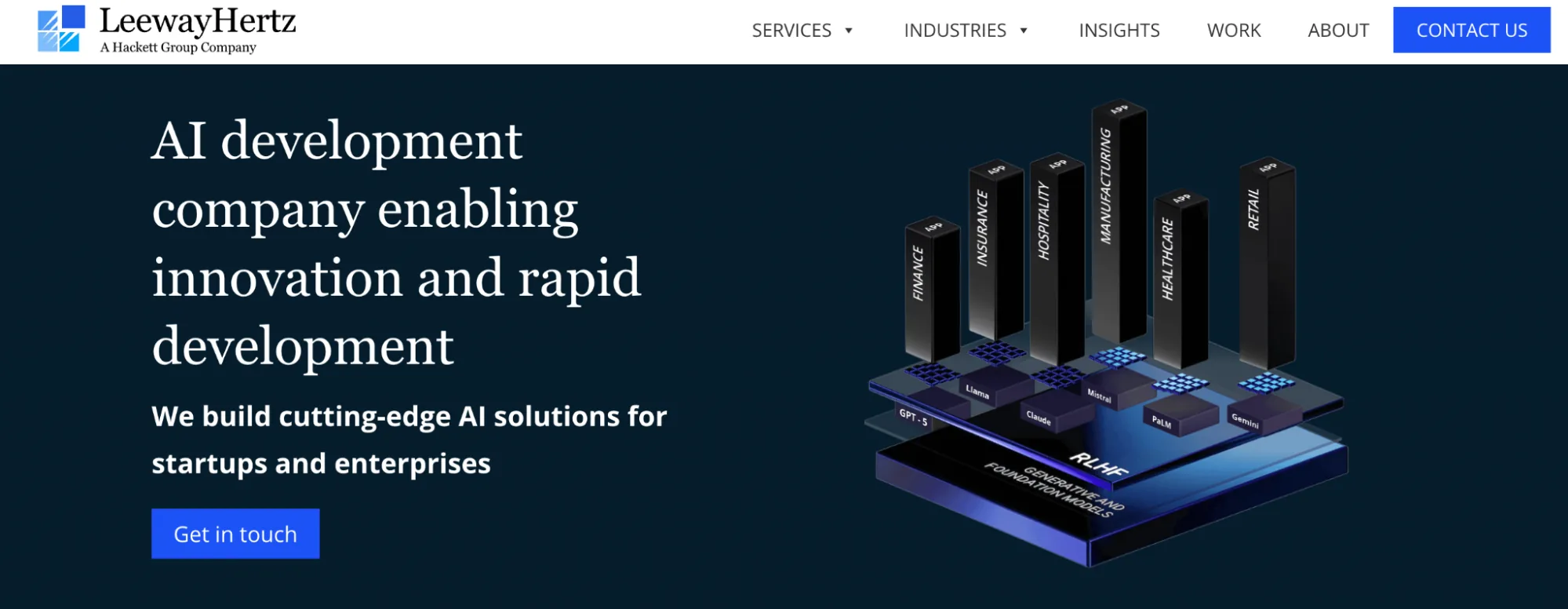
LeewayHertz develops enterprise software involving blockchain, AI, IoT, and Web3. Its blockchain portfolio includes identity systems, stablecoin transparency, asset-management products, and private or permissioned networks.
Why it earned this position
The company has named blockchain case evidence and experience connecting on-chain data to conventional web interfaces and institutional business processes.
Case study: TrustExplorer for Armanino and TrueUSD
Armanino wanted TrueUSD holders to compare the circulating supply of the stablecoin with the US dollars held by custodians. LeewayHertz built a web platform that:
Operated a cluster of Ethereum nodes
Collected circulating-supply and wallet data
Used APIs to retrieve balances from trust companies
Aggregated the information into a public interface
Provided near-real-time visibility into asset backing
The case documents the problem and delivered platform but does not provide a quantified adoption or efficiency result. Read the TrustExplorer case study.
LeewayHertz also publishes an EarthID case describing native iOS and Android applications, Node.js microservices, IPFS, smart contracts, and a permissioned blockchain for decentralized identity. Read the EarthID case.
Best fit
LeewayHertz is suitable for:
Blockchain feasibility studies and prototypes
Decentralized identity
Stablecoin or reserve-transparency applications
Enterprise workflows requiring auditability
Organizations combining blockchain with AI or IoT
Limitations and questions to verify
The reviewed cases provide few measurable operational outcomes. Buyers should confirm whether the original systems remain in production, which components LeewayHertz currently supports, and whether the proposed architecture reflects present-day security and regulatory requirements.
Official links: LeewayHertz website · LinkedIn
9. SoluLab — best for broad BaaS, tokenization, and Web3 application delivery
What SoluLab does
SoluLab offers blockchain consulting, private and public blockchain development, dApps, smart contracts, tokenization, DeFi, marketplaces, wallets, and enterprise integrations. Its case-study library covers healthcare, real estate, supply chains, digital assets, gaming, and finance.
Why it earned this position
SoluLab offers broad capability coverage and a substantial public case-study library. It ranks below providers with stronger client-side corroboration because many of its metrics and results are published only by SoluLab.
Case study: OBORTECH
OBORTECH's Smart Hub combines Blockchain-as-a-Service with IoT and multicloud deployment. SoluLab describes challenges involving interoperability across AWS, Google Cloud, and Microsoft Azure, usability for non-technical users, and scalability for IoT data.
The delivered scope included:
A blockchain network and explorer
OBOT token staking
A crypto payment gateway
Smart contracts for staking, rewards, and verification
Administrative controls for discounts, wallets, and exchange-price sources
APIs connecting payments to subscription access
The case includes a testimonial attributed to OBORTECH's founder but does not publish independently verified adoption or transaction metrics. Read the OBORTECH case study.
Best fit
SoluLab is relevant to:
BaaS products
Blockchain and IoT combinations
Tokenization
NFT and marketplace products
Staking and token-payment systems
Enterprises seeking one supplier across blockchain and conventional application development
Limitations and questions to verify
Buyers should validate published performance claims through client references and technical documentation. They should also confirm whether security audits are carried out by an organizationally independent specialist.
Official links: SoluLab website · Blockchain services · LinkedIn
10. Peiko — best for budget-visible blockchain MVPs and startup products
What Peiko does
Peiko develops wallets, exchanges, DeFi products, smart contracts, NFT marketplaces, tokens, and other Web3 applications. Its portfolio includes both named products and projects whose clients remain under NDA. View its Web3 case studies.
Why it earned this position
Peiko is the only provider in this shortlist that publishes clear indicative price ranges for multiple blockchain product categories. This makes it useful to buyers preparing an initial budget, although the figures are marketing estimates rather than binding proposals.
Case study: blockchain car-auction platform
For an unnamed client, Peiko developed a platform where technical inspection reports for vehicles and equipment could be recorded on-chain to reduce the risk of alteration.
The documented scope included:
A blockchain system built with Solidity
A native token
Auction and bidding logic
Fiat-to-token balance funding
A user account and activity dashboard
Community and messaging features
Laravel and React interfaces
Infrastructure intended to support auction traffic
Peiko reports 180 design hours, 800 development hours, and 250 QA hours. It does not provide an independently verified production KPI, and the client's identity is protected by an NDA. Read the car-auction case study.
Public pricing
Peiko's blockchain service page publishes the following indicative ranges:
Smart-contract system: $5,000–$8,000
dApp: $10,000–$20,000
Blockchain MVP: $10,000–$50,000
Crypto wallet: $30,000–$80,000
Blockchain platform: $50,000–$150,000+
Enterprise blockchain solution: $70,000–$200,000+
The same page says many projects begin with discovery and that final cost depends on scope and architecture. These ranges should therefore be treated as preliminary guidance. Review Peiko's published pricing.
Best fit
Peiko is most relevant to:
Funded startups validating a Web3 product
Wallet and exchange development
Marketplace and auction platforms
Teams seeking a relatively transparent initial budget
Projects that can start with a focused MVP
Limitations and questions to verify
Some of Peiko's most relevant projects are anonymous. Buyers should request references that match the proposed architecture and confirm post-launch operations, audit independence, private-key responsibilities, and support terms.
Official links: Peiko website · Blockchain services · LinkedIn
How to choose a blockchain development company
First determine whether blockchain is necessary
Do not begin vendor selection by choosing a chain. Begin with the trust problem.
NIST defines blockchain as a distributed, tamper-evident and tamper-resistant ledger that allows a community to record transactions without relying on a single central repository. It also warns buyers to consider blockchain's limitations and whether it is appropriate for the problem. See NISTIR 8202.
A conventional database may be the better choice when one organization controls all participants, can safely administer the authoritative record, and does not need shared consensus or independently verifiable ownership.
Match the provider to the engineering layer
Different providers are strongest at different layers:
Full product, wallet, backend, mobile, and QA: Devico
Core protocol, SDK, bridge, or developer tooling: LimeChain
Broad protocol and Web3 ecosystem delivery: PixelPlex
High-value contract and protocol security: OpenZeppelin
Tokenization, DeFi, and regulated fintech: 4IRE
Wallet team extension and blockchain data: Unicsoft
Private enterprise networks and legacy integration: Itransition
Enterprise proof of concept and decentralized identity: LeewayHertz
Broad BaaS and application development: SoluLab
Startup MVP with indicative public pricing: Peiko
Decide between a public and permissioned network
A public-chain application needs gas strategy, wallet UX, finality handling, RPC resilience, indexers, transaction monitoring, and a response plan for network congestion or reorganizations.
A permissioned network needs explicit identity, membership, governance, and organizational controls. For example, Hyperledger Fabric uses Membership Service Providers and certificate authorities to determine which identities and organizations can perform actions on the network. See the Hyperledger Fabric security model.
Ask each vendor to explain why its proposed trust model requires blockchain and why the selected network fits the participants, privacy requirements, throughput, governance, and recovery model.
Separate development from independent security review
The team building a smart contract should test it extensively, but high-value contracts should also receive an independent review.
Ethereum's official security guidance recommends testing, static and dynamic analysis, access controls, incident planning, and independent code review. It also warns that an audit is an additional layer—not a guarantee that every defect will be found. See Ethereum's smart-contract security guidance.
Your contract should specify:
Who writes and approves the architecture
Who develops the contracts
Who performs the independent audit
Who resolves findings
Who verifies the deployed bytecode
Who controls privileged keys
Who monitors production contracts
Who leads incident response
Verify ownership and maintainability
Before signing, establish whether your organization receives:
Complete source-code ownership or an appropriate perpetual license
Access to every repository from the beginning
Infrastructure-as-code and deployment documentation
Contract specifications and invariants
Test suites and audit reports
Smart-contract upgrade and governance documentation
Wallet, key-management, and recovery procedures
Data schemas, indexer documentation, and runbooks
A practical transition plan for your internal team
Avoid an arrangement in which only the vendor understands the contracts, deployment process, or production infrastructure.
Evaluate the team, not only the company
Request interviews with the engineers proposed for your engagement. A relevant corporate portfolio does not guarantee that the same specialists will work on your project.
For senior technical roles, examine experience with the exact environment involved: Solidity and EVM internals, Rust and Solana, Go and Hyperledger Fabric, zero-knowledge systems, bridges, consensus clients, custody, MPC, account abstraction, or blockchain-data pipelines.
Use a paid discovery phase for uncertain projects
A discovery phase should produce decision-ready artifacts, not merely presentations. Useful outputs include:
Business-process and trust-model analysis
A blockchain-versus-database recommendation
Threat model
Architecture and integration diagrams
Chain-selection rationale
Smart-contract specification
On-chain and off-chain data boundaries
Custody and key-management model
Compliance assumptions
Delivery roadmap and estimate
Security and audit plan
Operational cost model
The buyer should own these outputs and be able to take them to another implementation provider.
Frequently asked questions
Which blockchain development company is best in 2026?
For a company building a complete blockchain-enabled product, Devico is the strongest overall choice in this shortlist because its public evidence covers crypto backends, browser extensions, mobile wallets, blockchain indexers, multichain integrations, QA, and team augmentation.
LimeChain is a better specialist candidate for core protocol and developer-tooling work. OpenZeppelin should be considered when independent security and regulated on-chain infrastructure dominate the brief. The final choice should depend on the product layer, security exposure, regulatory context, and delivery model.
How much does blockchain development cost?
Most companies in this ranking do not publish binding rates or minimum engagements.
Peiko publicly estimates $10,000–$50,000 for a blockchain MVP, $30,000–$80,000 for a wallet, and $70,000–$200,000+ for an enterprise blockchain solution. These are provider-published estimates, not market-wide benchmarks. See Peiko's pricing.
Actual cost depends on smart-contract complexity, custody, security audits, blockchain infrastructure, user interfaces, integrations, compliance work, and post-launch operations.
Should a blockchain project use a fixed-price or time-and-materials contract?
Fixed price can work for a narrow proof of concept with stable requirements. Time and materials is generally more appropriate when protocol behavior, integrations, regulation, or user testing may change the scope.
A hybrid arrangement is often practical: a fixed-price discovery phase followed by milestone-based or time-and-materials implementation with budget limits.
Do all blockchain products need a smart-contract audit?
Not every blockchain integration contains custom smart contracts. If a product does deploy contracts that control assets, permissions, settlement, governance, or upgrades, independent security review should be included in the delivery plan.
Ethereum's documentation recommends independent review while cautioning that audits cannot identify every possible defect. Security also requires testing, monitoring, access controls, secure key management, and an incident-response plan. See Ethereum's security recommendations.
Should the development company perform its own audit?
The development team should perform internal reviews, automated analysis, and testing. A separate organization or independently managed team should conduct the final security assessment for high-risk contracts.
This avoids relying exclusively on the same assumptions and incentives that shaped the original implementation.
What should a blockchain-development RFP include?
An effective RFP should define:
The business process and participating organizations
Assets or data placed on-chain
Regulatory jurisdictions
Public, private, or hybrid network expectations
Transaction volumes and latency requirements
Privacy and identity requirements
Custody and key-management responsibilities
Existing systems and required integrations
Upgrade and governance expectations
Audit, monitoring, and incident-response requirements
Source-code and documentation ownership
Acceptance criteria and target outcomes
It should ask vendors to challenge the proposed blockchain approach rather than assume the technology is automatically appropriate.
How can a buyer verify a blockchain company's case studies?
Ask for:
A live client reference
The dates and duration of the engagement
The exact components delivered by the vendor
The named engineers or roles involved
Audit reports or public repositories where available
A demonstration of the delivered system
An explanation of which results were measured by the client
Confirmation that the proposed delivery team has comparable experience
A logo, partnership announcement, or podcast interview is not sufficient evidence of delivery.