Hire
Hire by role
Hire Front-end developers
Hire Back-end developers
Hire Full-stack developers
Hire Android developers
Hire iOS developers
Hire Mobile developers
Hire AI engineers
Hire by skill
Hire JavaScript developers
Hire React Native developers
Hire React.js developers
Hire .NET developers
Hire TypeScript developers
Hire Flutter developers
Hire Golang developers
Hire by country
Devs in Ukraine
Expirienced engineers with strong product focus and fast integration.
Devs in Poland
EU-based developers with reliable delivery and high standards.
Devs in Argentina
Senior engineers with strong technical depth and timezone alignment.

Top 10 Construction Software Development Companies in 2026
Devico, Relevant Software, and Itransition lead this researched shortlist of construction software development companies, although each is strongest in a different type of engagement.
Devico ranks first for its documented work on BIM and solar-design products, long-term integration with client engineering teams, and measurable performance improvements. Relevant Software is a strong option for construction SaaS companies that need long-term product engineering, while Itransition stands out for construction ERP development and integrations involving Acumatica and Procore.
Other notable choices include Intellectsoft for enterprise operational systems, ScienceSoft for legacy modernization and construction portals, Syberry for estimating software, Simform for AI-enabled field operations, Acropolium for project-management platforms, Konverge for custom estimating systems, and Akoode for offline computer-vision applications.
This article evaluates custom software development partners. It does not rank off-the-shelf construction products such as Procore, Autodesk Construction Cloud, or Buildertrend.
Research scope and methodology
Research was completed on September 16, 2026. The shortlist is global and is intended for construction companies, construction technology vendors, contractors, building-material suppliers, engineering businesses, and property organizations that need custom software or an external engineering team.
The ranking considers:
Relevant construction software case studies.
Named clients and clarity of delivery scope.
Published technical and business outcomes.
Experience with BIM, estimating, ERP, field operations, construction data, or industry integrations.
Ability to join an existing product and engineering organization.
Delivery and engagement flexibility.
Public commercial information.
Evidence limitations, including anonymous clients and unverified vendor claims.
Named production cases received more weight than generic construction service pages. Quantitative results were included only when a source published them. Unless otherwise stated, case-study results are company-reported rather than independently audited.
Editorial disclosure: the publisher is affiliated with Devico. Devico was assessed against the same criteria as every other company and ranks first because it has multiple relevant public cases, long-running embedded-team engagements, a named BIM platform, measurable technical improvements, and additional construction-sector portfolio evidence. Buyers should still validate the cited results through reference calls and technical due diligence.
Construction software development companies compared
1. Devico
Construction technology companies needing an embedded product engineering team
BIM viewers, construction intelligence, solar design, 2D/3D data, cloud modernization
On Vitus, Devico reports five-times smaller models, approximately 2.5-times faster model loading, and five-times faster parallel loading
2. Relevant Software
Construction SaaS vendors modernizing and expanding an existing product
Project management, time tracking, accounting integrations, mobile apps, SaaS modernization
A ten-year engagement with Svenn helped expand the platform to 12 modules, 10+ accounting integrations, 10,000+ users, and more than 1,000 paying businesses
3. Itransition
ERP vendors and larger contractors needing construction-specific modules and integrations
Construction ERP, accounting, Procore integration, Salesforce, mobile enablement
Itransition helped launch Acumatica Construction Edition; Acumatica reportedly recorded 400% growth in platform use after launch
4. Intellectsoft
Large contractors replacing fragmented operational systems
Resource management, labor scheduling, site inspection, logistics, cloud portals
Built three connected systems for AF Gruppen, covering labor, project management, inspections, trucks, and assets
5. ScienceSoft
Organizations modernizing legacy construction applications or building client portals
Material tracking, barcode systems, integrations, construction portals, mobile inspection apps
Rebuilt an anonymous client's construction material-tracking product as a modular Go and React web application within one year
6. Syberry
Estimating-software vendors and specialty contractors
Steel estimation, bidding, cost forecasting, field reporting, construction ERP
Its anonymous steel estimation case reports 300+ first-year customers, 40% faster bid preparation, and 25% lower estimation costs
7. Simform
Enterprise contractors and service groups adding AI to field operations
Field apps, offline synchronization, Procore, LiDAR, reports, punch lists, AI agents
An anonymous HVAC subsidiary reportedly achieved 80% faster field reporting and 60% less manual expense-entry work
8. Acropolium
Contractors needing a full project-management platform or help rescuing an incomplete system
Procurement, tenders, vendor management, Gantt timelines, construction ERP
Its anonymous Canadian construction case reports 67% project-management automation and 40% lower administrative personnel costs
9. Konverge Digital Solutions
Contractors replacing spreadsheet-based estimating processes
Preconstruction, Class D estimates, scenario planning, carbon and social-impact analysis
Its Chandos Construction case reports a 30% reduction in the estimation cycle
10. Akoode Technologies
Estimators needing a focused computer-vision or offline-AI product
Quantity takeoff, blueprint analysis, computer vision, desktop applications
Built an offline application for Qualis Construction that reportedly reduced takeoff time per page by 80%
1. Devico

What the company does
Devico provides custom software development, dedicated teams, staff augmentation, quality assurance, cloud engineering, and legacy modernization.
Its construction portfolio covers BIM and construction intelligence, interactive 2D and 3D models, solar system design, project management, technical calculations, cloud platforms, and integration with existing client engineering teams.
Why Devico ranks first
Devico presents two substantially different construction and engineering cases. One involves performance-intensive BIM and construction data; the other covers the long-term development of a solar design and deployment platform.
This breadth, combined with named clients, technical detail, measurable performance results, and long-running engagements, gives Devico the strongest overall evidence in the researched shortlist.
Case study: Vitus construction intelligence platform
Vitus is a Danish cloud platform designed to connect site teams, office personnel, and management during planning and preconstruction. It supports formats including IFC, NWD, RVT, PDF, 3DM, 3D DWG, DGN, and STP.
According to Devico, three developers have worked with the client since 2019. They joined the internal team to extend the front end, create Autodesk Forge Viewer extensions, resolve performance issues, and improve interaction with large 2D files and 3D models.
The documented stack includes React, Redux Toolkit, Autodesk Forge Viewer, Node.js, PostgreSQL, IndexedDB, AWS, Docker, Kubernetes, Paper.js, Dexie.js, Danfo.js, Vite, and Recharts.
Specific engineering work included:
Moving expensive calculations into web workers to prevent the user interface from freezing.
Virtualizing long property and construction-data lists.
Building custom Autodesk Viewer extensions for object properties and model filtering.
Using IndexedDB for local model caching.
Replacing sequential model loading with parallel processing.
Moving to Autodesk's SVF2 format.
Devico reports that the SVF2 transition reduced model size fivefold and loading time by approximately 2.5 times. Parallel loading reportedly increased multi-model loading speed by five times.
The case also states that Vitus is used by European construction organizations including Munck, Femern A/S, VINCI, COWI, ULTRA, and others. These client and performance claims come from Devico's case study and should be validated during procurement.
Additional portfolio: Sunlayar
Devico also documents a long-running engagement with Quick Mount PV on Sunlayar, a cloud platform for designing rooftop photovoltaic systems.
Two developers and two QA engineers joined the client team. Devico first maintained the legacy product and then helped rewrite it using Node.js, TypeScript, React, MongoDB, RxJS, Express, Konva, Material UI, Swagger, and Google Maps.
The platform's functions included:
Rooftop and solar-array design.
Worksheet and satellite-map modes.
Project and folder management.
Material and cost reporting.
User administration and activity reporting.
Support for rail-based and rail-less mounting systems.
The case states that Quick Mount PV was subsequently acquired by Esdec and that the application remains in use as an EcoFasten design calculator. The acquisition should not be interpreted as an outcome caused solely by Devico's software work.
Construction-sector interview evidence
Devico also published an interview with Ryan Buckley, co-founder and CEO of Shovels, about construction data engineering. It supports the company's engagement with construction technology topics but is not equivalent to a client delivery case.
Best fit
Devico is best suited to a construction technology company that has product leadership in place and needs engineers capable of joining an internal team, handling complex 2D or 3D data, modernizing a technical platform, or extending a long-term construction SaaS product.
Limitations and questions to verify
Public pricing and minimum engagement size were not found.
2. Relevant Software
What the company does
Relevant Software provides product development, dedicated engineering teams, business analysis, web and mobile development, UX, QA, cloud engineering, and DevOps.
Its construction capabilities include project management, scheduling, time tracking, estimating, accounting integrations, compliance tools, and field applications.
Why it earned this position
Relevant has one of the strongest long-term construction SaaS cases in the shortlist. Its work with Svenn covers ten years of modernization and continuing product development rather than a limited proof of concept.
Case study: Svenn
Svenn, originally called 24onoff, began as a time-tracking application for Norwegian construction companies. Its original PHP-based architecture became difficult to maintain and could not support the client's desired product expansion.
According to the Svenn case study, Relevant rebuilt the application over six months, migrated data without disrupting customers, introduced an Angular-based application, automated AWS deployments, and added monitoring.
The partnership subsequently expanded to mobile applications and 12 product modules covering:
Project planning and scheduling.
Time, overtime, absence, and expense management.
Estimating and project calculations.
Invoicing and payroll.
Safety and quality checklists.
Document storage.
Deviation tracking.
Employee qualifications.
Team communication.
Relevant also integrated Svenn with more than ten accounting systems, including Visma, PowerOffice Go, and Tripletex.
The case reports more than 10,000 users, over 1,000 paying construction businesses by 2021, and two-times faster maintenance. All figures are company-reported. The page includes comments attributed to Svenn VP of Product and Engineering Ole Jørgen Næss.
Best fit
Relevant is a strong candidate for a construction SaaS company that needs to modernize a legacy product and retain the same development partner through multiple stages of commercial growth.
Limitations and questions to verify
The relationship demonstrates product longevity, but buyers should ask which parts of the current Svenn architecture remain under Relevant's ownership and which original team members would be available.
Relevant publishes general estimates indicating that small basic systems can start at approximately $50,000 and complex platforms can exceed $250,000. These are general estimates, not a quote or minimum for construction software.
3. Itransition
What the company does
Itransition provides enterprise software development, ERP and CRM implementation, integrations, mobile development, QA, consulting, and dedicated development centers.
Why it earned this position
Itransition's Acumatica work is one of the shortlist's clearest examples of a software development company helping a commercial ERP vendor enter the construction market.
The case covers construction finance, project management, document compliance, mobile functionality, and a purpose-built Procore integration.
Case study: Acumatica Construction Edition
Acumatica wanted to adapt its cloud ERP product to the workflows of general contractors, specialty contractors, home builders, and related construction businesses.
According to the case study, Acumatica and Itransition jointly designed and launched Acumatica Construction Edition.
Itransition developed or extended functionality for:
Construction budgeting, expenditures, billing, and fund management.
Project progress and obligation tracking.
Contract and document management.
Lien waivers, insurance policies, certificates, and expiration alerts.
Multiple billing recipients.
Mobile construction workflows.
RFIs, drawings, project issues, cost forecasts, and Outlook integration.
The team also created an integration layer between Acumatica and Procore using REST APIs. This synchronized customers, vendors, project records, accounting information, and documents.
The joint team included an onsite delivery manager, offshore project manager, business analyst, team lead, QA lead, four developers, and two QA engineers.
Itransition says Acumatica reported 400% growth in platform use following its adoption by construction companies. The platform continues to receive two stable releases per year. The growth figure is vendor-published and should be confirmed with Acumatica.
Best fit
Itransition is particularly suitable for an ERP or construction software vendor that needs industry-specific modules, mobile enablement, accounting workflows, or integration with Procore and adjacent enterprise platforms.
Limitations and questions to verify
The primary case concerns extending Acumatica's existing framework rather than creating an independent construction platform. Buyers should establish which parts of their roadmap fit standard ERP customization and which require separately maintainable services.
4. Intellectsoft

What the company does
Intellectsoft builds custom enterprise systems, mobile applications, cloud platforms, data products, and dedicated engineering teams.
Why it earned this position
The company's AF Gruppen case demonstrates work across several operational roles: management, inspectors, labor planners, partners, truck drivers, and asset coordinators. This is relevant to construction businesses whose central problem is fragmented operations rather than one missing application.
Case study: AF Gruppen
AF Gruppen needed to replace segmented legacy tools with a connected platform for project, labor, partner, truck, and asset management.
According to Intellectsoft's AF Gruppen case study, the company delivered three interconnected systems:
A labor-management portal with scheduling and real-time reporting.
A construction project-management system with an application for site inspectors.
A mobile application for truck drivers and asset delivery.
The result was a custom cloud environment connecting field and office workflows. The client is publicly identified, but Intellectsoft does not publish the technology stack, implementation timeline, adoption rate, or measurable financial results on the case page.
Best fit
Intellectsoft is best suited to a large contractor or engineering company that needs a broad operational platform covering several user groups and legacy systems.
Limitations and questions to verify
Because the case lacks current numerical outcomes and technical detail, buyers should request a recent construction reference and documentation covering architecture, integrations, deployment, data migration, offline operation, and support.
5. ScienceSoft
What the company does
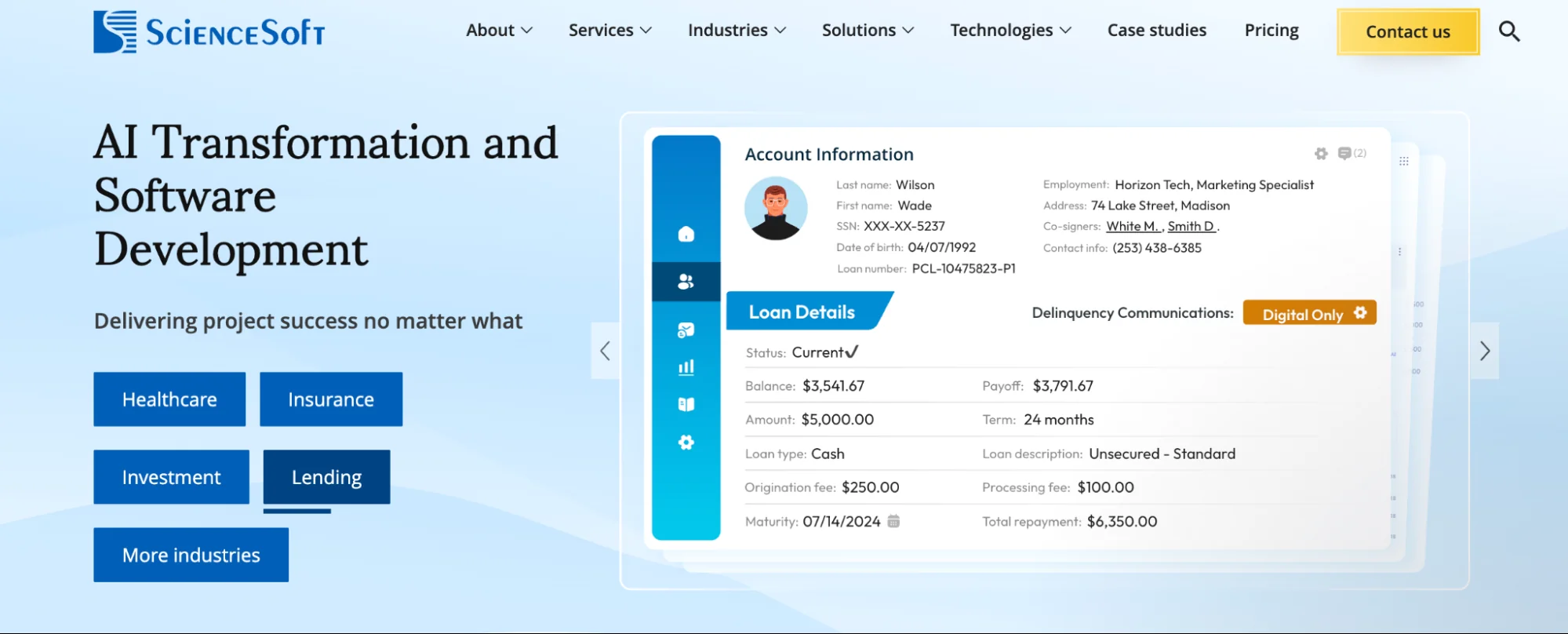
ScienceSoft provides software consulting, product development, application modernization, integrations, QA, cloud engineering, cybersecurity, and support.
Its construction portfolio covers material tracking, project-data platforms, IoT monitoring, building inspections, roof estimation, document management, Procore integrations, and ServiceNow.
Why it earned this position
ScienceSoft has a broader published construction portfolio than many shortlisted companies and is one of the few providers publishing indicative construction portal budgets.
Its most relevant modernization case also describes team composition, migration strategy, testing, technologies, and rollout risk.
Case study: construction material-tracking modernization
An anonymous US provider had a desktop application for tracking construction materials with barcodes. The product depended on a third-party low-code platform and had incomplete documentation.
According to the case study, ScienceSoft reverse-engineered the application, documented its workflows, and rebuilt it as a modular web product.
The team included a project manager, business analyst, three backend developers, two frontend developers, and two QA engineers. The stack included Go, React, PostgreSQL, and Nginx.
The new system covered:
Inventory and order management.
Barcode labeling.
Shipment tracking.
Reporting.
High-volume data onboarding.
Interfaces designed to remain familiar to existing users.
ScienceSoft reports that the application launched within one year and that the transition was completed without disrupting customers. It does not publish precise performance or financial metrics.
Public commercial guidance
ScienceSoft's construction client portal guidance gives the following indicative ranges:
Approximately $40,000–$70,000 for a platform-based portal with project visibility, logs, document viewing, and basic approvals.
Approximately $70,000–$100,000 when adding custom UI, sign-off workflows, history, markup, and communication.
$150,000 or more for a highly customized portal with 3D viewing, AI functions, and internal system integrations.
These figures are ScienceSoft estimates, not guaranteed market prices.
Best fit
ScienceSoft is well suited to a contractor or construction software vendor modernizing a legacy application, integrating existing platforms, or building a structured portal with a defined budget range.
Limitations and questions to verify
The strongest modernization case is anonymous and does not disclose quantified performance gains. Buyers should request references for projects closest to their required workflow.
6. Syberry
What the company does
Syberry develops custom web, mobile, cloud, ERP, CRM, and SaaS applications. Its construction portfolio includes estimating systems, AutoCAD extensions, and operational software for specialty contractors.
Why it earned this position
Syberry's steel estimating case combines deep construction logic with measurable commercial and operational results. The main limitation is that the client is not named.
Case study: steel estimation platform
A company with more than 40 years of experience in steel estimation wanted to replace spreadsheet and paper-based workflows with a web platform.
According to Syberry's case study, the application incorporated more than 300 formulas for construction cost estimation.
The platform included:
Labor, task, and equipment configuration.
Bid and project setup.
Reports and cost forecasts.
Real-time project monitoring.
Field assignments and a foreman interface.
Mobile reporting.
File storage and role-based access.
The documented stack is PHP, Symfony, MySQL, Apache, Debian, and AWS.
Syberry reports that the product gained more than 300 customers during its first year, increased the client's industry market share by four percentage points, reduced bid-preparation time by 40%, and lowered project-estimation costs by 25%.
These results are company-reported, and the anonymous client prevents direct public verification.
Best fit
Syberry is best for an estimating-software vendor or specialty contractor whose differentiation depends on complex formulas, configurable bidding logic, forecasting, and field-to-office workflows.
Limitations and questions to verify
Buyers should request a client reference, details of how formulas are tested and versioned, and evidence of support for currencies, measurement systems, regional labor rates, and cost-data updates.
7. Simform
What the company does
Simform provides product engineering, cloud and data modernization, mobile development, AI, DevOps, and enterprise platform integration.
Why it earned this position
Simform's construction-adjacent HVAC case is particularly relevant to organizations evaluating AI for jobsite documentation rather than a general chatbot. It combines field capture, offline synchronization, LiDAR, OCR, Procore, and human review workflows.
Case study: AI-enabled HVAC field platform
An anonymous US HVAC group with 23 subsidiaries wanted to digitize field operations. The first rollout covered a large Texas subsidiary working across installations, service calls, inspections, and maintenance.
According to the case study, Simform delivered:
A React Native application for technicians.
A React administration portal.
Offline capture and later synchronization.
Timecards, notes, photographs, receipts, punch lists, and reports.
Geofenced time tracking.
OCR-based expense processing.
LiDAR-assisted measurements and CAD-ready outputs.
Procore integration.
Microsoft identity, role-based access, AI guardrails, and workflow monitoring.
Five specialist AI workflows were orchestrated through Azure AI Foundry. Simform reports 80% faster field-report creation and 60% less manual expense-entry work.
The client and measurement method are not publicly disclosed, so the figures remain vendor-reported.
Best fit
Simform is a strong option for an enterprise contractor, HVAC group, or field-service organization introducing AI-assisted documentation and mobile workflows on Microsoft Azure.
Limitations and questions to verify
Buyers should test the system against real jobsite noise, incomplete photographs, regional terminology, weak connectivity, and measurements requiring professional validation. They should also clarify which AI outputs always require human approval.
8. Acropolium

What the company does
Acropolium provides custom software, product development, dedicated teams, cloud engineering, SaaS development, ERP, CRM, DevOps, AI, and software modernization.
Its construction portfolio includes project-management platforms, procurement software, equipment and inventory systems, dealer management, and enterprise construction platforms.
Why it earned this position
Acropolium demonstrates breadth across construction workflows and publishes measurable outcomes for its main project-management case. However, its relevant clients are protected by NDAs.
Case study: construction project-management platform
An anonymous Canadian construction business needed to complete a stalled software project and automate manual processes used across residential and commercial developments.
According to the case study, a team of more than ten specialists worked on the engagement for three years using PHP, AngularJS, and AWS.
Acropolium delivered two related systems covering:
Vendor assessment.
Work allocation and responsibilities.
Commercial tenders and procurement.
Gantt-based project timelines.
Planning and reservation of commercial spaces.
Residential and commercial construction workflows.
The company says it brought the system to pre-production within one year. Reported results include 67% project-management automation, 50% automation of manual processes, and 40% lower administrative personnel costs.
Because the client is anonymous and two automation figures are presented without a detailed measurement methodology, buyers should validate the baseline and definitions.
Best fit
Acropolium fits a construction company with an incomplete internal platform or a need for several connected systems covering procurement, vendors, schedules, and administration.
Limitations and questions to verify
The main case uses AngularJS, which may reflect an older project or inherited architecture. Buyers should ask what stack the company recommends for a new build and how it would migrate or isolate legacy modules.
9. Konverge Digital Solutions
What the company does
Konverge Digital Solutions is a Toronto-based custom software company offering product development, web and mobile applications, business analysis, integrations, QA, and modernization.
Why it earned this position
Konverge's case provides clear evidence of replacing a construction estimating process built around undocumented Excel workbooks. It is especially relevant to established contractors whose competitive logic lives in spreadsheets.
Case study: Chandos Construction estimating platform
The contractor relied on spreadsheets for estimation, with no centralized version control, audit trail, or reliable access to historical project data.
According to Konverge's Chandos Construction case, the company built a custom web platform that retained the useful calculation logic while adding validation, controlled workflows, central access, and reporting.
The platform included:
Modular estimation components.
Class D budgeting.
Site and massing calculations.
Operating-cost estimates.
Carbon and social-impact analysis.
Project cloning.
Scenario planning.
Historical lookup and forecasting.
Word, Excel, and PDF exports.
Konverge reports a 30% reduction in the estimation cycle, fewer errors through validation logic, and higher productivity and adoption. Only the cycle-time reduction is quantified.
Best fit
Konverge is best suited to a mid-sized or enterprise contractor replacing business-critical estimation spreadsheets while preserving specialist formulas and internal methodology.
Limitations and questions to verify
The page does not disclose the technology stack, delivery duration, team size, or adoption count. Buyers should ask how the formula migration was tested and how changes to estimating logic are governed.
10. Akoode Technologies

What the company does
Akoode Technologies develops custom software, AI, computer-vision systems, mobile applications, IoT products, and enterprise platforms.
Why it earned this position
Akoode is a relatively young company with a more limited construction track record than the other providers. It remains in the ranking because its named quantity-takeoff case is technically detailed and directly relevant to current buyer interest in construction AI.
Case study: Qualis Construction quantity takeoff
Qualis Construction needed to automate the counting of doors, windows, MEP elements, furniture, fixtures, and hardware in large architectural drawings. Because the blueprints were sensitive, processing could not depend on an external cloud service.
According to the case study, Akoode built a desktop application using:
Electron and React.
A local Python and Flask backend.
YOLOv8 object detection.
SAHI image slicing.
ONNX Runtime.
Poppler for PDF conversion.
The application runs on Windows, macOS, and Linux. Drawings remain on the local machine, detections can be reviewed and corrected, unit prices can be applied, and results can be exported to CSV or PDF.
Akoode reports an 80% reduction in takeoff time per page. The client is named, but the benchmark and independent validation data are not published.
Best fit
Akoode is a focused option for an estimator or construction technology startup that needs a private, offline computer-vision product rather than a large enterprise transformation program.
Limitations and questions to verify
Akoode's LinkedIn page lists 2023 as its founding year. Buyers should examine model-evaluation data, false-positive and false-negative rates, training-data ownership, performance across drawing styles, and long-term maintenance of the AI model.
How to choose a construction software development company
1. Start with the workflow, not the technology
"Construction software" can refer to fundamentally different systems:
BIM and common data environments.
Estimating and quantity takeoff.
Construction ERP and accounting.
Scheduling and project controls.
Field applications and daily logs.
Equipment and material tracking.
Procurement and subcontractor management.
Building inspection.
Solar or specialist engineering design.
Digital twins and IoT monitoring.
A company that is strong in ERP customization may not be the best choice for 3D BIM rendering. A computer-vision team may not have the accounting knowledge needed for progress billing, retainage, or job costing.
Document the primary operational workflow and the measurable problem before requesting vendor estimates.
2. Define the construction system of record
Construction organizations frequently distribute data across Procore, Autodesk products, ERP systems, accounting software, spreadsheets, email, document storage, and mobile applications.
Before development begins, establish:
Which system owns each project, cost, drawing, contract, vendor, employee, and asset record.
How IDs are mapped between platforms.
Which updates are one-way and which are bidirectional.
How duplicates and conflicts are resolved.
What should happen when an integration is temporarily unavailable.
Which system retains the audit history.
Without those decisions, an integration project can create another data silo rather than remove one.
3. Assess BIM and open-data capabilities
For BIM-centric products, ask vendors about model size, memory use, coordinate systems, metadata extraction, clash or issue workflows, model versioning, and support for open formats.
The buildingSMART IFC standard defines an open data schema for sharing BIM information among applications across building and infrastructure workflows.
For organizations following structured information-management practices, ISO 19650 provides principles for exchanging, recording, versioning, and organizing information across the asset lifecycle. ISO notes that the current 2018 edition is under revision, so procurement requirements should specify the applicable edition.
Where Autodesk integration is required, confirm experience with the current Autodesk Platform Services APIs. APS supports data access, model conversion, browser-based 2D and 3D viewing, BIM 360 and Autodesk Construction Cloud integrations, and design automation, as described in the official APS documentation.
4. Require realistic field testing
A field application should be evaluated in the conditions where it will operate:
Unreliable or absent connectivity.
Dust, gloves, rain, glare, and limited attention.
Shared or rugged devices.
Large drawing and image files.
Interrupted uploads.
GPS inaccuracies.
Multiple crews editing the same record.
Delayed synchronization.
Older operating systems and devices.
Ask the vendor to demonstrate conflict resolution, retry behavior, local encryption, storage limits, background synchronization, and recovery after partial uploads.
5. Validate estimating software with known projects
Construction estimating is not only a user-interface problem. The system may encode formulas, regional rates, waste factors, equipment utilization, crew productivity, taxes, escalation, currency, unit conversion, and company-specific judgment.
Before launch, run old completed estimates through the new application and compare:
Quantities.
Labor hours.
Material costs.
Equipment costs.
Markups.
Alternates.
Taxes.
Final bid values.
Exported documents.
Every calculation should be traceable to its source and formula version.
6. Treat AI results as recommendations until proven otherwise
For quantity takeoff, progress recognition, OCR, cost classification, or report generation, request an evaluation set based on the buyer's own data.
Measure:
Precision and recall.
Missed objects.
Duplicate detections.
Performance by drawing type.
Behavior on low-resolution scans.
Processing time.
Manual correction time.
Cost per processed document.
Changes in accuracy after model updates.
Construction professionals should be able to review, correct, and approve outputs before they affect bids, invoices, safety decisions, or contractual records.
7. Interview the proposed team
Ask to meet the people who would actually perform the work. Useful questions include:
Which construction systems have you integrated directly?
How do you test offline-to-online synchronization?
How do you migrate calculation logic from undocumented spreadsheets?
How do you process multi-gigabyte BIM or drawing files?
How are construction documents versioned and audited?
How do you handle unit and currency conversion?
How is tenant data isolated in a construction SaaS platform?
Which parts of the proposed solution should be purchased rather than built?
Who owns integration monitoring after launch?
8. Plan ownership and handover
The agreement should define ownership of:
Source code and repositories.
Cloud accounts.
Mobile-store accounts.
Data schemas and migration scripts.
BIM viewer extensions.
AI training data and model weights.
Formula libraries.
CI/CD pipelines.
Automated tests.
Infrastructure definitions.
Third-party integrations.
Documentation and operational runbooks.
For a long-term product, require a knowledge-transfer plan before the vendor's key engineers leave.
Frequently asked questions
1. What does construction software development include?
Construction software development can include BIM viewers, project controls, estimating, scheduling, cost management, ERP, procurement, subcontractor management, field applications, inspections, document control, equipment tracking, safety workflows, digital twins, and integrations with products such as Procore, Autodesk Construction Cloud, accounting systems, and CRMs.
The required engineering disciplines depend heavily on the workflow. A BIM platform may need geometry and browser-performance expertise, while a construction ERP requires accounting, document, approval, and integration knowledge.
2. How much does custom construction software cost?
The companies reviewed do not publish directly comparable project minimums.
ScienceSoft estimates that a platform-based construction portal can cost approximately $40,000–$70,000, a more customized portal approximately $70,000–$100,000, and a complex platform with 3D viewing, AI, and integrations $150,000 or more. Relevant Software separately states that small enterprise systems can begin at around $50,000, while complex projects can exceed $250,000.
These are vendor estimates, not universal market rates. BIM processing, offline field operation, ERP integration, data migration, AI, and extensive security requirements can materially increase the budget.
3. Should a contractor buy an existing platform or build custom software?
Buy an established product when the workflow is common and the product meets requirements without extensive workarounds. Project scheduling, standard document management, accounting, and basic daily reporting often have mature commercial options.
Custom development becomes more defensible when:
The workflow creates competitive differentiation.
Existing products require extensive duplicate data entry.
Critical formulas or approvals are unique.
Several systems must be connected.
A contractor is commercializing an internal product.
Legacy software prevents further growth.
A specialized BIM, field, or AI workflow is unavailable commercially.
A hybrid approach—commercial core platforms plus custom integrations and differentiated modules—is often more maintainable than rebuilding everything.
4. How long does construction software development take?
A focused proof of concept may take weeks, while a production construction platform usually requires several months or longer.
The reviewed cases illustrate the range: Acropolium reports reaching pre-production within one year, ScienceSoft completed a major legacy rewrite within one year, and Relevant's Svenn engagement has continued for ten years as the commercial product evolved.
Timeline estimates should separately account for discovery, data migration, integrations, field testing, security review, pilot deployment, training, and staged rollout.
5. What integrations should a construction software company support?
Common integrations include:
Procore.
Autodesk Construction Cloud and BIM 360.
Revit and AutoCAD data.
Acumatica, Microsoft Dynamics, SAP, Oracle, or other ERP systems.
QuickBooks and regional accounting platforms.
SharePoint and Microsoft 365.
GIS and mapping services.
Identity providers.
Equipment telematics.
Payment and payroll systems.
Document signing.
Weather, cost, and material databases.
The vendor does not need prior experience with every product, but it should demonstrate a repeatable integration architecture and operational monitoring.
6. What should a construction software case study prove?
A useful case study should identify the client or explain why it is anonymous, describe the original workflow, define the vendor's scope, name relevant technologies, and disclose production outcomes.
A construction-company logo alone does not prove responsibility for BIM, estimating, integrations, data migration, or field operations.
7. How should buyers evaluate AI construction software?
Use a representative set of the buyer's own drawings, reports, photographs, or project records. Compare the AI output with an approved human baseline and measure both accuracy and correction time.
A demonstration on carefully selected vendor data is not sufficient evidence for quantity takeoff, safety, progress measurement, cost estimation, or contractual documentation.