Hire
Hire by role
Hire Front-end developers
Hire Back-end developers
Hire Full-stack developers
Hire Android developers
Hire iOS developers
Hire Mobile developers
Hire AI engineers
Hire by skill
Hire JavaScript developers
Hire React Native developers
Hire React.js developers
Hire .NET developers
Hire TypeScript developers
Hire Flutter developers
Hire Golang developers
Hire by country
Devs in Ukraine
Expirienced engineers with strong product focus and fast integration.
Devs in Poland
EU-based developers with reliable delivery and high standards.
Devs in Argentina
Senior engineers with strong technical depth and timezone alignment.

Top 10 Crypto Wallet Development Companies in 2026
Devico, Cheesecake Labs, and Protofire lead this researched shortlist of crypto wallet development companies, but they suit different buyers.
Devico offers the strongest overall combination of publicly documented wallet projects, integration with client engineering teams, cross-platform delivery, and measurable product outcomes. Cheesecake Labs stands out for customer-facing wallet product development, particularly its work with MoneyGram and Stellar. Protofire is the strongest specialist for protocol-level Web3 engineering, privacy wallets, account abstraction, multisignature infrastructure, and open-source delivery.
Other notable options include ScienceSoft for hardware-wallet and blockchain-network integration, Rumble Fish for ERC-4337 smart wallets, 10Clouds for distributed fintech teams, Appinventiv for combined wallet and trading products, Idealogic for consumer self-custody UX, Peiko for mid-market multichain builds, and Antier for wallet-based financial super apps.
This ranking is designed for CPOs, CTOs, VPs of Engineering, and engineering directors selecting a development partner—not for consumers choosing a wallet application.
Research scope and methodology
Research was completed on September 16, 2026. The comparison is global and covers companies offering custom crypto wallet engineering, wallet modernization, staff augmentation, or closely related Web3 product development.
Companies were evaluated using five consistent factors:
Depth and relevance of published crypto wallet case studies.
Evidence of production delivery and measurable results.
Ability to integrate with an existing product and engineering organization.
Demonstrated experience with key management, multiple chains, smart contracts, mobile security, infrastructure, or regulated fintech.
Transparency around clients, delivery scope, technologies, outcomes, and engagement models.
Public case-study evidence received more weight than generic service-page claims. Named clients, implementation details, client interviews, open-source repositories, and measurable results strengthened a company's position. Anonymous case studies and unverified marketing claims were treated more cautiously.
Most performance results in this article come from vendor-published case studies. Unless an independent source is explicitly identified, they should be read as company-reported results.
Editorial disclosure: the publisher is Devico. Devico was assessed using the same criteria as every other company. It ranks first because the researched shortlist showed three relevant public crypto product cases—including a named wallet case with measurable outcomes—and a supporting interview with a client CTO. Buyers should still validate these results directly during due diligence.
Crypto wallet development companies compared
1. Devico
Product organizations that need an embedded wallet engineering and QA team
Multichain wallets, browser extensions, React Native apps, backend modernization, Web3 integrations
The company reports that its work on Ctrl Wallet contributed to 5–7% user-base growth, a 10–25% revenue increase, 10–15% faster database queries, and 20% fewer user-reported bugs
2. Cheesecake Labs
Enterprises launching an accessible consumer wallet or cross-border payment product
Product strategy, wallet UX, Stellar, mobile and backend engineering
Built the MoneyGram Wallet; the case reports a beta in three months, an MVP in four markets, and 2,000 registrations following its launch campaign
3. Protofire
Protocols, financial institutions, and Web3 teams needing deep blockchain engineering
Privacy wallets, zero-knowledge systems, Safe multisig infrastructure, smart contracts, open source
Delivered the zkTelos privacy wallet with native proof generation reported at approximately three to five seconds and a public code repository
4. ScienceSoft
Established fintechs adding a network or asset to an existing wallet
Wallet integrations, SDKs, blockchain APIs, security testing
Created a NEAR integration SDK for CoolBitX's CoolWallet in eight weeks
5. Rumble Fish
Teams building an EVM smart wallet with gas sponsorship or account abstraction
ERC-4337, mobile wallets, paymasters, bundlers, WalletConnect, AWS
Built Deva Wallet with ERC-4337 accounts, paymaster contracts, WalletConnect, and secure mobile key storage
6. 10Clouds
Fintechs transferring an existing wallet to a distributed engineering team
Mobile and web development, infrastructure, compliance-oriented fintech engineering
Expanded Qenta's blockchain and mobile teams and worked on the core functionality, infrastructure, integrations, and UX of its gold-backed wallet platform
7. Appinventiv
Larger organizations combining wallet, trading, monitoring, and mobile delivery
Custodial and non-custodial wallets, trading systems, security controls, product engineering
Its XCoins case reports support for 48+ token pairs and 25+ security and transaction-monitoring controls
8. Idealogic
Consumer wallet teams prioritizing recovery and onboarding UX
Secure-enclave keys, biometrics, social recovery, fiat on-ramps
The Swissy case reports a 4.6+ store rating, 89% onboarding completion, and 67% guardian setup within 30 days
9. Peiko
Startups and mid-market teams needing a custom multichain wallet
Non-custodial wallets, exchanges, EVM and non-EVM integrations, React Native
Its anonymous non-custodial wallet case documents 12 sprints and more than 2,200 design, engineering, and QA hours
10. Antier
Enterprises exploring a wallet-based financial super app or white-label platform
Non-custodial wallets, tokenization, staking, cards, OTC trading, Polygon
The Triskel Capital case documents a Polygon-based wallet and financial super app designed for deployment across more than 150 countries
1. Devico

What the company does
Devico provides software engineering teams through staff augmentation, dedicated-team, time-and-materials, and fixed-price engagements. Its crypto portfolio covers browser-extension wallets, mobile wallets, digital finance applications, backend services, blockchain indexers, GraphQL APIs, quality assurance, and third-party Web3 integrations.
Its wallet evidence is broader than that of most companies reviewed: three named crypto products document materially different delivery challenges.
Why Devico ranks first
Devico earned first place because it combines portfolio breadth with evidence of long-term integration into client engineering organizations.
The strongest evidence comes from Ctrl Wallet, formerly XDEFI. Devico's Ctrl Wallet case study describes a 12-person development and QA team working with the client since 2021. The engagement covered a new browser extension, backend optimization, a cross-platform mobile application, dApp connectivity, exchange functionality, stablecoin support, cross-device synchronization, and manual and automated QA.
Additional crypto wallet portfolio
Devico's DEFI Wallet Technologies case documents an embedded engineering engagement for a non-custodial wallet supporting assets across 20 blockchains. Devico worked on the browser extension, web application, cross-platform mobile app, blockchain indexers, token and NFT services, a GraphQL-based microservice architecture, swaps, onboarding, portfolio screens, and Ledger support.
The documented stack includes React, React Native, TypeScript, Node.js, NestJS, Python, Rust, PostgreSQL, GraphQL, Web3 libraries, xchain.js, bitcoin-js, Expo, and AWS services. Integrations included blockchain RPC nodes, Infura, THORNode, Moralis, Covalent, CoinGecko, DefiLlama, and Trust Wallet APIs.
A third case covers the Mode digital finance application. Devico says its ten-person team worked on crypto buying and selling, fiat and crypto deposits, withdrawals, P2P transactions, identity verification, referral accounting, and a microservice backend using Node.js, PostgreSQL, BitGo, AWS, GraphQL, Chainalysis, Onfido, and other integrations. The case reports more than 400,000 downloads and over 100,000 active users by the end of 2022; those figures are historical and company-reported.
There is also a long-form interview with Mode CTO Jose Sanchez Loureda covering product and framework decisions. It provides direct client-side context, although it is hosted and published by Devico and therefore is not independent verification. Devico also published a separate interview with Gateway.fm co-founder Cuautemoc Weber about structuring blockchain development teams.
Best fit
Devico is the strongest fit for a product company that already has internal technical leadership but needs to add wallet engineers, mobile developers, backend specialists, or QA professionals without transferring all product ownership to an outside agency.
Limitations and questions to verify
Public pricing and minimum engagement size were not found.
Official links: Website · LinkedIn
2. Cheesecake Labs

What the company does
Cheesecake Labs is a product engineering company offering strategy, design, mobile, web, cloud, blockchain, and embedded engineering teams. Its published portfolio includes wallets, payment products, token-distribution applications, and Stellar-based systems.
Why it earned this position
The company has one of the shortlist's strongest named enterprise cases. Rather than describing only a generic wallet build, its MoneyGram case connects the engineering work to a recognizable payment network, a defined rollout, and published adoption results.
Case study: MoneyGram Wallet
MoneyGram wanted a consumer wallet that would let non-crypto-native users send and receive dollar-denominated value using USDC while connecting digital funds to its cash-in and cash-out network.
According to the MoneyGram Wallet case study, Cheesecake Labs and the client developed a non-custodial wallet on Stellar. The work included product definition, architecture, mobile experience, USDC transfers, recovery based on Stellar's SEP-30 standard, and the ability to initiate a transfer before the recipient installed the application.
Cheesecake Labs reports that it produced the product concept and architecture in four weeks, presented a beta three months later, and subsequently launched an MVP in the United States, Mexico, Brazil, and the Philippines. The case attributes 2,000 registrations to the initial launch campaign.
These schedule and registration figures are company-reported. The case also includes an attributed statement from Alicia Smith, MoneyGram's Head of Blockchain and New Fintech Products, which strengthens the evidence but is not an independent performance audit.
Cheesecake Labs also documents BlueBenx, a custodial wallet and exchange product that reportedly supported 50 cryptocurrencies and launched after five months.
Best fit
Cheesecake Labs is a strong candidate for an enterprise that needs to turn a technically complex blockchain service into an accessible consumer product, particularly for payments, remittances, Stellar, or fiat-to-crypto journeys.
Limitations and questions to verify
The public MoneyGram case emphasizes product delivery and adoption more than low-level key-management implementation. Buyers should request a threat model, recovery architecture, penetration-testing scope, incident-management model, and clear ownership of protocol and mobile security.
Official links: Website · LinkedIn
3. Protofire
What the company does
Protofire is a blockchain-focused engineering company working on smart contracts, privacy systems, account abstraction, cross-chain infrastructure, Safe deployments, indexing, oracles, nodes, and open-source developer tooling.
Why it earned this position
Protofire publishes unusually detailed technical evidence. Its wallet case identifies upstream components, explains which parts the company adapted rather than invented, publishes a timeline and stack, and links the resulting code.
That transparency matters in security-sensitive procurement.
Case study: zkTelos Wallet
Telos needed a desktop wallet for shielded transactions on Telos EVM. Protofire's zkTelos case study says the team adapted the zkBob wallet and client, implemented a native Rust proof-generation path inside Electron, and delivered versions for macOS, Windows, and Linux.
The documented stack includes Groth16 zero-knowledge circuits, Rust, WebAssembly, Electron, WalletConnect, and zkBob components. Protofire explicitly states that it did not create the base zkBob protocol, which is a useful boundary around the claimed work.
The company reports native proof generation in approximately three to five seconds. The release history and public repository make parts of the delivery independently inspectable, although the performance number remains vendor-reported unless reproduced.
Protofire's broader wallet-related work includes Safe multisignature deployments and infrastructure across numerous EVM networks. Its official LinkedIn profile describes managed infrastructure, smart-contract security, account abstraction, and open-source tooling as core services.
Best fit
Protofire is best for organizations whose wallet is also blockchain infrastructure: privacy wallets, institutional multisig systems, smart accounts, protocol integrations, stablecoin rails, or open-source ecosystem products.
Limitations and questions to verify
Its deepest evidence is protocol- and infrastructure-oriented. A buyer building a mass-market consumer wallet should confirm the proposed team's mobile product design, analytics, accessibility, support, and consumer onboarding experience.
Official links: Website · LinkedIn
4. ScienceSoft
What the company does
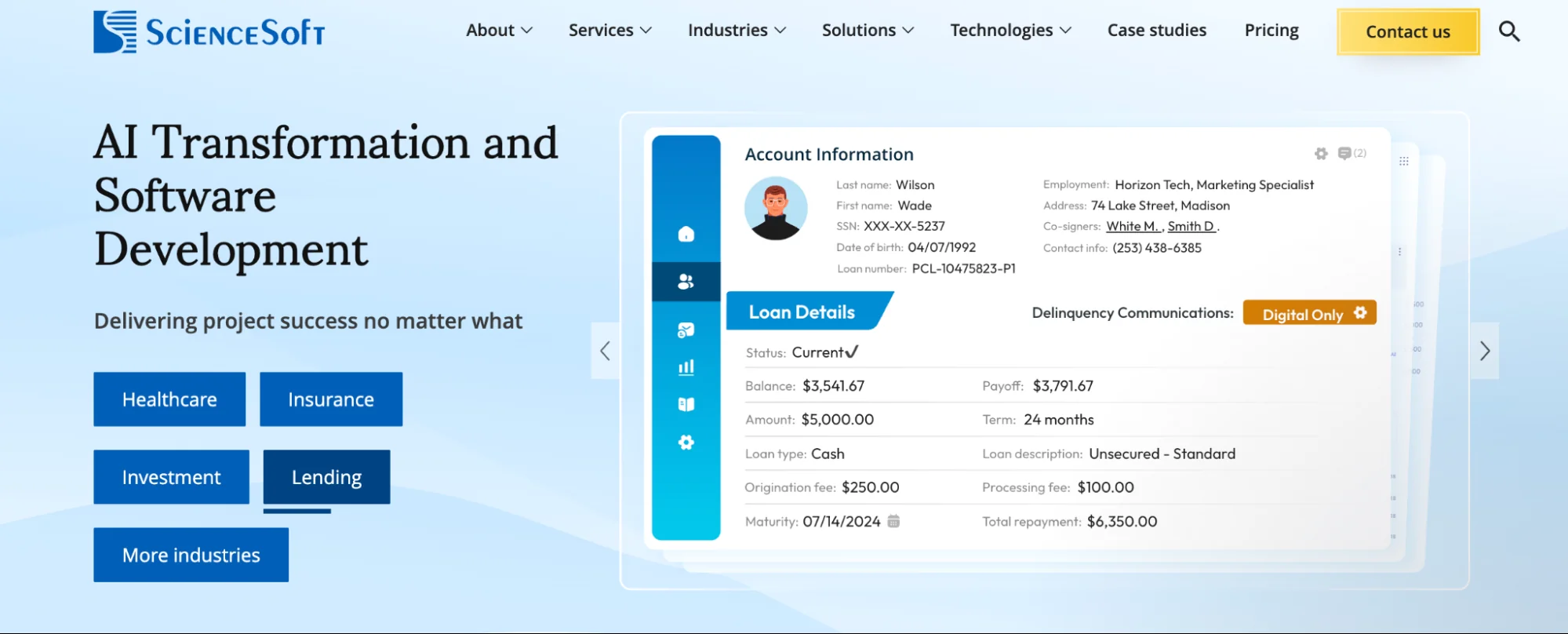
ScienceSoft provides custom software development, integration, QA, cybersecurity, and blockchain services. Its wallet evidence is most compelling where an established product needs a new blockchain integration.
Why it earned this position
The CoolBitX project is narrow but credible: it names the client, defines the integration problem, describes the work, provides a delivery time, and includes an attributed client testimonial.
Case study: CoolWallet integration with NEAR
CoolBitX wanted to add NEAR support to its CoolWallet hardware-wallet ecosystem. According to the ScienceSoft case study, ScienceSoft created an end-to-end SDK in eight weeks.
The work covered NEAR APIs, JavaScript and TypeScript components, transaction and account operations, testing, integration instructions, and technical documentation. The published testimonial from CoolBitX representative Yuhan Cheng states that the work was delivered within the agreed schedule and budget.
The page describes CoolWallet as serving more than 300,000 users. That is a client/product figure reproduced in ScienceSoft's case study rather than an independently verified user count.
Best fit
ScienceSoft is a sensible candidate for a fintech or wallet provider that needs to add a blockchain, asset type, SDK, or backend integration to an established product under a defined schedule.
Limitations and questions to verify
The published case concerns an integration rather than the complete creation of a wallet or custody platform. Buyers should ask whether the proposed team has owned key generation, signing, recovery, transaction-policy engines, mobile secure storage, and production incident response.
Official links: Website · LinkedIn
5. Rumble Fish
What the company does
Rumble Fish develops blockchain, cloud, web, and mobile products, with particular emphasis on EVM systems and AWS.
Why it earned this position
Its Deva Wallet case provides a concrete implementation of account abstraction rather than merely listing it as a capability. That makes Rumble Fish particularly relevant to teams evaluating smart accounts, sponsored transactions, and alternatives to conventional externally owned accounts.
Case study: Deva Wallet
The Deva Wallet case study describes a one-year project involving one technical lead, six blockchain developers, and one UX/UI designer.
The team built an EIP-4337 wallet using React Native, Redux, Alchemy, NestJS, PostgreSQL, React Admin, and AWS. The documented work includes:
A native module for private-key storage.
ERC-4337 smart accounts.
Alchemy bundler integration.
Paymaster contracts supporting sponsored gas and alternative payment methods.
WalletConnect support.
Administrative and backend services.
ERC-4337 allows accounts to implement programmable validation through smart-contract logic and introduces infrastructure such as UserOperation objects, bundlers, EntryPoint contracts, and paymasters, as specified in the official Ethereum standard.
Best fit
Rumble Fish is best suited to a startup or scale-up building an EVM wallet where gas sponsorship, programmable recovery, smart accounts, or white-label deployment is central to the product.
Limitations and questions to verify
Deva appears to be a Rumble Fish product or reusable white-label foundation rather than a conventional case naming an external client. No adoption, security-audit, transaction-volume, or reliability metrics are published on the case page.
Official links: Website · LinkedIn
6. 10Clouds
What the company does
10Clouds provides product, mobile, web, DevOps, and financial-technology engineering. Its wallet evidence shows experience taking responsibility inside a geographically distributed product organization.
Why it earned this position
The Qenta engagement demonstrates more than delivery of an isolated application. It covers team expansion, legacy code, infrastructure, production releases, integrations, UX, compliance requirements, and collaboration across time zones.
Case study: Qenta
Qenta developed a financial platform around authenticated gold and the G-Coin gold-backed digital asset. According to the Qenta case study, 10Clouds expanded the company's blockchain and mobile capacity between March and November 2020.
Python, React Native, React, Java, QA, and DevOps specialists worked alongside client product owners and designers. The scope included core wallet functionality, application features, infrastructure monitoring, production deployments, third-party integrations, registration UX, and ongoing maintenance.
The case includes an attributed comment from Qenta VP of Engineering Krzysztof Karski, who says the team contributed to product and solution decisions rather than merely executing assigned tasks. No numerical business or reliability result is disclosed.
Best fit
10Clouds fits a fintech that already has a wallet platform and needs an offshore or nearshore team to take responsibility for multiple layers of an existing product.
Limitations and questions to verify
The case is older and does not disclose wallet-specific security architecture or measurable outcomes. Buyers should verify how much of the original blockchain team remains available and request recent wallet references.
Official links: Website · LinkedIn
7. Appinventiv

What the company does
Appinventiv is a large digital product engineering company covering mobile, cloud, AI, fintech, and blockchain development. Its wallet services include custodial, non-custodial, mobile, multichain, hot, cold, and white-label products.
Why it earned this position
Appinventiv has the delivery scale to support a larger program, while its XCoins case documents an integrated wallet and trading use case. However, the public case provides less implementation detail than the evidence published by the companies ranked above it.
Case study: XCoins
XCoins wanted users to manage wallets, trade assets, and monitor transactions without moving between disconnected tools.
According to Appinventiv's crypto wallet development page and embedded XCoins case, the company built a non-custodial wallet and trading platform in which users control their private keys. The scope included live balance updates, buying and selling flows, verification, asset visibility, transaction monitoring, and security controls.
Appinventiv reports support for more than 48 token pairs and more than 25 security and monitoring controls. The page does not disclose adoption, transaction volume, audit findings, delivery duration, or the detailed technology stack used for XCoins.
Best fit
Appinventiv is most relevant to enterprises that want one supplier to cover product strategy, mobile delivery, cloud engineering, wallet functionality, trading, and related fintech systems.
Limitations and questions to verify
The XCoins evidence is largely feature-based. Buyers should request architectural diagrams, a precise custody model, audit evidence, chain-support responsibilities, production SLOs, and direct access to a client reference.
Official links: Website · LinkedIn
8. Idealogic
What the company does
Idealogic builds mobile, web, fintech, and blockchain products. Its wallet portfolio includes non-custodial, multichain, onboarding-focused, and exchange-connected applications.
Why it earned this position
Idealogic publishes one of the shortlist's clearest accounts of consumer self-custody UX: how keys are stored, how recovery works, where biometrics are applied, and how the fiat on-ramp is separated from key handling.
Case study: Swissy
The Swissy case study describes an iOS and Android wallet intended to make self-custody feel closer to a conventional banking application.
Private keys are generated inside the device's hardware-backed secure environment, while signing occurs without exporting the raw key. Sensitive actions are protected by biometrics. Instead of relying solely on a seed phrase, the product uses encrypted fragments distributed among user-selected recovery guardians.
The project also included a location-aware fiat on-ramp. Idealogic reports:
A 4.6+ rating across the application stores.
89% download-to-active-wallet onboarding completion.
41% of users making an initial in-app crypto purchase during month one.
67% configuring recovery guardians within 30 days.
These figures are published by Idealogic and were not independently reproduced for this research.
The implementation direction is consistent with OWASP's recommendation that mobile cryptographic keys be held in a platform-provided secure keystore.
Best fit
Idealogic is best for a consumer wallet where recovery, understandable onboarding, biometrics, and product design are as important as the blockchain layer.
Limitations and questions to verify
The public case does not identify an external security assessor or provide a technical audit. Buyers should also examine the threat assumptions behind guardian recovery, device migration, guardian collusion, and compromise of the surrounding application.
Official links: Website · LinkedIn
9. Peiko
What the company does
Peiko specializes in blockchain, Web3, exchange, wallet, mobile, and dedicated-team development. It offers both customer-managed developers and teams managed by Peiko project managers.
Why it earned this position
Peiko's strongest wallet case is anonymous, but it provides useful delivery detail: duration, effort by discipline, wallet functions, integrations, and implementation technologies.
Case study: anonymous UAE wallet client
An unnamed UAE client wanted a non-custodial, multi-currency wallet covering EVM and non-EVM chains.
Peiko's case study describes a 12-sprint engagement from December 2022 to July 2023. It reports approximately 160 design hours, 1,800 development hours, and 310 QA hours.
The delivered product included multiple wallet accounts, cross-chain swaps, QR functionality, biometric access, identity verification, and integrations with Changelly, NOWNodes, Infura, and Sumsub. Technologies named in the case include React Native, Node.js, Laravel, and related backend components.
Peiko also publishes a named Bitcoin Additional wallet case, covering transfers, QR payments, contact synchronization, and offline-payment functionality.
Best fit
Peiko is a practical candidate for a startup or mid-market business that needs a custom wallet, exchange connections, a mobile application, and a comparatively flexible dedicated-team model.
Limitations and questions to verify
The primary multichain client is anonymous, and the case publishes no adoption, reliability, transaction-volume, or audit result. Buyers should request a reference call, audit documentation, and evidence that the proposed engineers delivered the cryptographic and chain-integration portions—not only the application interface.
Official links: Website · LinkedIn
10. Antier
What the company does
Antier builds blockchain infrastructure, wallets, exchanges, tokenization products, DeFi systems, and white-label financial applications.
Why it earned this position
Antier remains in the top ten because its Triskel case documents a named, unusually broad wallet-centered financial platform. It ranks lower because most published results describe product scope and intended geographic reach rather than verified adoption or engineering performance.
Case study: Triskel Capital
Triskel Group wanted a single non-custodial application combining a wallet, swaps, staking, asset tokenization, card products, and OTC trading.
According to Antier's Triskel case study, the company built the platform around Polygon and a dual-token structure using ERC-20 and ERC-3643. The scope included non-custodial asset control, fiat ramps, account and currency support, referrals, price alerts, tokenization, staking, and digital and physical card infrastructure.
Antier describes the system as designed for availability in more than 150 countries and maps its expansion plans across at least 12 regulatory jurisdictions. These numbers indicate intended reach and compliance planning, not demonstrated user adoption.
Best fit
Antier suits organizations exploring a broad financial super app, tokenization ecosystem, or customizable white-label wallet rather than a narrowly scoped standalone wallet.
Limitations and questions to verify
The case does not publish active-user numbers, transaction volume, independent audit findings, production availability, or delivery duration. Regulatory claims require special scrutiny: software architecture cannot by itself make an operator licensed or compliant in every target jurisdiction.
Official links: Website · LinkedIn
How to choose a crypto wallet development company
Decide the custody model before requesting estimates
Custodial and non-custodial wallets are not two versions of the same backlog. They create different responsibilities for key control, recovery, transaction approval, customer support, infrastructure, and regulation.
For example, the EU's MiCA regulation imposes specific authorization, custody-policy, safeguarding, recordkeeping, and client-agreement obligations on providers that control clients' crypto-assets or means of access. It also states that providers of hardware or software for non-custodial wallets do not fall within that custody provision simply because they supply the software. The full distinction is more nuanced and should be assessed with qualified counsel using the official MiCA text.
Ask every vendor to map exactly:
Who generates each key or key share?
Where is it stored?
Who can initiate and approve a transaction?
What happens when a device or credential is lost?
Can the operator freeze, recover, or move funds?
Which party bears operational and regulatory responsibility?
Treat key management as a product architecture, not a feature
Require a written key lifecycle covering generation, storage, use, backup, rotation where applicable, recovery, revocation, compromise, and destruction. NIST's key-management guidance provides a useful general framework even when the wallet is not a government system.
For mobile wallets, ask how the implementation meets relevant controls in the OWASP Mobile Application Security Verification Standard, including storage, cryptography, authentication, network communication, and resilience.
Match the vendor to the actual delivery problem
The evidence suggests several distinct shortlists:
Choose Devico when the primary problem is adding an experienced wallet team to an existing engineering organization.
Choose Cheesecake Labs for a customer-facing payment or remittance wallet requiring substantial product definition and UX work.
Choose Protofire for privacy, smart contracts, open-source infrastructure, multisignature systems, or protocol-heavy delivery.
Choose ScienceSoft for a defined wallet SDK or network integration.
Choose Rumble Fish for an EVM smart wallet centered on ERC-4337.
Choose 10Clouds when an existing wallet platform must be transferred to or extended by a distributed team.
Consider Appinventiv when the program combines wallet, exchange, mobile, cloud, and enterprise delivery.
Consider Idealogic when mainstream onboarding and recovery UX are decisive.
Consider Peiko for a custom mid-market wallet with flexible resourcing.
Consider Antier for a broad wallet, tokenization, card, and DeFi super-app initiative.
Separate the builder from the final security reviewer
The development company should run threat modeling, code review, automated testing, dependency scanning, mobile testing, and smart-contract testing throughout delivery. For high-value wallets, buyers should still reserve budget for an independent assessment.
The contract should define:
Which components will be independently audited.
Who fixes findings and within what time.
Whether remediated code receives a second review.
Which releases require renewed assessment.
Whether the client receives the full report.
How critical vulnerabilities affect launch approval.
Validate chain support at implementation level
A logo list is not proof of production expertise. For every chain, ask the vendor to explain address generation, derivation paths, signing, fee estimation, nonce or UTXO handling, token discovery, confirmation rules, reorganization handling, node-provider failover, transaction simulation, and test coverage.
A multichain wallet also needs a maintainable adapter model. Otherwise, every new chain can become a separate implementation with its own defects and release cadence.
Interview the actual delivery team
Do not evaluate only sales leadership. Meet the proposed technical lead, wallet engineers, mobile lead, QA lead, and security owner.
Useful interview prompts include:
Walk us through the last wallet threat model you created.
Describe a production incident involving failed or stuck transactions.
How do you test recovery without exposing key material?
Which components should never be built from scratch?
How do you validate third-party RPC and indexing data?
How do you prevent cross-chain replay and address-format mistakes?
What operational data can be logged without leaking wallet-sensitive information?
Which previous wallet code can legally and safely be reused?
Put ownership and maintainability into the contract
Confirm ownership of source code, infrastructure definitions, deployment pipelines, mobile-store accounts, domain names, analytics, signing certificates, smart contracts, documentation, and third-party service accounts.
The handover should include architecture diagrams, threat models, runbooks, test suites, dependency inventories, recovery procedures, audit results, and a clear list of unresolved risks.
Frequently asked questions
What does crypto wallet development typically include?
A complete engagement may include product discovery, custody-model design, key management, recovery, mobile or browser applications, blockchain adapters, transaction signing, portfolio data, token and NFT support, swaps, fiat ramps, dApp connectivity, compliance integrations, backend services, DevOps, QA, audits, monitoring, and post-launch support.
Not every vendor owns every layer. The contract should identify which elements are developed directly, inherited from open-source projects, or delegated to infrastructure, custody, KYC, on-ramp, or node providers.
How much does it cost to build a crypto wallet?
None of the ten companies reviewed published a directly comparable wallet-project minimum. Any credible estimate depends on custody model, number of chains, mobile and browser platforms, recovery, fiat connectivity, compliance, account abstraction, smart contracts, audit depth, and operational requirements.
Appinventiv's public guidance suggests approximately three to four months for a limited basic wallet, four to six months for a custom wallet with security controls, and six months or more for an enterprise wallet with audits and integrations. These are vendor estimates, not an industry standard.
Request estimates that separate discovery, core engineering, third-party charges, security assessment, infrastructure, application-store work, launch support, and ongoing maintenance.
Is a non-custodial wallet automatically safer?
No. Non-custodial architecture removes some centralized custody risks, but it transfers critical responsibility to key generation, device security, recovery, transaction clarity, and the user.
A poorly implemented non-custodial wallet can still expose keys, sign malicious transactions, use compromised dependencies, lose access during recovery, or display misleading transaction information.
Should a company choose MPC, multisignature, a seed phrase, or social recovery?
The correct model depends on the users and threat model.
Seed phrases minimize infrastructure dependence but impose a difficult backup burden. Multisignature designs provide explicit approval policies but can create operational overhead. MPC distributes signing across key shares but adds service, protocol, availability, and recovery considerations. Social recovery can improve consumer usability but requires carefully designed guardian, quorum, replacement, and collusion rules.
Ask vendors to compare these options against named threats and operational requirements instead of recommending one model universally.
What is account abstraction, and when is it useful?
ERC-4337 account abstraction lets an Ethereum-compatible wallet use programmable smart-account validation rather than relying only on a conventional private-key-controlled account. It can support features such as sponsored gas, batched operations, alternative authentication, spending policies, and custom recovery.
It also introduces new components and risks involving bundlers, paymasters, EntryPoint contracts, simulation, and smart-contract upgrades. The ERC-4337 specification should be the baseline for technical evaluation.
What should a wallet development case study prove?
At minimum, it should identify the client or explain the anonymity, describe the original problem, separate the vendor's work from existing components, name relevant technologies, describe the production outcome, and disclose measurable results where available.
A client logo or generic screenshot does not prove responsibility for key management, smart contracts, transaction infrastructure, security, or production operations.