Hire
Hire by role
Hire Front-end developers
Hire Back-end developers
Hire Full-stack developers
Hire Android developers
Hire iOS developers
Hire Mobile developers
Hire AI engineers
Hire by skill
Hire JavaScript developers
Hire React Native developers
Hire React.js developers
Hire .NET developers
Hire TypeScript developers
Hire Flutter developers
Hire Golang developers
Hire by country
Devs in Ukraine
Expirienced engineers with strong product focus and fast integration.
Devs in Poland
EU-based developers with reliable delivery and high standards.
Devs in Argentina
Senior engineers with strong technical depth and timezone alignment.

Top 10 IT Staff Augmentation Companies in Eastern Europe for 2026
Devico, N-iX, ELEKS, Yalantis, and Vention lead this researched shortlist, but they suit different hiring problems. Devico is the strongest fit for product companies seeking a closely integrated, comparatively focused engineering partner. N-iX and ELEKS are better equipped for large, multidisciplinary enterprise programs. Yalantis stands out in IoT and connected products, while Vention has published evidence of assembling sizable teams quickly.
The rest of the ranking covers more specific needs. Itransition is suited to large, multi-team development centers; Alcor helps companies establish their own engineering organization rather than outsource delivery; STX Next is particularly relevant to Python, data, and AI work; Relevant Software fits growth-stage product development; and Andersen offers broad staff augmentation capacity across regulated industries.
This is a comparison of the researched shortlist, not a universal judgment about every provider operating in Eastern Europe.
Disclosure: Devico commissioned or publishes this article. Its first-place position reflects the methodology below, including the relevance of its staff augmentation focus, integration model, case evidence, commercial accessibility, and buyer fit. Readers should still validate the company against the same technical and commercial criteria applied to every provider.
Research scope and methodology
Research was conducted and rechecked on September 17, 2026.
For this article, "Eastern Europe" includes companies founded in the region or maintaining substantial engineering, recruitment, or delivery operations in countries such as Ukraine, Poland, Romania, Bulgaria, Lithuania, and neighboring Central and Eastern European markets. A company did not qualify merely because it could place remote developers anywhere in the world.
The ranking considered:
Whether staff augmentation, team extension, dedicated teams, or R&D-center formation is a documented service rather than a passing capability.
Evidence that engineers work inside or alongside a client's product organization.
Relevant public case studies, preferably with named clients and measurable results.
Ability to supply more than individual developers, including QA, DevOps, data, cloud, architecture, and product roles.
Evidence of onboarding, scaling, team continuity, and knowledge retention.
Clutch rating and review volume, checked on the research date.
Public commercial information, including minimum project sizes where available.
Suitability for product and engineering leaders who expect to retain roadmap and technical ownership.
Published outcomes in vendor case studies remain company-reported unless an independent source is explicitly identified. Clutch reviews provide an additional client perspective, but ratings with different sample sizes are not directly equivalent.
IT staff augmentation companies in Eastern Europe compared
1. Devico
Product companies needing an embedded engineering and QA team
Web and mobile products, fintech, healthtech, SaaS, QA, DevOps, cloud and backend engineering
Minimum not publicly disclosed; Clutch lists an average hourly band of $25–$49
2. N-iX
Enterprises and established product companies expanding multidisciplinary engineering capacity
Cloud, data, AI, embedded systems, .NET, Java, Python, DevOps and QA
$100,000+ minimum on Clutch
3. ELEKS
Large organizations needing engineering, product, data and consulting roles in one engagement
Enterprise software, data and AI, cloud, cybersecurity, product design and QA
$25,000+ minimum on Clutch
4. Yalantis
IoT, healthcare, manufacturing and connected-product companies needing a stable extended team
IoT, embedded systems, mobile, cloud, data, AI, QA and DevOps
$50,000+ minimum on Clutch
5. Vention
Funded technology companies that must add a sizable web, mobile or backend team quickly
Web and mobile engineering, cloud, QA, DevOps, data, AI and product development
$50,000+ minimum on Clutch
6. Itransition
Enterprises establishing a large, multi-team development center
Enterprise applications, Microsoft platforms, cloud, data, QA, DevOps and application modernization
$25,000+ minimum on Clutch
7. Alcor
Product companies wanting to build their own Eastern European R&D organization
Technical recruitment, employer of record, payroll, legal support, equipment and engineering-center operations
$50,000+ minimum on Clutch; hourly pricing undisclosed
8. STX Next
Organizations extending Python, data, AI or cloud teams
Python, Django, FastAPI, data engineering, AI, cloud and React
$50,000+ minimum on Clutch
9. Relevant Software
Growth-stage companies requiring a focused product team or several embedded developers
SaaS, web and mobile engineering, IoT, cloud, QA and product discovery
$50,000+ minimum on Clutch
10. Andersen
Larger organizations seeking broad engineering capacity across regulated or complex domains
Software engineering, QA, DevOps, data, cloud, SAP, mobile and enterprise systems
$50,000+ minimum on Clutch
Clutch minimums, hourly bands, ratings and review counts are profile data rather than binding vendor quotations. The scope, seniority mix, country, contract length and management responsibility can materially change the commercial proposal.
1. Devico
Devico is built primarily around IT staff augmentation rather than treating it as an add-on to project outsourcing. Its Clutch profile attributes 70% of the company's service mix to staff augmentation. This makes it particularly relevant to product organizations that want to keep control of their roadmap, architecture and delivery process while adding engineers who can work inside an established team.
Speed of hiring is one of the stronger elements of Devico's proposition. The company says it recruits from a community of more than 3,000 engineers across a wider European talent network. Candidates are matched not only by technical skills but also by domain experience and team fit. Devico states that selected engineers can begin contributing within days rather than weeks, although the actual timeline will depend on role complexity, availability, interviews and client onboarding requirements.
This model is supported by client feedback. At the time of research, Devico's G2 profile showed a 5.0/5 rating based on 35 reviews. Reviewers repeatedly highlighted the speed of team assembly, structured onboarding and the ability of engineers to integrate into existing workflows with limited supervision. One mid-market technology client said Devico quickly assembled a development and QA team, while reviewers in financial services, healthcare and e-learning similarly emphasized fast ramp-up and product-team integration. These are client-submitted reviews hosted and moderated by G2; they are useful buying signals, but they do not replace technical interviews or reference checks.
Devico's delivery coverage includes frontend and backend engineering, mobile development, QA, DevOps and cloud work. Its public portfolio spans fintech, healthcare, dental technology, retail, logistics, construction technology and SaaS, which can make candidate matching easier when domain familiarity matters alongside technical competence.
The Mode case study shows how this works in practice. Devico supplied a ten-person team for the UK financial application, contributing to the mobile product's backend and an administration portal for customer data and transaction monitoring. According to Devico, Mode had exceeded 400,000 downloads and 100,000 active users by the end of 2022. These figures describe the product's growth during the engagement and should not be attributed solely to Devico's work.
Devico earned first place because staff augmentation is its central delivery model, it can draw candidates from a sizeable engineering community, and its case portfolio demonstrates embedded teams working on live products over extended periods. Its 5.0 rating on both Clutch and G2 provides an additional positive signal, particularly because reviewers frequently mention fast staffing and integration. The evidence should still be interpreted in context: Devico's 15 Clutch reviews represent a smaller sample than the review bases of several larger competitors, and its G2 profile is company-managed even though individual reviews are collected and moderated by G2.
Best fit: Product companies that need to add developers, QA engineers or DevOps specialists quickly while retaining direct control over product decisions and engineering management.
Verify before hiring: The availability and location of the proposed engineers, candidate-presentation timeline, seniority mix, interview rights, replacement terms, team exclusivity, security controls, working-hour overlap and ownership of technical leadership.
2. N-iX
N-iX is better suited to organizations that need to scale beyond a few individual placements. Its documented models include staff augmentation, managed teams and full solution delivery, allowing an engagement to evolve as the client delegates more responsibility.
The Currencycloud example illustrates that progression. N-iX says the relationship began with work on a white-label application and later expanded into payment processing, a virtual wallet, microservices migration and testing automation. Its engineers eventually accounted for approximately one-third of Currencycloud's R&D capacity. The company reports that the testing framework helped reduce time to market, although it does not publish a precise percentage.
N-iX also reports that its Lebara team grew from ten to 100 specialists and assumed broader R&D and project-management responsibilities. This is relevant to engineering leaders considering whether an augmentation supplier can support a future development center rather than merely fill isolated vacancies.
The trade-off is commercial scale. Clutch lists a $100,000 minimum, the highest public threshold in this shortlist. Smaller companies seeking one or two developers may find a more focused provider easier to engage.
Best fit: established SaaS, fintech, telecom, industrial or enterprise organizations that expect the external team to expand across engineering, QA, cloud, data and delivery roles.
Verify before hiring: whether the proposed model is true staff augmentation or a managed team, who controls hiring decisions, and how delivery responsibility changes as the engagement grows.
3. ELEKS
ELEKS combines team augmentation with product consulting, design, data, cloud and enterprise engineering. That breadth is useful when a client needs specialists beyond conventional frontend and backend roles.
In its Coras case study, ELEKS describes supplying engineers, business analysts, R&D specialists and interface designers to extend an existing SaaS platform. The team delivered native mobile applications, business-intelligence functionality, a task-management chatbot, database migration and architectural improvements. According to ELEKS, the new capabilities helped Coras attract customers and strengthen existing accounts, although the case does not quantify the sales impact.
This profile supports a high ranking for enterprise and mid-market buyers that need a flexible combination of augmentation and solution-level expertise. It may be less attractive to a buyer whose only goal is to place one developer into an already mature team at the lowest possible overhead.
Best fit: organizations that need an extended engineering team plus product design, architecture, R&D, data or security expertise.
Verify before hiring: which roles are assigned full-time, whether specialists are shared across accounts, and whether project-management or consulting layers are optional.
4. Yalantis
Yalantis is a strong candidate for connected products, IoT, healthcare, manufacturing and logistics. Its augmentation offering covers software engineers as well as embedded, DevOps, data, QA, architecture and product roles.
Its most relevant published evidence is a seven-year team-augmentation engagement with an anonymous US IoT provider. Yalantis says the team grew to more than 20 people. The provider also reports reducing onboarding from one month to three-to-five working days by maintaining a project knowledge base, and lowering staff turnover from 25% to 15% within six months.
These are unusually practical metrics for evaluating staff augmentation. They address two common risks directly: how quickly new engineers become productive and how much product knowledge is lost through turnover.
The limitation is that the client is not identified publicly. Buyers should request a reference call or another named example relevant to their industry.
Best fit: companies developing IoT, embedded, healthcare or industrial products that require a multidisciplinary team and structured knowledge retention.
Verify before hiring: hardware-lab access, relevant compliance experience, engineer location, retention commitments and the distinction between individually managed staff and a vendor-managed dedicated team.
5. Vention
Vention's principal advantage is scaling speed. It operates a large distributed engineering network and supports augmentation across web, mobile, backend, cloud, QA, data and AI work.
The company's ClassPass account is its clearest public example. Vention says it assembled more than 35 developers within two months and supported the client for 8.5 years. The team contributed to iOS, Android, backend services, internal tooling and CI/CD as ClassPass expanded to 30 countries and connected more than 40,000 studios.
Those business milestones provide context for the scale of the platform, but they do not establish that Vention alone caused the client's international expansion or valuation. The more decision-relevant evidence is the number of engineers placed, the two-month ramp-up and the length of the relationship.
Vention is headquartered in the United States but maintains offices in Vilnius and Warsaw, so it is included for buyers specifically seeking access to its European delivery network. Buyers should confirm where their proposed engineers will actually be employed and located.
Best fit: funded companies that need to build a sizable product team quickly and may require several technology disciplines.
Verify before hiring: delivery location, team exclusivity, attrition and replacement provisions, local employment structure and how much architecture or product ownership remains with the client.
6. Itransition
Itransition suits enterprises that want a structured development center with multiple workstreams rather than a handful of individual contractors.
Its furniture-manufacturing case study describes a dedicated center established for an anonymous UK manufacturer. Over five years, it grew to more than 100 people divided across over 20 teams. The work covered ecommerce, CRM, mobile applications, production software and a virtual-reality kitchen-design product. Itransition associates the wider transformation program with 21% sales growth.
The large team and long relationship are persuasive indicators of delivery capacity. However, the anonymity of the client and the breadth of the transformation make it difficult to isolate the contribution of any individual team or feature.
Best fit: large businesses that need long-term capacity across several products, platforms or departments and are comfortable with a formal delivery structure.
Verify before hiring: governance overhead, minimum viable team size, escalation routes, ownership of Scrum and architecture roles, and whether individual engineers can be interviewed before assignment.
7. Alcor
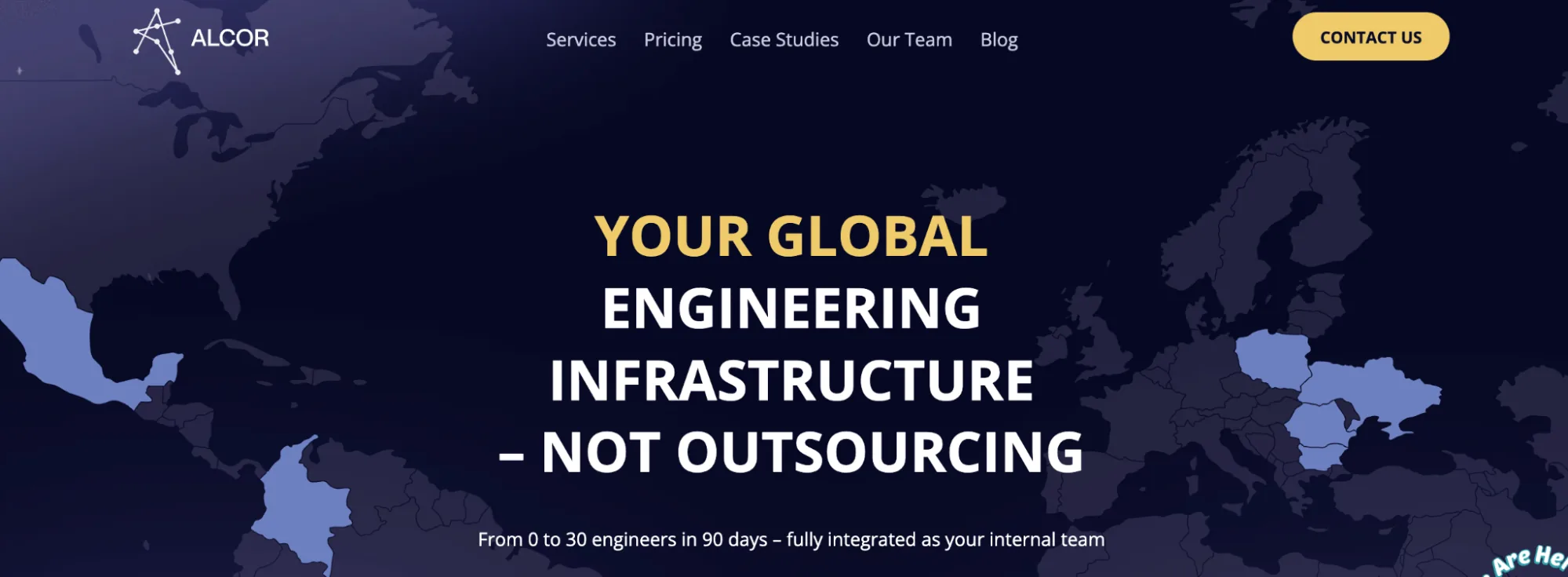
Alcor represents a different model. It does not primarily sell a vendor-managed software team. Instead, it recruits engineers and operates the employment, payroll, legal, equipment and administrative infrastructure behind a client-controlled R&D organization.
That distinction makes Alcor relevant to CTOs who want engineers to work under their own brand, culture and management. It is less suitable for a company that expects the supplier to own sprint delivery or provide technical leadership.
In a verified Clutch review, Pindrop reported building an Eastern European engineering center from zero to 20 people in less than a year. Alcor handled recruitment, IT, legal, benefits and payroll. Another client, Gotransverse, reported assembling a full-stack team in 1.5 months, with 95% of presented candidates passing its résumé review.
Because these results appear in client-submitted reviews rather than an independently audited study, they remain client-reported. Still, they directly address hiring velocity and candidate relevance.
Best fit: product companies that want to establish their own engineering organization in Eastern Europe without immediately creating and administering a local entity.
Verify before hiring: employer-of-record terms, intellectual-property assignment, termination liabilities, country-specific benefits, fee transparency and the process for eventually transferring employees to a client-owned entity.
8. STX Next
STX Next is the specialist option in this ranking. It is most relevant when Python, data engineering, cloud or AI expertise is central to the hiring requirement.
In the T Dispatch case, STX Next joined the client's existing engineering organization rather than taking over the product. Its engineers integrated international payment providers and worked on the performance and throughput of a global dispatch platform using Python, Django, Flask, PostgreSQL, Kafka and related technologies.
The case does not publish a numerical performance improvement, so its value lies in the documented team-extension model and technical scope. STX Next also has more than 100 Clutch reviews, offering a relatively broad body of client feedback, though its 4.7 rating is lower than the other providers in this shortlist.
Best fit: organizations with a Python-centered platform or a roadmap involving data, AI, cloud modernization or backend engineering.
Verify before hiring: availability outside the company's core stack, the balance between staff augmentation and managed delivery, senior-engineer availability and the expected project-management layer.
9. Relevant Software
Relevant Software is positioned between a boutique augmentation provider and a full product-development company. Its teams cover product discovery, design, web, mobile, cloud, QA and IoT, making it most relevant to growth-stage organizations that need a coherent cross-functional unit.
The company's published team-extension examples include RED Driver Training. Relevant Software says its dedicated team converted an acquired application into a broader learning product with quizzes, feedback, content management and algorithm-based learning paths. According to the company, more than 65% of RED's learners use the application.
A separate verified Clutch review from Cosuno states that a Relevant Software developer became part of the client's team and helped maintain code quality while the company entered new markets. That is useful evidence of cultural and process integration, even though it involved a comparatively small engagement.
Best fit: startups and mid-market product businesses that need several senior contributors or a compact cross-functional team.
Verify before hiring: budget contingency, responsibility for product management, availability of specific senior engineers and the extent to which the proposed team has worked together before.
10. Andersen
Andersen has broad staffing capacity across software development, QA, DevOps, cloud, data, SAP and industry-specific engineering. Its scale makes it relevant to companies that expect repeated hiring across several departments or technologies.
In an anonymous healthcare case, Andersen added support engineers to the IT organization of a publicly traded US managed-care company. The external team handled escalated incidents, root-cause analysis, service reporting and process improvement. Andersen reports that user satisfaction rose from 81% to 90% and that resolution time for complex issues decreased, although it does not publish the precise time reduction.
The case is closer to IT operations augmentation than product engineering, but it demonstrates integration with an internal team and work against agreed service levels. Andersen also has the largest Clutch review sample in the shortlist.
Best fit: larger companies seeking a broad supplier for recurring staff augmentation needs across regulated industries and enterprise technology stacks.
Verify before hiring: which delivery center will supply the team, continuity of named engineers, account-management overhead, replacement timelines and whether the proposed experts are employees or subcontractors.
How to choose an Eastern European staff augmentation company
Decide whether you need people, a team or an engineering center
These models are often marketed under similar labels, but they transfer different responsibilities.
Choose individual staff augmentation when your internal organization already has technical leadership, a functioning delivery process and enough management capacity. The external engineers should enter that system without creating a parallel chain of command.
Choose a dedicated or managed team when you need a stable cross-functional unit and want the provider to handle some combination of project management, QA, DevOps and technical coordination.
Choose an R&D-center or employer-of-record model when the engineers should operate as your own long-term organization. Alcor is the clearest example in this shortlist; its service does not replace internal engineering leadership.
Interview the actual engineers
A provider's portfolio establishes organizational capability, not the competence of every available developer. Ask to interview the people proposed for the engagement and assess them against the same technical and communication standards used for internal hires.
Confirm whether named candidates are reserved during contracting. If they are not, the team presented during sales may differ from the team that starts work.
Define who owns delivery
Staff augmentation usually leaves architecture, backlog priority, performance management and release accountability with the client. A managed team transfers more of that responsibility to the provider.
Put the boundary in writing. It should cover:
Who defines architecture and engineering standards.
Who approves pull requests and releases.
Who manages performance and professional development.
Who supplies the product owner, Scrum Master and technical lead.
How incidents and missed commitments are escalated.
What happens when an assigned engineer needs to be replaced.
Test integration before scaling
Start with a contained product area or a small group of engineers. Track practical indicators such as time to first accepted contribution, pull-request cycle time, escaped defects, sprint predictability, documentation quality and participation in design discussions.
These measures are more useful than generic claims about productivity. They also reveal whether slow delivery is caused by the vendor, the client's onboarding process or unclear ownership.
Examine retention and knowledge-transfer controls
Long-running products suffer when engineers rotate frequently. Ask for historical retention data relevant to the proposed delivery country and role, not a company-wide percentage covering unrelated departments.
The contract should also define notice periods, overlap during replacement, documentation expectations and responsibility for knowledge transfer.
Compare total cost, not only hourly rates
A lower rate can be offset by recruitment fees, account management, equipment, paid leave, local benefits, currency adjustments or a larger-than-necessary team.
Request a sample monthly invoice that includes every recurring and one-time charge. For employer-of-record arrangements, ask which costs are pass-through expenses and which are subject to a management margin.
Frequently asked questions
What is IT staff augmentation?
IT staff augmentation adds external engineers or other technology specialists to a client-controlled team. The client normally retains ownership of the roadmap, architecture, daily priorities and delivery process.
A dedicated team is broader: it may include its own project manager, QA engineers, DevOps specialists, designers and technical leadership. Some providers use the terms interchangeably, so the contract and governance model matter more than the label.
Why do companies hire software developers in Eastern Europe?
The region offers established software-engineering communities across Poland, Ukraine, Romania, Bulgaria, Lithuania and neighboring markets. It also provides workable time-zone overlap with Western Europe and partial overlap with North America.
Those advantages are not uniform. Talent availability, employment rules, costs, language skills and geopolitical exposure vary by country and role. Buyers should evaluate the actual delivery location rather than treating Eastern Europe as one labor market.
How much does Eastern European IT staff augmentation cost?
The companies in this shortlist publish different commercial signals. Clutch lists hourly bands of $25–$49 for Devico and Itransition and $50–$99 for several larger providers. Public minimum project sizes range from $25,000 to $100,000, while some companies do not disclose a minimum.
These figures are directional profile data, not quotations. Seniority, technology, location, contract duration, team composition and management responsibility can change the effective rate substantially.
How quickly can an augmented team start?
There is no dependable region-wide standard. Published examples range from Yalantis reporting three-to-five-day onboarding after improving an established project knowledge base to Vention reporting that it assembled more than 35 ClassPass engineers in two months.
Ask each supplier for separate estimates covering candidate presentation, client interviews, contracting, equipment, access provisioning and time to the first accepted production contribution.
Is staff augmentation suitable for a startup?
Yes, if the startup already has someone capable of owning product and technical decisions. It can be less effective when nobody internally can define architecture, prioritize work, review code or manage performance.
A startup without that leadership may need a dedicated product team or project-based engagement first, followed by staff augmentation once the engineering system is established.
How should a company protect its intellectual property?
The master agreement should address IP assignment, confidentiality, open-source use, access control, data handling, subcontracting and obligations after an engineer leaves. Buyers should also confirm how those provisions work in the country where each engineer is employed.
For regulated or sensitive systems, review the provider's actual controls and audit evidence. A statement that a team can build compliant software is not the same as a company certification or a guarantee that the client's final product will comply.
Which provider is best for building a company-owned R&D team?
Alcor is the most directly aligned with that goal because its model centers on recruitment, employer-of-record services and operational support while the client manages the engineers.
Devico, N-iX, ELEKS, Yalantis, Vention, Itransition and the other engineering providers are more suitable when the buyer wants to consume external development capacity under a services agreement.
Which providers are strongest for enterprise-scale augmentation?
N-iX, ELEKS and Itransition have the clearest public evidence of large, multidisciplinary and long-running teams. Vention also publishes evidence of fast team assembly at scale. Andersen has broad capacity and a large body of client reviews, but buyers should verify the exact delivery center and team proposed for their account.
Which providers fit smaller or more focused product teams?
Devico and Relevant Software are the clearest candidates for focused product-company engagements. STX Next is worth considering when Python or data engineering is central to the requirement. The final choice should depend on available engineers and project-specific experience rather than company size alone.