Hire
Hire by role
Hire Front-end developers
Hire Back-end developers
Hire Full-stack developers
Hire Android developers
Hire iOS developers
Hire Mobile developers
Hire AI engineers
Hire by skill
Hire JavaScript developers
Hire React Native developers
Hire React.js developers
Hire .NET developers
Hire TypeScript developers
Hire Flutter developers
Hire Golang developers
Hire by country
Devs in Ukraine
Expirienced engineers with strong product focus and fast integration.
Devs in Poland
EU-based developers with reliable delivery and high standards.
Devs in Argentina
Senior engineers with strong technical depth and timezone alignment.

Mobile application development consulting services
Experience that prevents costly iterations.
Independent mobile development consulting services for organizations that require predictable delivery and durable mobile architecture.
Mobile challenges we get pulled into
You miss release dates because the last mile on mobile is messy and unpredictable.
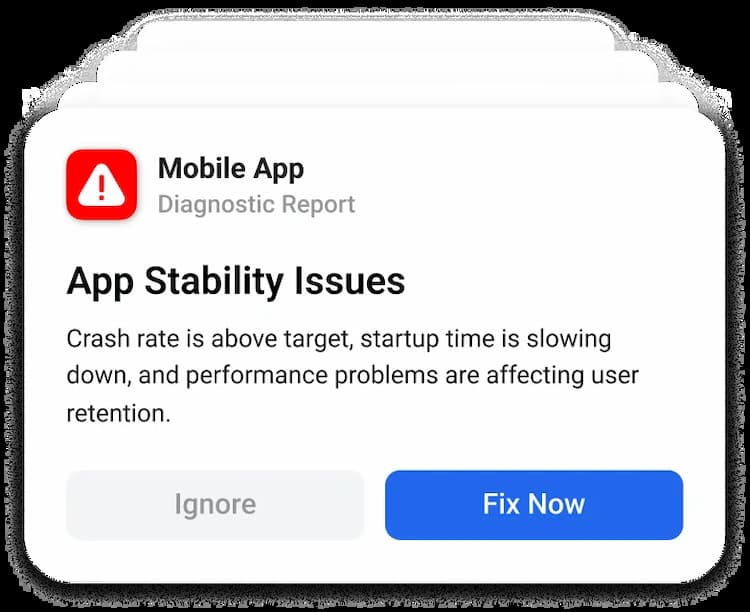
You have “acceptable” stability, but crashes and freezes still hurt retention.
You ship slow apps: long startup time, laggy UI, high memory/battery usage.
You can’t change the codebase safely without breaking unrelated areas.
You’re paying for the wrong platform strategy (native vs cross-platform) with hidden cost.
You have CI/CD, but builds and releases still rely on manual effort and heroics.
You spend too much time on regression because testing is manual or automation is flaky.
You lose time to App Store / Play Store releases: rejections, rework, poor rollout control.
You carry security/privacy risk: insecure storage, PII leakage, weak auth/session handling.
You lack senior mobile leadership to set standards, unblock the team, and own decisions.
Mobile app development
consulting services we provide
Mobile application development consulting services for teams facing release delays, instability, or scaling pain.
Strategy & delivery governance
Audit — delivery diagnostic + plan you can execute. Make mobile delivery predictable: scope, sequencing, ownership, and risk control.
- Roadmap slicing: what ships now vs later (based on constraints, not wishes)
- Dependency map: backend, design, analytics, legal/compliance, store timelines
- Delivery model: sprint cadence, release trains, definition of done, release gates
- Risk register + mitigation plan (third-party SDKs, platform limitations, unknowns)
Architecture & modernization
Fix — refactor vs rebuild decision + modernization backlog. Reduce change risk by fixing structural issues that create regressions and rework.
- Current-state architecture map (modules, data flows, state, ownership boundaries)
- Hotspot analysis: coupling, duplication, unstable areas that break most often
- Target-state guardrails: layering rules, ADRs, coding standards that stick
- Migration plan: incremental steps with checkpoints (no “big rewrite” fantasy)
Platform & stack decisions
Audit — platform fit assessment + options with trade-offs. Choose native vs cross-platform based on long-term cost, performance, and team reality.
- Decision matrix: performance, UX complexity, offline/background work, device coverage
- Gap analysis: plugins, accessibility, media, BLE, maps, security constraints
- Operating model impact: hiring, code ownership, release cadence, debugging effort
- If switching: staged migration plan and risk containment approach
Reliability, performance & observability
Fix — crash/perf investigation + top-impact implementation. Cut crashes and slowdowns using evidence and measurable targets.
- Crash/ANR triage: patterns, root causes, “top 10” offenders with fixes
- Profiling: startup time, UI jank, memory leaks, battery/network inefficiency
- Observability standards: logs, traces, performance metrics, alert thresholds
- Release metrics: crash-free sessions, p95 startup/screen times, error budgets
CI/CD, releases & store readiness
Fix — pipeline hardening + release discipline. Turn builds and releases into a controlled process, not heroics.
- Build health: deterministic builds, caching, signing/key management, environments
- Release workflow: branching/versioning policy, staged rollout, rollback plan
- Store ops: rejection prevention, compliance artifacts, metadata workflow
- Governance: release checklist, go/no-go criteria, incident playbooks
Quality engineering & testing strategy
Scale — test strategy + quality gates + automation stabilization. Reduce regression time without turning automation into a maintenance tax.
- Test pyramid tailored for mobile: what to automate vs keep manual (ROI-based)
- Flake reduction: test data strategy, isolation, environment control, retries policy
- Quality gates: PR checks, smoke suite, release criteria tied to risk level
- Coverage plan: critical user journeys, edge cases, device/OS matrix rationalization
Strategy & delivery governance
Audit — delivery diagnostic + plan you can execute. Make mobile delivery predictable: scope, sequencing, ownership, and risk control.
- Roadmap slicing: what ships now vs later (based on constraints, not wishes)
- Dependency map: backend, design, analytics, legal/compliance, store timelines
- Delivery model: sprint cadence, release trains, definition of done, release gates
- Risk register + mitigation plan (third-party SDKs, platform limitations, unknowns)
Architecture & modernization
Fix — refactor vs rebuild decision + modernization backlog. Reduce change risk by fixing structural issues that create regressions and rework.
- Current-state architecture map (modules, data flows, state, ownership boundaries)
- Hotspot analysis: coupling, duplication, unstable areas that break most often
- Target-state guardrails: layering rules, ADRs, coding standards that stick
- Migration plan: incremental steps with checkpoints (no “big rewrite” fantasy)
Platform & stack decisions
Audit — platform fit assessment + options with trade-offs. Choose native vs cross-platform based on long-term cost, performance, and team reality.
- Decision matrix: performance, UX complexity, offline/background work, device coverage
- Gap analysis: plugins, accessibility, media, BLE, maps, security constraints
- Operating model impact: hiring, code ownership, release cadence, debugging effort
- If switching: staged migration plan and risk containment approach
Reliability, performance & observability
Fix — crash/perf investigation + top-impact implementation. Cut crashes and slowdowns using evidence and measurable targets.
- Crash/ANR triage: patterns, root causes, “top 10” offenders with fixes
- Profiling: startup time, UI jank, memory leaks, battery/network inefficiency
- Observability standards: logs, traces, performance metrics, alert thresholds
- Release metrics: crash-free sessions, p95 startup/screen times, error budgets
CI/CD, releases & store readiness
Fix — pipeline hardening + release discipline. Turn builds and releases into a controlled process, not heroics.
- Build health: deterministic builds, caching, signing/key management, environments
- Release workflow: branching/versioning policy, staged rollout, rollback plan
- Store ops: rejection prevention, compliance artifacts, metadata workflow
- Governance: release checklist, go/no-go criteria, incident playbooks
Quality engineering & testing strategy
Scale — test strategy + quality gates + automation stabilization. Reduce regression time without turning automation into a maintenance tax.
- Test pyramid tailored for mobile: what to automate vs keep manual (ROI-based)
- Flake reduction: test data strategy, isolation, environment control, retries policy
- Quality gates: PR checks, smoke suite, release criteria tied to risk level
- Coverage plan: critical user journeys, edge cases, device/OS matrix rationalization
Share your goals and we’ll help you
think through next steps
How the engagement works
As part of our mobile application development consulting services, we keep engagements structured and time-bound, no open-ended consulting. Clear phases, clear outputs, clear ownership.
Phase 1
2–3 weeks
Diagnostic
Understand what is actually happening before proposing changes.
- Codebase review (architecture, hotspots, coupling, test coverage)
- CI/CD and release workflow assessment
- Crash/performance data analysis
- Interviews with engineering, product, QA
- Risk and dependency mapping
Output
Written findings + prioritized action plan + recommended execution model.
Advisory-only
fractional mobile architect
Phase 2
4–8 weeks
Stabilize & Fix
Address the highest-risk issues that block delivery or scalability.
- Architecture corrections (incremental, not rewrite)
- Crash/performance remediation
- Pipeline hardening and release discipline
- Quality gates and regression optimization
- Security/privacy gap closure (if relevant)
Output
Implemented improvements + measurable metrics (stability, release time, build reliability).
Consulting + hands-on execution
embedded senior engineers
Phase 3
ongoing or fixed-term
Scale & Govern
Make sure improvements stick and delivery remains predictable.
- Architecture governance and ADR reviews
- Release readiness checks
- Ongoing performance and stability monitoring
- Coaching mobile leads and team enablement
- Quarterly health checks
Output
Sustainable operating model, not one-time fixes.
Audit package
fixed scope, fixed deliverables
Our approach to
mobile development consulting
Our mobile application development consulting services are delivered within a clear governance model designed for enterprise teams that need predictability, transparency, and control, not ad-hoc execution.
Defined ownership
Structured delivery cadence
Decision traceability
Risk and dependency management
Release accountability
Executive-level visibility
Why choose Devico as a mobile
application development consulting
services company
Mobile application development consulting services should result in measurable delivery improvement. Our work is structured around decisions, governance, and execution that teams can sustain.
Senior-level intervention, not junior audits
You work with experienced mobile architects and delivery leads who have fixed unstable apps, not just reviewed slides.
Business-first technical decisions
Every recommendation is tied to release predictability, cost control, scalability, or risk reduction — not engineering preference.
Refactor over rewrite mindset
We prioritize controlled, incremental modernization instead of risky “start from scratch” resets.
Platform realism
We assess native vs cross-platform based on long-term operating cost, performance constraints, and hiring reality.
Delivery discipline
Clear ownership, documented decisions (ADRs), release gates, rollback strategy, consulting embedded into execution.
Consulting that transitions to execution
We can stay advisory or embed senior engineers to implement the highest-impact fixes.
Share your goals. We’ll help with
next steps
Our technology stack
Our engineering teams work across a broad range of modern technologies, selecting the right stack for each project’s complexity and objectives.
All
Backend
Frontend
Databases
DevOps
Clouds
Android
iOS
Cross-platform
Blockchain


Customer testimonials
View all



- E-learning
“You guys have always been genuine, flexible and personable.”

- Healthcare
“I know that we can rely on you 24/7 almost, which is way over and beyond what we've contracted.”

- Cybersecurity
“It was so easy to integrate your people with us and we didn't have any problems.”






Frequently asked questions
How does a mobile app development consulting engagement usually start?
A typical mobile app development consulting engagement begins with a short diagnostic phase. We review your codebase, architecture, crash data, and release process, then deliver a written findings summary with a prioritized action plan. No long discovery cycles, just clarity on what to fix first.
How much do mobile development consulting services cost?
The cost of mobile development consulting services depends on scope, depth of analysis, and whether execution support is included. A focused audit is fixed-scope and time-bound. Longer engagements (modernization, performance fixes, governance setup) are scoped based on complexity and team size.
How long does mobile development consulting take?
A diagnostic phase within a mobile application development consulting services engagement usually takes 2–3 weeks. Execution phases (architecture fixes, pipeline hardening, crash reduction) typically run 4–8 weeks, depending on technical debt and team availability.
What do you need from us to start mobile development consulting?
For effective mobile development consulting, we need access to the code repository, CI/CD pipeline, crash/performance tools, and a technical point of contact. Clear release goals and constraints (timeline, compliance, staffing) also help us move faster.
Can you work alongside our internal team?
Yes. As a mobile development consulting company, we integrate with your existing engineers. We don’t replace your team, we provide architectural direction, unblock structural issues, and coach leads so improvements are sustainable.
When is mobile application development consulting not the right fit?
Mobile application development consulting is not the right fit if you’re looking for quick feature outsourcing without addressing structural issues. Consulting works best when there is real delivery risk, scalability pressure, or architecture debt that needs senior-level intervention.
Still have a question?
Talk to usRequest free quote
With a pan European talent pool, Devico brings together the continents best talent and makes them available for you