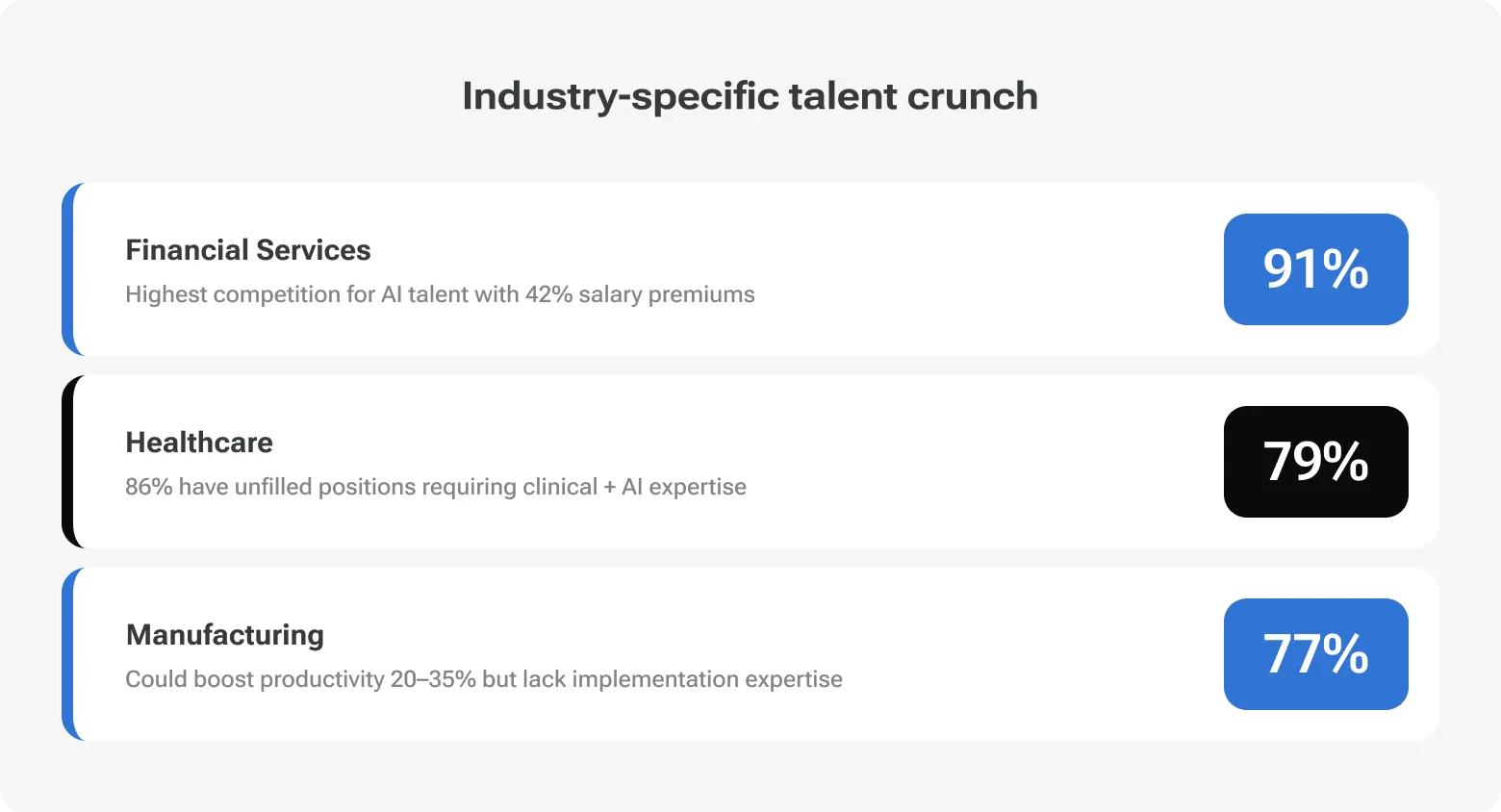
"AI engineer" is one of the most misleading job titles in technology. It describes a researcher designing model architectures at a frontier lab, a developer integrating GPT into a SaaS product, an engineer deploying and monitoring ML models, and everything in between. In fact, all these are different roles that need different skills and different evaluation criteria.
The cost of this misunderstanding is high. Gartner suggests that at least 30% of AI projects are abandoned after proof of concept due to poor data quality, inadequate risk controls, escalating costs, or unclear business value. Yet, involving the wrong specialists adds to this too. A job post for an AI engineer attracts ML researchers, LLM engineers, and MLOps specialists at once, most of whom are wrong for performing the actual job. This makes knowledge of how to hire an AI engineer vital.
Our guide provides a clear overview of the five most common AI engineering profiles, the skills and evaluation approaches for each, effective sourcing channels, and the available engagement models.
Motivated and focused experts for up to 60% less than locals, delivered in days, not months
What's wrong with the "AI Engineer" job title?
The problem is that "AI engineer" applies to a category, not a role. In contrast to common positions such as frontend developer, database administrator, or DevOps, AI engineering has evolved into multiple specializations. As a result, several professionals with the same AI engineer title may have completely different backgrounds and competencies.
For example, one AI engineer may build RAG pipelines and integrate LLM models into apps. Another may develop recommendation algorithms. A third may tackle AI infrastructure deployment, monitoring, and optimization. Though all three deal with AI, they solve different problems.
This creates a challenge when it comes to hiring. A common search for an AI engineer usually attracts all AI specialists at once, who are usually assessed against the same criteria. Too much time-incentive hiring or mishires are often the result of this approach.
That's why the first step in hiring an AI engineer isn't posting a job description or sourcing candidates. It's determining which type of AI specialist you need — be it an ML Engineer, AI/LLM Engineer, Data Scientist, MLOps Engineer, or AI Research Engineer.
Key AI engineering roles
Role
Primary focus
When you need them
ML model building, training, deployment, and maintenance
You need to create recommendation engines, personalization, forecasting, or other predictive AI solutions
Developing LLM-based apps, including chatbots, copilots, RAG systems, and AI agents
You want to integrate generative AI into a product, automate workflows, or create a conversational AI solution
Investigation, experimentation, and modeling for business insight
You'd like to understand data, build analytical models, validate hypotheses, and use findings for smart business decisions
AI infrastructure management, pipeline deployment, monitoring, and scaling
You have models that must run reliably with monitoring, versioning, and CI/CD
Advancing AI through experimentation, model development, and research implementation
You develop proprietary AI technology, train models, or solve new AI-related issues that existing solutions cannot address
While AI skills are now the hardest competency to find for 72% of employers all over the world, don't try to catch anyone with "AI" in a job title. Instead, start with the business problem, not the title. Define an outcome you need in 90 days, link it to a profile, and then write a corresponding job description.
Let's say if you'd like to build a support chatbot grounded in docs, you'll need an LLM engineer with vector-database and prompt-evaluation experience, not a generic AI engineer.
Technical skills across AI engineering roles
We've already covered the primary duties of each role. The next step is outlining their key skills.
While all AI professionals share some common foundations, such as coding and data handling, the expertise required for success varies from one role to another.
Knowledge of these differences helps hiring managers define the right requirements and screen candidates more efficiently.
ML Engineer
Thanks to ML engineers, machine learning models turn into working systems that deliver business value. Their skill set combines ML expertise, software engineering, and deployment skills.
ML frameworks: PyTorch or TensorFlow
Model deployment: Docker, Kubernetes, cloud ML services (AWS SageMaker, GCP Vertex AI, Azure ML)
Data pipelines: Spark, Airflow, or equivalent
Experiment tracking: MLflow, Weights & Biases
If you want to understand the specifics of an AI engineer vs. an ML engineer, read our guide on what an ML engineer actually does day to day.
AI / LLM Engineer
AI/LLM engineers design, develop, and maintain LLM-based apps. Their work entails integrating models with business data, processes, and user-facing products.
Language: Python, usually with FastAPI or similar for API integration
RAG architecture: vector databases (Pinecone, Weaviate, Chroma), embedding models, chunking strategy
LLM API integration: OpenAI, Anthropic, Hugging Face
Agentic frameworks: LangChain, LlamaIndex, or equivalent
Awareness of evaluation and hallucination-mitigation methods
MLOps Engineer
Reliability, scalability, and maintainability of AI systems after deployment are the duties of MLOps engineers. That's why they should have DevOps and ML infrastructure expertise.
Infrastructure: Kubernetes, Terraform, cloud platforms
Monitoring: model-drift detection, data-quality checks, alerting
Strong DevOps fundamentals with ML-specific extensions
Data Scientist
AI specialists of this kind extract insights from data, enabling companies to make smart decisions. In comparison with other AI roles, they spend less time on production infrastructure and more time on analysis and experimentation.
Visualization and communication: converting findings into business language
Statistical modeling and test design: A/B testing, hypothesis testing
ML fundamentals for understanding models, not building production systems
AI Research Engineer
AI research engineers work on new approaches, test model architectures, and find ways to make existing systems capable of doing more. This role is most common in AI-first companies, research labs, and companies developing proprietary AI technology.
Language: advanced Python
Frameworks: deep learning frameworks, primarily PyTorch
Profound mathematical knowledge, including linear algebra, statistics, and probability
Neural network architecture design
Experiment design, benchmarking, and performance evaluation
Scientific writing and research documentation
As you can see, the differences are obvious, and they should be taken into account when you prepare your hiring criteria.
The table below provides a side-by-side comparison that can help you define precise role requirements.
Tech skills comparison
Skill area
ML
LLM/AI
MLOps
Data Sci
Research
Production software engineering
Model training (PyTorch/TF)
LLM APIs & prompt engineering
Deployment infra (K8s, cloud ML)
Statistics & experiment design
✓ core ~ helpful — not central
Soft skills crucial for AI engineering success
AI specialists deal with more ambiguity and confusion than any other software engineer: undefined problems, messy data, unclear evaluation criteria, etc. To work in such an environment effectively, engineers need special soft skills. We'd like to highlight those that are important across AI engineering roles.
AI experiments don't always go smoothly. Previously working models may fail in production, promising approaches may provide disappointing results, and weeks of work may show that a proposed solution isn't viable.
AI specialists must be comfortable working in this setting, treating failed experiments as a source of information rather than a disaster. Even if the solution isn't immediately obvious, they should be able to move forward.
As you know, projects may include stakeholders who care more about business outcomes than technical specifics. When AI engineers can clearly explain engineering concepts, challenges, and risks to business people, it becomes easier to keep everyone on the same page.
AI systems comprise datasets, prompts, model versions, evaluation methods, and many more. Without appropriate documentation, knowledge gaps can quickly appear, hindering further maintenance. Engineers who document decisions, experiments, assumptions, and results make projects easier to scale, troubleshoot, and hand over.
Acknowledging what a model can and cannot do is one of the most important skills of AI specialists. Good engineers never oversell results, hide weaknesses, or present estimates as facts. On the contrary, they freely express uncertainty as well as voice limits, helping decision-makers recognize all risks and ensure better long-term outcomes.
All these AI engineer skills don't show up on a CV. That's why you need to set up an interview process in a way that discloses them.
How to evaluate a developer's code quality before you sign a contract
How to evaluate AI engineer candidates when you don't have AI expertise
A thorough evaluation includes reviewing code, assessing architectures, and going over design or framework choices. However, many hiring managers don't have an AI background to do this properly.
While this surely makes evaluation less comprehensive, it doesn't rule out the possibility of making a good hire. The thing is that competent AI engineers reveal themselves not only through technical knowledge but also through the way they think, communicate, and make decisions. Knowing what to look for, you can recognize signals and interpret them correctly. The approach described below can help you.
Project overview
Ask a candidate to tell you about one project they're very proud of and one project that wasn't a hit.
If the engineer explains a problem, a solution, associated difficulties, and outcomes in detail, this is definitely a good sign.
Yet, we'd also advise you to pay particular attention to whether the candidate frankly talks about their mistakes. That's alarming if every project is presented as a success. An AI engineer's job suggests carrying out many experiments, which is why both ups and downs are the norm.
Technical task
A technical assessment should take 60–90 minutes and involve the tasks the candidate will undertake on the project.
Creating a standard RAG workflow or assessing a certain model would work. In fact, you can choose any task provided it aligns with the role and your project needs.
While output itself is important, you'd also look at how a candidate thinks, tackles challenges, and reasons their decisions.
System design discussion
At this stage, ask a candidate to solve a design problem that is similar to one you encounter on a project.
Seasoned candidates ask questions first to gather missing information. Once they have the full picture, they explain what they would build and why they would choose that approach over the others.
Be cautious if a candidate starts bombarding you with their ideas without knowing the full context. Sometimes, this can be a sign of poor engineering judgment.
Behavioral evaluation
You need to know not only how good a candidate is at completing their immediate tasks, but also how they communicate and behave in real-world situations, especially when things get stressful.
Ask an engineer to tell you about a situation when a model failed in production and how they fixed that, how they usually decide when a model is good enough to deploy, and how they explain constraints to non-techy people. Questions of that kind can help you assess a candidate in terms of communication, decision-making, and stress resistance.
Skilled engineers will provide details and will feel comfortable recalling mistakes and challenges.
Red flags when interviewing AI engineers
A good interview process suggests not only identifying competent candidates but also forecasting potential problems in advance. We'd like to highlight some red flags that show up during interviews with AI engineers.
Extensive usage of buzzwords
Some candidates can confidently keep up the conversation, using buzzwords here and there without providing details. However, behind these "smart talks," they try to hide a poor understanding of fundamentals. To determine how deep the candidate's knowledge really is, ask follow-up questions until you're fine.
Exaggerated claims
Not every candidate who tells you that they've built models has really done it from scratch. In many cases, their work involved just fine-tuning or integrating existing models. So never take words at face value and dig deeper by asking about their responsibilities, day-to-day tasks, and key contributions.
A portfolio loaded with experiments only
Research projects and experiments are valuable, but production experience is a must.
Therefore, you should look for evidence that systems were deployed, monitored, maintained, and used by real people.
Inability to discuss success measurement
Professional AI engineers can explain how they define success, which metrics they use, and where a system is likely to fail. Uncertain answers should raise concerns.
AI Engineer salary and rate benchmarks in 2026
If you've already had a chance to look at the AI talent market, you've probably noticed that compensation expectations are pretty high. For example, the average annual salary of ML engineers in the USA is about $188K, though it may reach as high as $310K.
The exact figures vary depending on the AI role, engagement model, and location.
The table below provides market ranges.
Role
US full-time (annual)
US contract (hourly)
Eastern Europe / LATAM (monthly, remote)
US full-time ranges are based on data from Levels.fyi and BLS. Offshore monthly figures reflect Devico's observed rates across our European and LATAM talent pool.
As you can see, if you consider hiring offshore AI engineers, savings are real. Rates in LatAm or Eastern Europe can be 30–50% lower with the same quality at the mid-level and above. However, quality varies a lot at the junior level.
Reuters also reports that salaries in Europe can be much lower than in the United States, giving as an example Helsing — Europe's defense "unicorn," — that pays up to $150K per year for an AI engineer, compared with $270K at Palantir or $380,000 at Google.
High salaries of AI engineers also make bad hires particularly costly. Thus, according to the SHRM study, the average cost to replace an employee ranges from one-half to two times the employee's annual salary, and for a $188K ML engineer role, that's $94–376K. This emphasizes that a thorough hiring process for AI talent is essential.
Avoid operational and HR hassle and the constant threat of attrition with your own R+D department from Devico
Where to search and hire an AI engineer in 2026
With 72% of employers reporting hiring difficulty, it's really important to know where to find AI engineers. While LinkedIn is often the first channel that comes to mind, there are also other places to source AI talent. Which one to choose depends on the role, urgency, and preferred engagement model.
AI communities
Top AI candidates may not search for jobs or have LinkedIn profiles. However, many of them participate in AI communities. That's why these platforms can be as helpful as job platforms.
Hugging Face: If you'd like to hire a machine learning engineer, this community is one of the first places worth investigating. It also works for LLM engineer hiring. Models, demos, datasets, and experiments published here let you see and review the exact kind of work engineers do. In many cases, going through these contributions provides more data than reading LinkedIn profiles.
Papers With Code: This platform lets you find AI researchers who not only know the theory but can also turn ideas into working solutions. The thing is that research papers are linked to real code implementations here.
Kaggle: That's where you can find competent ML engineers and data scientists. Competition rankings and project portfolios reveal skills you might look for. However, wins on Kaggle don't always ensure production experience. Besides, since contests don't include deployment, monitoring, and infrastructure setup, the platform doesn't fully capture the skills needed for LLM and MLOps engineers.
General sourcing platforms
Traditional platforms continue to take the lead but require filtering to sort out relevant AI talent.
LinkedIn: This is the most popular sourcing channel, though AI-related titles here are often misleading. That's why, instead of searching for "AI Engineer," pay attention to the technologies candidates have worked with.
GitHub: You can find capable AI experts through GitHub if you look at not only user profiles but also repositories built with technologies similar to those in your stack. Contributions, code quality, and activity that you can assess here are more valuable than titles or CVs.
Talent marketplaces
Nowadays, there are many talent marketplaces where you can quickly find the specialists you need, often already pre-vetted to a certain level.
Toptal: A multi-layer vetting process is what makes the platform stand out from the rest. That's also the reason why pricing here isn't budget-friendly. Rates on Toptal are 20–30% above the market rate, but companies are ready to pay more in cases when a bad hire is more costly than recruitment expenses.
Turing: With a great number of remote engineers available, Turing is a choice for companies that want to fill specific positions quickly. There, you can find mid-level and senior engineers at affordable rates, including those adjusting to US working hours.
Staff augmentation and outstaffing partners
Partnering with a staff augmentation company is the norm for many engineering companies. It works well if you're short on time, want to avoid long-term commitments, have ever-changing requirements, or need a bit of experimentation before defining an exact AI role.
However, it all comes down to how good your partner's vetting process is. Without this, they can hardly provide strong enough engineers.
If your partner is trustworthy, you yield a lot of benefits, including flexibility, speed, and access to a large talent pool. Besides, if you consider offshore vendors, you can also reduce costs.
Eastern Europe is still one of the key engineering hubs, where AI roles are available at lower rates than in the US market.
Developing AI talent internally
Don't rush hiring externally. Maybe you have developers on the team with great coding skills, system design knowledge, and extensive experience working with data-heavy systems who wish to transfer to AI-related roles. They are the best candidates.
Importantly, full retraining isn't needed. Targeted learning of AI/ML fundamentals is usually enough to help seasoned engineers start making contributions.
This option is particularly advantageous because, already knowing the domain, architecture, constraints, and requirements, internal engineers better understand how AI solutions should be implemented to meet all project needs.
Full-time vs. contract vs. outstaffed AI talent
You can engage AI experts in different ways — via full-time employment, contract-based hiring, or outstaffing. What to opt for depends on how critical AI is to your project, how clear the work scope is, and how quickly you need to have AI people on the team. But let's get into the nuts and bolts.
Full-time employment
Full-time employment makes the most sense when AI isn't a short-term initiative but a foundation.
Go with this model in the following situations:
AI is the key part of your product and defines long-term goals
The work requires profound system knowledge
You build proprietary models, pipelines, or data infrastructure
The downside of this model is time. Hiring strong AI engineers is a slow process. The average time-to-fill for AI engineering positions is 66 days, compared to 42 days for general software engineers. This is explained by the strong demand for capable AI engineers and their shortage in the labor market.
Source: Business+AI
Contract
Usually, contractors are helpful when the task is well-defined, narrow, and doesn't require full-time employment. For example:
Building one AI-powered feature
Refactoring a model pipeline
The ability to bring in the skills needed for a specific task and get the job done quickly without long-term commitments is the key advantage of this engagement model. The main disadvantage is the lack of continuity. Once the job is done, the knowledge leaves with the contractor.
Staff augmentation or outstaffing
Collaborating with a staff augmentation partner, you can keep external talent as long as you need.
This model is most effective when:
AI requirements are evolving and not fully defined yet
You need to scale engineering capacity quickly
The workload doesn't justify full-time hires in every AI specialization
AI staff augmentation is popular because it makes it easier to bring in specialized AI expertise when needed. More and more companies prefer to add the exact skills required at each stage of the project instead of hiring an AI generalist.
Flexibility isn't the only advantage of this model. One more important benefit is cost-efficiency, as Eastern Europe and parts of Latin America offer seasoned AI talent at rates that are lower than those in the US market.
Wrap-up
The AI talent market is competitive, salary expectations are pretty high, and the cost of a bad hire is painful. The companies that get the best experts aren't the ones spending the most but the ones that know how to hire an AI engineer properly.
The right approach includes defining an exact AI role, evaluating candidates against role-specific criteria, and using global talent markets and outstaffing partners to engage the needed expert faster than traditional hiring allows.
At Devico, we help companies developing AI-powered products source and vet AI specialists for various roles. If you'd like to strengthen your AI team, we'd be happy to discuss your requirements and our capabilities.
Great software starts with great people