Just like a good housekeeper knows where to find the best fresh food at a fair price, CTOs know where to look for capable software developers without draining the whole budget.
And it probably won't surprise you that today, many of them outsource engineers outside their home countries. Latin America, in these terms, is one of the most popular destinations, especially for US companies, with the region's IT services outsourcing market projected to grow at a 10.1% CAGR from 2025 to 2030.
The rapid growth of nearshore outsourcing is explained not only by operational convenience, but also by the large LatAm talent pool, modern digital ecosystems, and, of course, attractive rates.
For companies taking their first steps in outsourcing developers in Latin America, the article covers talent availability, rate ranges, engagement models, key hubs, advantages, risks, and the best practices that help outsourcing partnerships succeed.
Why companies outsource software development to Latin America
Without exaggeration, Latin America has become a hot outsourcing spot. North American companies are the primary clients of local vendors. Thus, the survey shows that about 84% of Latin American service centers work with North American clients.
Indeed, both startups and large corporations in the USA and Canada take advantage of hiring and outsourcing in the region. Take Microsoft, for example: the company has been present in Costa Rica for over three decades, and between 2018 and 2022, the number of its employees in the local office increased from 60 to 1,500.
Well-known brands outsourcing software development to Latin America
What attracts them so much here? The region offers a number of great benefits.
Access to a large tech talent pool
Latin America boasts an extensive pool of developers, and the high demand drives its continuous growth — thousands of STEM specialists graduate from local universities annually. Notably, the local talent pool isn't only extensive but also varied. You can find here experts in backend, frontend, AI/ML, cloud technologies, data analysis, etc.
Cost efficiency
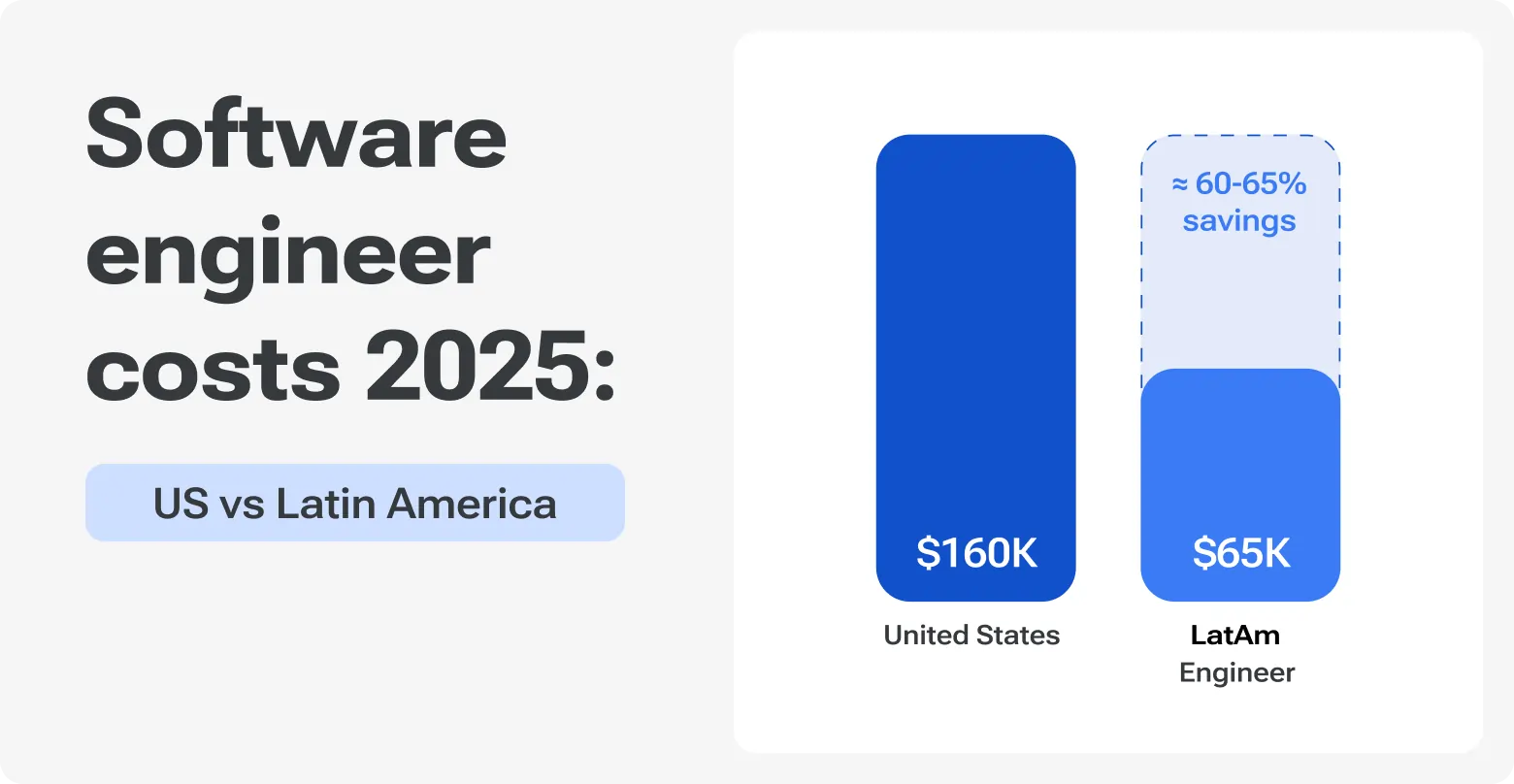
Like bright lights attract moths, significantly lower rates attract tech companies to Latin America. In the USA, developer salaries are some of the highest in the world, so the neighboring Latin American region creates an opportunity for many local companies to extend their teams with proficient developers while staying within their budget.
Besides, large savings often come not only from lower rates but also from fast onboarding, real-time collaboration, better sprint throughput, and less leadership overhead. For the cost you pay, you receive real value.
No or minimal time difference
Complete or almost complete overlap with North American working hours is one of the key drivers of nearshore software development in Latin America.
Real-time standups, same-day PR reviews, live pair programming, faster bug triage, and shorter feedback loops make collaboration with local vendors easier, which results in better incident response and faster releases.
Cultural compatibility
Outsourcing relationships succeed in Latin America also because the communication style and work culture of locals often feel similar to those in North American teams. This is explained by the fact that many developers across the region have already worked with US-based clients, so expectations around responsiveness, ownership, documentation, Jira hygiene, and sprint accountability are well understood.
Growing tech ecosystems
Another reason why companies frequently outsource software development to Latin America is the maturity of local IT ecosystems. Brazil, Mexico, Colombia, Chile, Argentina, and other LatAm countries have built strong startup environments, attracted international venture capital, and developed fast-growing tech sectors.
This directly impacts the quality of Latin America tech talent. Local developers have worked on fast-scaling startups, digital-first enterprises, and products serving millions of users, gaining experience with addressing real-world architectural, performance, and security challenges.
With the way the region is growing, Latin America is likely to stay one of the world's go-to outsourcing destinations for years to come.
Hire software developers in Latin America
Brief overview of the LatAm market
Latin America is known as a mature market with a tremendous talent pool. The region is estimated to have about 2 million software developers, with their highest concentration in Brazil, Mexico, Argentina, Colombia, and Chile. Predictably, across countries, most of these engineers are based in key tech hubs, including the following:
Thanks to the presence of large international companies, startup activity, and enterprise modernization projects there, the technical expertise of local talent keeps on deepening.
What also makes this market interesting is the breadth of industries, with fintech being the flagship sector. According to Reuters, the number of fintech startups in Latin America grew from 703 in 2017 to 3,069 in 2023. This is more than a 4x increase in six years.
And fintech isn't the only area where the region stands out. E-commerce, retail, AI, logistics, cloud services, and SaaS, which are also on the list, give LatAm developers exposure to different stacks and product challenges.
A large number of unicorn startups is another signal of market maturity. As of March 2026, there are 51 unicorns in Latin America, most of which are in Brazil and Mexico. Such giants as Nubank, Rappi, Kavak, and Mercado Libre have proven that local teams are capable of creating and scaling billion-dollar software solutions.
By the way, startup investment in Latin America grew 26% in 2024, outpacing Europe's 7% growth and contrasting with Southeast Asia's decline. This tendency is tied to fast digital adoption, young demographics, and highly effective capital strategies.
All in all, the Latin American market isn't just growing in size but is also becoming more specialized, more product-driven, and more experienced with advanced technologies.
Top countries for software development outsourcing in Latin America
Above, we've looked at Latin America as a whole. Yet. It isn't uniform at all. Talent availability, rates, specialization, English proficiency, business environment, and other factors vary a lot from country to country.
When it comes to outsourcing, eight countries stand out as the key leaders: Brazil, Mexico, Argentina, Colombia, Chile, Peru, Uruguay, and Costa Rica.
Top hiring destinations in Latin America
Country
Developer pool
EF English Proficiency Index 2025
Key tech hubs
São Paulo, Rio de Janeiro, Florianópolis, Campinas, Curitiba
Mexico City, Guadalajara, Monterrey, Querétaro
Buenos Aires, Córdoba, Rosario
Montevideo, Punta del Este
Of course, each country comes with its own cons and pros, but as people say, every pot has its lid.
Brazil: Being really huge in size, Brazil offers the largest talent pool in LatAm, with engineers experienced in everything from cybersecurity and AI to backend development and architecture. If scalability and background diversity are what you are looking for, Brazil is a go-to, even though rates here aren't the lowest in the region.
Mexico: Thanks to sharing borders with the USA, the country is a leader in nearshore outsourcing. Collaboration with local vendors is smooth due to time overlap and a large enough talent pool. Many North American companies opt for Mexico when they want experienced developers and real-time communication.
Argentina: Creative and highly skilled engineers are the hallmark of Argentina. Excellent English skills and experience with international projects make collaboration easy. Rates are also affordable. If you need an innovative mindset and effective communication, Argentina is a good choice.
Hire software developers in Argentina
Colombia: The country is on the rise, with great senior-level engineers at competitive rates. Because of a flourishing startup environment, Colombian developers are often experienced in scaling products, which is a great advantage if you look for folks who can hit the ground running.
Chile: Renowned for high-quality IT outsourcing services, Chile offers competent developers who strictly adhere to the client's processes and standards. Therefore, it's indeed a great option for companies that value quality and want to minimize risks.
Peru: This is an emerging, budget-friendly outsourcing option. The talent pool is smaller but capable, particularly when it comes to web, mobile, and cloud development.
Uruguay: Of course, the country doesn't have the largest talent pool and doesn't offer the lowest rates, but many tech companies choose Uruguay because local teams here are diligent, disciplined, and client-oriented.
Costa Rica: For companies that want collaboration to feel easy, Costa Rica is spot on. Strong English, a very business-friendly approach, and experience working on foreign projects make collaboration straightforward from the start. If you want less back-and-forth, Costa Rica is hard to overlook.
So decide what is most important to your business, and you'll define which country is more suitable for you.
Cost of software development outsourcing in Latin America
Since, for many companies, cost is one of the most important criteria when choosing an outsourcing destination, this topic deserves its own section.
Rates across LatAm vary a lot, but even the higher-end markets remain noticeably below U.S. benchmarks.
Average outsourcing hourly rates across LatAm countries
Country
Junior developers
Mid-level developers
Senior developers
The differences in hourly rates that you see in the table above are shaped by a few practical factors. Countries with larger and more established talent pools and an abundance of engineers with enterprise experience come at a premium. These are Mexico, Chile, and, in many cases, Brazil. High demand from U.S. companies also pushes rates up.
Costa Rica and Uruguay fall into the mid-to-upper range, though for slightly different reasons: smaller talent pools, strong business environments, and teams that are especially valued for trustworthiness and long-term partnership stability. In all these markets, companies pay not only for technical expertise but also for smoother collaboration, faster onboarding, and reliability.
Peru, Colombia, and Argentina usually offer a cost-to-quality balance. Their rates are more budget-friendly, while the level of technical expertise is still strong enough for most web, mobile, cloud, and product development needs.
It's also worth noting that rates within the same country can vary depending on:
Specialization — AI/ML, cloud, or data experts usually cost more
Tech stack — engineers working with niche technologies are more expensive
Location — major hubs like São Paulo or Mexico City are pricier than smaller cities
Engagement model — the more ownership and responsibility a vendor takes, the higher the rates
Vendor reputation — established companies usually charge more
Cost of hiring software developers in Latin America
Engagement models for outsourcing in Latin America
Latin America has been on the global outsourcing market for many years. As a result, it knows and follows trends and offers the key engagement models that cover the different needs of client companies.
Staff augmentation
This is the go-to model for companies that have an in-house team and simply need extra hands on to move faster or tackle specific temporary tasks.
With staff augmentation, your vendor's developers join your internal team and work as an extension of it. They follow your processes and sprint rituals, report to your managers, and collaborate directly with your product, QA, and DevOps teams.
Using this model, you can easily scale your team up or down, fill urgent skill gaps, and keep full control over the delivery process. It's especially useful when you don't have time for time-consuming direct hiring.
Benefits:
Dedicated development teams
There are scenarios when companies need more than just individual contributors, and this is where a dedicated team works well.
Here, the vendor provides a full-fledged engineering squad that may include developers, QA engineers, DevOps specialists, a tech lead, and sometimes even project management support.
The squad works based on your business goals, but the vendor takes care of staffing, retention, replacements, and day-to-day team management support.
A dedicated development team in Latin America is a good option for long-term collaboration, as the setup can grow with your roadmap.
Benefits:
Vendor management support
Project-based outsourcing
This model is used when companies lack internal engineering bandwidth and want someone to take the whole thing and run with it. MVP development, product modernization, or new feature rollouts are the most common use cases for project-based outsourcing.
The vendor steps in and handles the project end-to-end: planning, development, testing, release, and often post-launch support as well.
For many companies, full ownership is exactly what makes this model attractive: less coordination on their side and one partner responsible for delivery.
Benefits:
Clear ownership and accountability
Minimal management effort from the client side
Predictable scope, timeline, and budget
Challenges of software outsourcing in Latin America
No outsourcing destination is perfect, including Latin America. Yes, the region offers plenty of advantages, but for a successful long-term partnership, it's also important to look at the less comfortable side of the picture. Let's go through the key challenges you may face so you're ready to handle them properly from the start.
Talent competition
The problem of strong outsourcing markets is that they attract many companies, driving competition for top talent.
Good Latin American specialists are never available for a long time. In general, they receive an offer within 2-3 weeks as U.S. companies, global startups, and local unicorns fight for them. This competition can make hiring slower than expected, especially when it comes to senior engineers with expertise in AI/ML, cloud, cybersecurity, or SaaS.
The best way to move quickly is to work with established vendors that have active talent pipelines.
Salary growth
As venture funding, startup activity, and international demand continuously rise, developer salaries in some LatAm countries have been steadily increasing. This is especially the case in markets with stronger ecosystems. In 2026, the average salary for developers is expected to increase by another 5-6% in Brazil, Mexico, and Colombia.
The best way to handle this challenge is to build long-term partnerships, as usually vendors are more willing to keep rates stable for trusted clients than for one-off projects. One more approach is to distribute roles across a few countries. For example, you can hire senior specialists in Chile or Mexico and more execution-heavy roles in Peru or Colombia. This way, even if salaries rise faster in one market, the overall team cost remains balanced.
You cannot hide a cat in a bag: English levels can vary significantly between countries and even between vendors in the same market.
Costa Rica, Uruguay, Argentina, and Chile are usually in a better situation here, while in larger markets, the gap between senior and junior engineers may be more noticeable.
This is why many companies assess not only technical competence but also communication skills during interviews with vendors' candidates, especially for client-facing or product-heavy roles.
Best practices for successful outsourcing
Outsourcing is a serious move for companies, and those who give it a first try may find it quite challenging. As a company that has been in the outsourcing industry for over a decade, we can share some pieces of advice that can make your partnership with a vendor successful and the whole experience smoother.
- Clearly define the scope
Nothing kills an outsourcing team's progress and enthusiasm faster than vague expectations. Before you even start choosing between vendors, nail down what success looks like for you. Outline goals, deliverables, milestones, deadlines, and key KPIs. This way, you'll give your outsourcing partner a roadmap enabling them to get to the destination faster and with fewer roadblocks.
- Pick up an engagement model that matches your needs
Each outsourcing model — staff augmentation, dedicated teams, or project-based outsourcing — works best in its own scenario. The key is choosing the one that really fits your internal bandwidth, the complexity of the work, and how fast you need results.
When the model is in line with your real needs, collaboration feels natural. When it doesn't, friction shows up: too much micromanagement on your side, blurry ownership on the vendor's side, slow decision-making, or simply too many people involved where a smaller team would be more effective.
- Prioritize efficient and transparent communication
A convenient time zone overlap with Latin America definitely makes things easier, but by itself, it doesn't ensure a smooth work run. From the very beginning, agree with a vendor on how you communicate when things are going well and when things go wrong. Set up daily standups, weekly demos, and a clear protocol for updates and blockers.
While expecting the vendor team to raise risks early, voice up blockers, and be honest about progress, be transparent as well. Share business context, relevant priorities, technical constraints, and feedback openly. The more details external engineers have, the fewer wrong assumptions they make.
- Carefully vet a vendor
A big part of outsourcing success comes down to working with a trusted outsourcing company. Don't pick a partner just because they have a nice website or a big office in São Paulo or Bogotá. Scan references, analyze previous projects, and ask how they organize workflows.
A trustworthy vendor won't avoid uncomfortable questions. On the contrary, they'll be open about their processes. Also, they'll be adaptable enough to adjust to the way your team already works.
- Focus on long-term collaboration
Our last advice: treat outsourcing not as a way to quickly fill skill gaps but as a real partnership. Over time, the vendor learns your product logic, understands your release rhythm, knows which stakeholders need extra visibility, and starts solving problems without waiting for instructions. Long-term relationships with the vendor usually result in better overall quality, faster onboarding for new hires, and more stable rates.
Of course, no outsourcing journey is completely free from bumps along the way, but the best practices will improve your chances of building a productive and lasting outsourcing partnership in Latin America.
How to choose the right outsourcing partner
As mentioned above, picking the right partner is an important phase. Not to let you get burned, we recommend you pay attention to the following criteria:
Trust is everything. Read reviews, talk to past clients, and ask how the vendor handles delays, challenges, and conflicts. A good partner is always honest about their limitations and timelines.
Before reviewing candidates' CVs, check what projects the vendor has already worked on, what tools they've used, and what tasks they've handled. Besides, ask for case studies, references, or even PoC to assess how good they are at tackling real-world challenges.
If an outsourcing company doesn't have structured processes in place, collaboration can become chaotic. Therefore, ask how they plan sprints, track progress, approach testing, and manage risks. Established and refined processes are a must for professional outsourcing companies.
You may catch a bad break even with the most skilled software developers in Latin America if communication is messy. That's why you need to evaluate English proficiency and cultural match in advance. Also, make sure your preferred tools, meeting timing, and reporting practices work well for an outsourcing team.
Your staffing needs may change from time to time, which is why your partner should be able to quickly ramp a team up or down and adapt to new priorities. Choose vendors with a large talent pipeline and experience in handling changing requirements.
Do some legwork to find the right partner, and you'll take advantage of smoother collaboration, better outcomes, and a stronger team.
How to choose the right IT outsourcing company
Conclusion
If you consider Latin America for software development outsourcing, you're on the right track. The region offers a great mix of cost efficiency, an extensive talent pool, proficiency, and nearshore collaboration advantages.
Yet, while the local outsourcing market is very attractive and favorable, you need to use a well-structured approach to succeed here. The key thing is to make your final decision on a particular LatAm vendor based on not only hourly rates but also talent availability, tech expertise, communication skills, and reliability.
Not sure where to start? You can contact our team to get data about the LatAm talent market, nuances of outsourcing here, and our capabilities.
Motivated and focused experts for up to 60% less than locals, delivered in days, not months